Tag Archives: Westerns

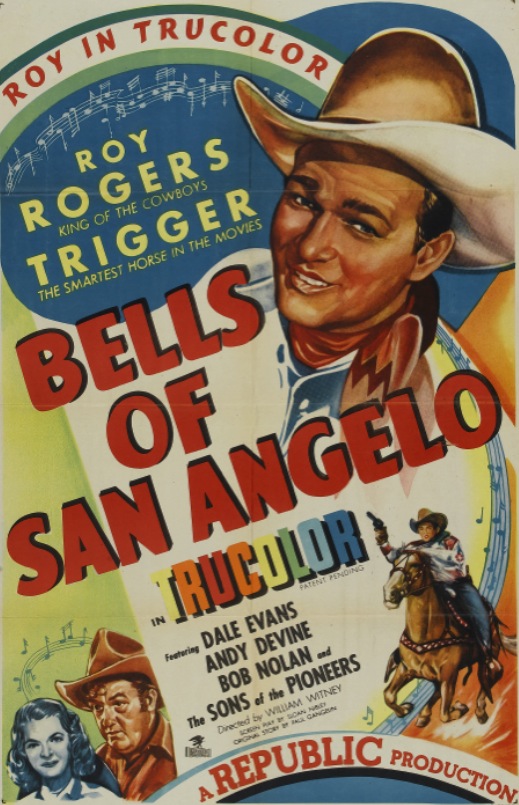
Bells of San Angelo (April 15, 1947)

Bells of San Angelo
Bells of San Angelo (1947)
Directed by William Witney
Republic Pictures

Bells of San Angelo was Roy Rogers’s second western filmed in “Trucolor,” a two-color film process. (The first was Apache Rose, released earlier in 1947.) It was also the fifth film he made with director William Witney, who I’ve been a big fan of since high school. Witney directed my favorite Republic serials (often with John English), such as Adventures of Captain Marvel (1941), Jungle Girl (1941), and Spy Smasher (1942). Witney had a sure hand with pulpy material, and never made a picture that was less than entertaining. The stunt work in his films was always a high point. His action scenes — especially the fights — were incredibly well-staged, and still hold up pretty well.

There are currently a few ways to see Bells of San Angelo online. It’s available on YouTube, at Internet Archive, and on Netflix instant watch. The version on Netflix is the version that was edited for TV. It’s in black and white, not color, and shaves more than 20 minutes off the running time. Among the scenes that are lost is a really good fistfight between Roy and one of the bad guys. So if you want to see this movie, I recommend downloading the version from Internet Archive or watching it on YouTube. (You can click the links above to go directly to this movie.)

In Bells of San Angelo, Roy plays — as usual — a character named “Roy Rogers.” In this one, Roy is a border investigator. There are nefarious goings-on down at the old Monarch mines, which are run by a man named Rex Gridley (John McGuire), a handsome, dark-haired gentleman with a pet bird named “Cinderella.” In the first of many exciting action scenes, Gridley’s right-hand man, Ulrich (David Sharpe), shoots a man fleeing by stagecoach, then plants some silver ore in his pocket. Ulrich’s official story is that he was shooting down a thief, but Roy smells something rotten.

Roy’s comical sidekick in Bells of San Angelo is a big fat guy named Cookie Bullfincher (Andy Devine), who’s San Angelo’s mayor, sheriff, and official dog catcher (but the soft-hearted Cookie is really more of a “dog keeper”). Cookie may have a passel of titles, but Roy is the real authority, and his reach extends down into Mexico.

When Roy learns that western pulp writer Lee Madison is coming to town, and will be observing him work, he exclaims, “I don’t mind chasin’ thieves and murderers, but this is too much.” Madison is the author of numerous western potboilers, including one called Murder on the Border, and Roy thinks Madison will just twist reality to suit the tastes of a bloodthirsty readership.

It should come as absolutely no surprise to anyone when it’s revealed that Madison is actually a woman, or that she will hide her identity from Roy as long as she can, creating all manner of humorous misunderstandings.

Madison is played by Dale Evans, Roy’s real-life wife, and they’re really cute together. They always seem to be having fun in their scenes, which softens things when he’s being a chauvinist and threatening to spank her, or calling her “the nosiest girl I’ve ever met.”

Director Witney is more concerned with packing the film full of entertainment than with narrative coherence. But who cares? There are songs aplenty, subplots galore, and lots of action, some of it pretty rough for a Saturday matinée picture aimed at kids.

Bells of San Angelo was filmed in Valley of Fire State Park in Nevada, and the scenery is spectacular. Of course, it looks nothing like San Angelo, Texas, which — by the way — is in the heart of Texas, not anywhere near the Mexican border. But whatever. If you like Roy Rogers, Dale Evans, and Trigger, you’ll love this movie.
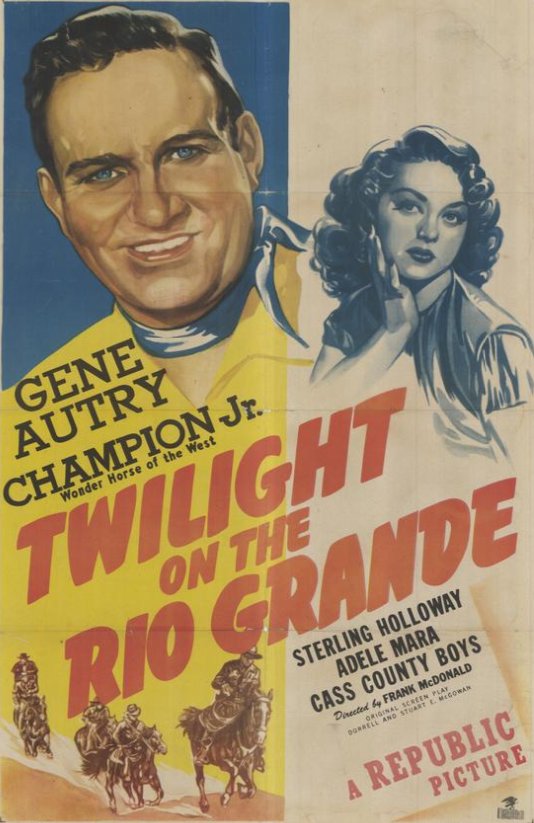
Twilight on the Rio Grande (April 1, 1947)

Frank McDonald’s Twilight on the Rio Grande features Gene Autry and his co-stars being put through their B-movie paces south of the border.

Crime melodramas (we call them film noirs nowadays) were very popular Hollywood products in 1947, and Twilight on the Rio Grande incorporates several elements from them, such as the hero investigating the murder of his partner, lots of nighttime photography, a plot about jewel smuggling, and a beautiful knife-throwing señorita. (They showed up in noirs every now and then, didn’t they?)

Gene Autry (played by Gene Autry) and his ranch hands, Dusty Morgan (Bob Steele), Pokie (Sterling Holloway), and the singing trio The Cass County Boys, are all down in Mexico, singing in Spanglish and ogling the ladies. (If there was a deeper purpose to their visit, I missed it.)

The diminutive Bob Steele was a western actor whose star had faded by the mid-’40s, and he picks up a pretty easy paycheck in Twilight on the Rio Grande, since his character is murdered in the first reel, which I thought was a shame. I like Steele, and would have enjoyed seeing him and Autry solve the murder of Sterling Holloway’s character, Pokie, since the loose-limbed, rubber-faced Holloway is more annoying than a barrel of Jim Carreys.

The femme fatale of the film is the beautiful and hot-blooded Elena Del Rio (Adele Mara), who throws knives at Gene while he’s singing “I Tipped My Hat and Slowly Rode Away.” She throws one after the other into the wall behind him, in order to show him how angry she is. She has a steady hand, so she doesn’t hurt him. But then Gene shows her his steady hand when he finishes his song, throws her over his knee, and spanks the bejeezus out of her with the flat of a big knife blade.

Dusty is murdered with a knife in the back, and a smuggler Gene and his boys rope out on the prairie winds up with a knife in his back that could only have been thrown, not thrust at close range, so suspicions fall on Elena.

The title song is a good one, and was never released as a record by Autry, so if you’re a fan of his music, it’s a reason to see this picture. He sings two versions, a slow, mournful version at Dusty’s funeral, and a more upbeat version to close the picture.

If you’re not a fan of Autry’s music, there is really no reason to see this picture. It’s not terrible, but there are plenty of better B westerns out there.

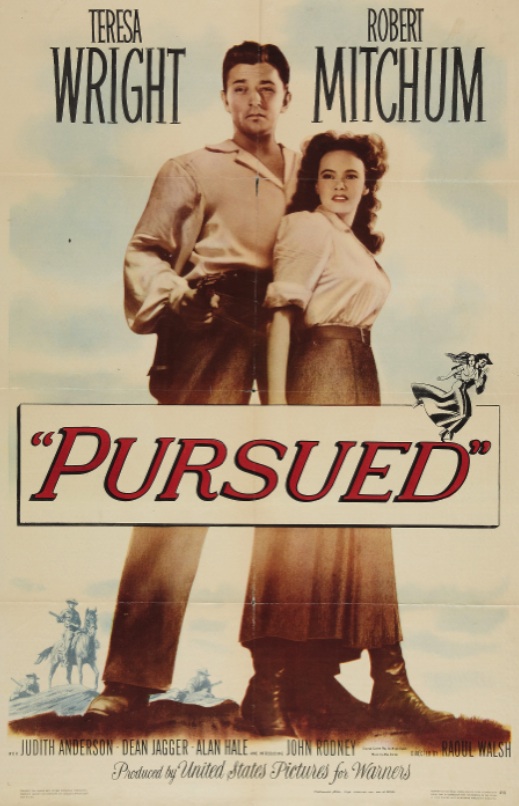
Pursued (March 2, 1947)

Pursued
Pursued (1947)
Directed by Raoul Walsh
United States Pictures / Warner Bros.

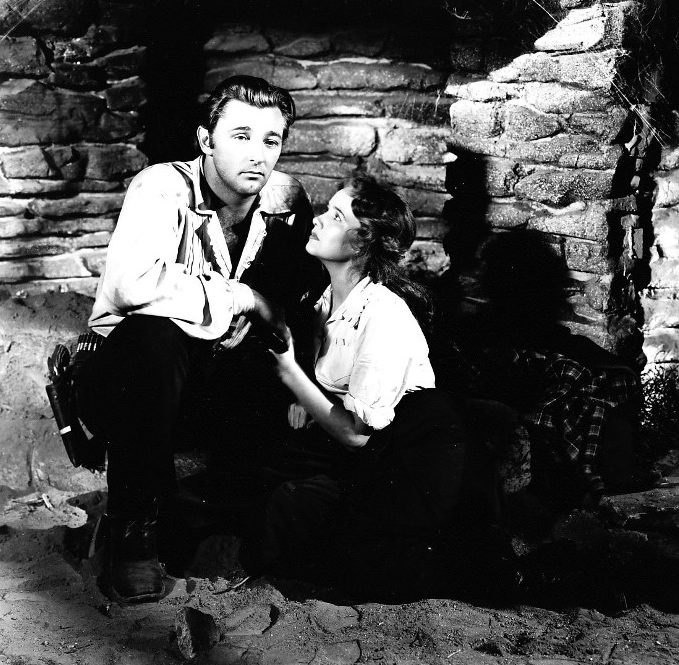
In the territory of New Mexico at the turn of the century, a handsome, sloe-eyed man named Jeb Rand (Robert Mitchum) is hunted across a desolate landscape by gunmen. He returns to the cabin where he was found as a boy and prepares for a showdown. The mountains that surround the cabin are drenched in shadows, and they tower above the tiny human figures below them like skyscrapers. As Jeb waits, he is plagued by nightmares of boots on wooden floors — boots with jangling spurs — but he can’t make sense of his strange visions.

Welcome to the world of Raoul Walsh’s Pursued. It’s an oneiric film about a man who is haunted by the past. Mitchum narrates the film, sounding like someone who knows he is doomed. (“I always have a feeling something’s after me,” he says.)

Pursued is a western, not a film noir, but it has all the hallmarks of noir, including stunning black and white cinematography by the great James Wong Howe, Freudian relationships up the wazoo, the sins of the past coming back to haunt the present, a man on the run, plenty of sinister characters packing heat, and a story mostly told in flashback.

Young Jeb Rand (played by Ernest Severn) survived the massacre that killed his family and was taken in by Mrs. Callum (Judith Anderson), who has two children about Jeb’s age — Thor (short for “Thorley”) and Adam. They’re played by Peggy Miller and Charles Bates as kids, and by Teresa Wright and John Rodney as adults.

Jeb often complains that his head hurts. Nothing about his past makes sense, and his present is equally confusing. Thor and Adam don’t treat him as a brother. (His separation from them is represented visually as well as thematically. In one scene in which the family gathers, Mrs. Callum stands in the center, with Thor and Adam on one side of her and Jeb on the other.) Adam hates his adopted brother Jeb. Thor loves Jeb, but her love seems more romantic than sisterly.

One day, someone shoots young Jeb’s horse out from under him. Mrs. Callum tells him it was probably just careless deer hunters, but Jeb is convinced that it was Adam.

We eventually learn that Mrs. Callum’s brother-in-law, Grant Callum (Dean Jagger), led the attack on Jeb’s family. Grant’s brother (Mrs. Callum’s husband) was killed in the attack, and Grant was wounded and had to have his arm amputated. Grant vowed not to rest until every last Rand on earth was dead. Mrs. Callum, on the other hand, considers the events of that night Providence — the Lord may have taken her husband, but He delivered unto her a second son.

Jeb, Thor, and Adam grow to adulthood. When the draft board demands that at least one young man from every family in the territory enlist to fight in the Spanish-American War, Jeb and Adam flip a coin. Jeb loses.

Robert Mitchum and Teresa Wright

He returns home from the war to find that little has changed. Adam still hates him, and Thor still has romantic feelings for him. “I want you to come courtin’ me,” she says. “I know that seems silly when we grew up together, but I want to pretend we didn’t.”

Mrs. Callum doesn’t have a problem with Jeb and Thor marrying, but she refuses to ever talk with Jeb about the night his family was killed, no matter how much he pushes her. “I’m giving you my daughter for your wife,” she says. “Isn’t that enough for you? Doesn’t that show you that you’re loved?”

Grant Callum dogs Jeb’s every move, sending shooters after him even though he clearly just wants to be left alone. After he’s forced to kill two men in self-defense, Mrs. Callum and Thor shun Jeb, and tell him that he’s dead to them.

“Right then I knew I had to have you,” Jeb says in voiceover as he watches Thor at a funeral. “I’d have to climb across two graves to get to you, but nothing in the world would hold me back.”

Pursued has a happy ending, but that doesn’t stop Jeb and Thor’s semi-incestuous love from having a doomed quality. “There was a black dog riding my back and yours,” Jeb tells Thor as they reminisce about their past while waiting in the burned-out cabin together for Grant Callum and his gunmen to arrive.

This noirish sense of doom pervades the film. So many scenes take place at night or indoors — in smoky saloons and casinos — that the film has a powerful sense of claustrophobia. And the fact that Jeb is a returning combat veteran plagued by nightmares gives him more in common with many of the protagonists of post-war film noirs than it does with the cowboy heroes of most post-war oaters.

Ramrod (Feb. 21, 1947)

Ramrod
Ramrod (1947)
Directed by André De Toth
United Artists

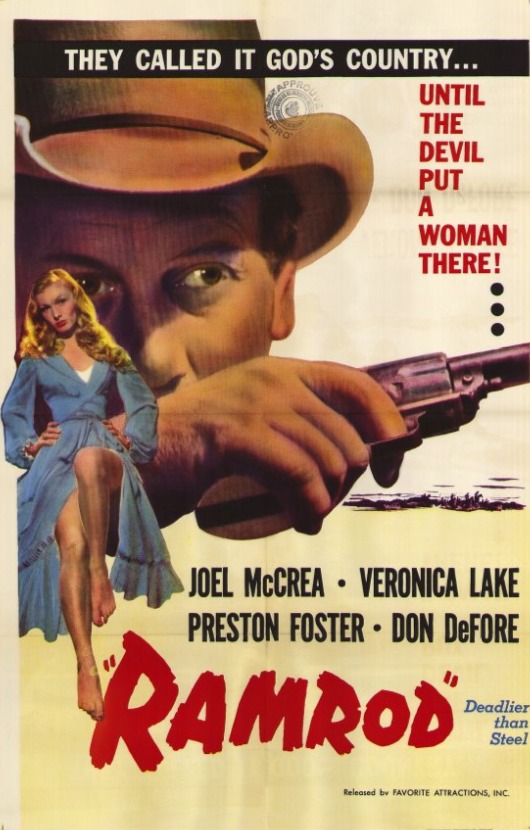
They called it God’s country … until the Devil put a woman there! screams the poster for André de Toth’s Ramrod.

That darned Scratch. Goin’ and puttin’ women where they oughtn’t to be.

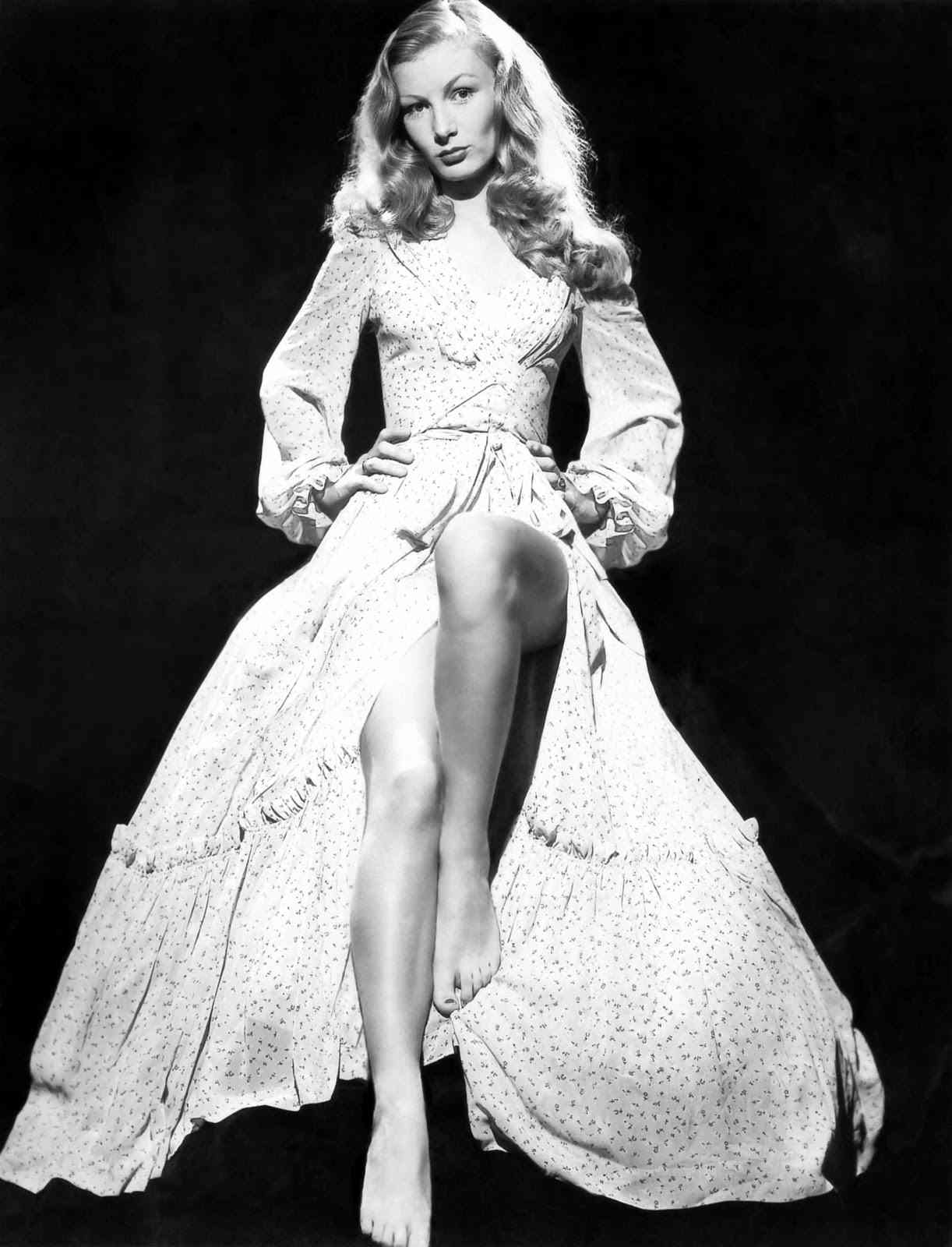
The woman in Ramrod is Connie Dickason, whose slight frame and small stature belie her will of iron. She’s played by Veronica Lake (de Toth’s wife from 1944 to 1952).

Connie’s fiancé, Walt Shipley (Ian MacDonald), plans to bring sheep through public grazing land, which hasn’t endeared him to local cattleman Frank Ivey (Preston Foster), who has Connie’s father, Ben Dickason (Charles Ruggles), in his pocket.

Alcoholic cowhand Dave Nash (Joel McCrea) has worked for Shipley for the past three weeks. At the request of Connie, with whom he has a history, he backs up Shipley when Ivey and his men attempt to stop Shipley from leaving on the night stage. (If Shipley gets out of town, he’ll come back with sheep.)

Sheriff Jim Crew (Donald Crisp) cautions Dave to stay out of it. When Dave says to the sheriff, “I work for Walt,” the sheriff responds, “For three weeks? What do you owe that fool, your life?”

All of this takes place in the first 10 minutes of the film. De Toth drops the viewer into the action in media res. Without a scorecard, it’s hard to keep track of who’s who during the first reel. (And it doesn’t help that Shipley and Ivey look nearly identical.)

Veronica Lake

But things become more clear as the plot rolls forward. Shipley decides that he doesn’t love Connie enough to die for her, so he heads out of town, leaving her his ranch. Connie’s father expects that she’ll do his bidding after Shipley departs, but she throws down the gauntlet with a fiery speech: “From now on I’m going to make a life of my own. And being a woman, I won’t have to use guns. This isn’t just a fight between father and daughter. You’ve pushed Frank Ivey at me ever since I can remember. For years I’ve watched him run things his way. The town, the valley, you, and now me! No one’s ever had the nerve to stand up to him. Well I have!”

Connie hires Dave to be foreman of her ranch, the Circle 66. He in turn hires an old friend of his, a handsome, charming loose cannon named Bill Schell (Don DeFore). Dave is determined that everything the Circle 66 does to fight Ivey be above board, but Connie and Bill have their own ideas. Connie may have made the decent and honest Dave “ramrod” of her outfit, but it’s the violent Bill Schell who is the true instrument of her will.

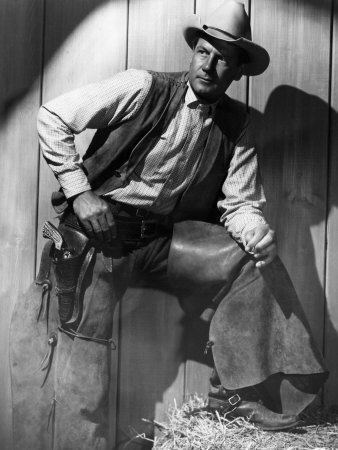
Joel McCrea

Joel McCrea has the pleasantly handsome, soft-featured face of the dad next door, but he’s tall enough and projects enough quiet menace to be convincing as the ramrod of the Circle 66 ranch. Don DeFore, who usually played pleasant, jovial men, is excellent playing against type as a cold-blooded gunman.

Ramrod is a great western. It’s based on a novel by Luke Short, and de Toth does an excellent job of capturing Short’s hard-boiled western prose and talent for characterization. The tone of the picture is closer to the film noirs of the period than it is to the westerns.

In Ramrod, de Toth creates a grim, violent world in which the righteous are just as likely to die as the wicked. Fistfights in this film don’t end with a bunch of broken furniture, they end with blood. A group of Ivey’s men beat an unarmed cowhand to death in front of Connie. When Bill Schell slaps a man in the face to enrage him, he tells Bill that he won’t be “rawhided” into drawing, so Bill burns his hand with a cigar. When Ivey shoots a man, he steps forward and finishes him off with another shot. Ramrod ends with a shootout, of course, but it doesn’t end with a quick draw or any fancy trick shooting. It ends with a shotgun blast to the gut.

True to the noir tone of the film, there’s a “good girl” to counterbalance Connie, named Rose (Arleen Whelan). The intertwined relationships of Dave, Bill, Connie, and Rose are well-played, and evolve naturally over the course of the film. Character drives the plot of Ramrod forward as much as bullets and fists.

Ramrod premiered on Friday, February 21, 1947, in Salt Lake City, at both the Utah and Capitol theaters. The world premiere event was part of Utah’s centennial celebration as a U.S. Territory. Ramrod went into wide release on May 2, 1947.

Code of the West (Feb. 20, 1947)

Code of the West, a programmer from RKO Radio Pictures, has the same pedigree as Sunset Pass (1946). Both films are based on novels by Zane Grey, the screenplays for both films were written by Norman Houston, both are directed by William Berke, both star James Warren and John Laurenz, and both feature Robert Clarke, Harry Woods, Steve Brodie, and Harry Harvey in supporting roles.

In Sunset Pass, the tall, lean, blond-haired, scowling Warren played a cowboy named “Rocky.” Here, he plays a cowboy named “Bob Wade.” John Laurenz plays the same character, Chito Rafferty, a comical, musically inclined Irish-Mexican. (Incidentally, “Chito Rafferty” was a sidekick character made famous by Richard Martin, who played the character in 33 different westerns from 1943 to 1952. Laurenz was the only other actor to play the character, and he only did so in Sunset Pass and Code of the West.)

While I won’t be able to tell you the plot of either of these films at this time next month, I thought Code of the West was the better picture, largely due to the presence of a young Raymond Burr, who is a smoother and more malevolent villain than Harry Woods was in Sunset Pass.

In Code of the West, Burr plays a land baron (what else?) named Boyd Carter. Carter and his henchmen know that the railroad is coming through town, but they’re keeping the information to themselves as they buy up all the land they can get their hands on. When a young banker named Harry Stockton (Robert Clarke) lends Bob and Chito money to stake a claim of their own, Carter’s men go into action.

If you were drawn to this film by the poster above, be forewarned that Carter’s arson-murder gang that blasts the frontier is mostly a collection of stock footage. But if you squint your eyes, suspend your disbelief, and take another sip of bourbon, you’ll be fine.

Vigilantes of Boomtown (Feb. 15, 1947)

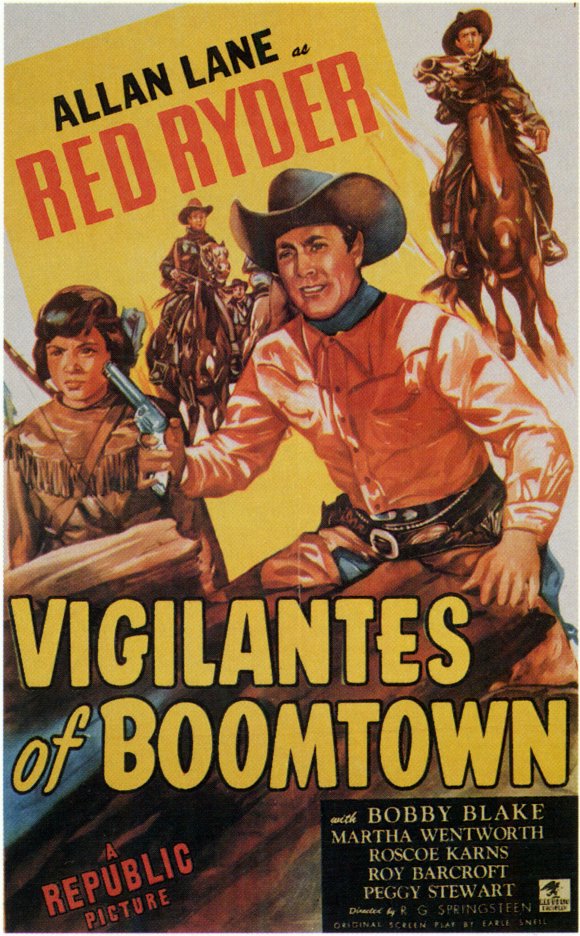
I thought Allan Lane’s third go-round as Red Ryder was his best yet, but it could just be because I’m a boxing fan.

Or maybe I’m just getting used to good old “Wild” Bill Elliott no longer playing Fred Harman’s comic-strip cowboy in his inimitable wooden style.

Either way, Vigilantes of Boomtown was a fun way to spend an hour. It begins with a tour of boomtowns, culminating with Carson City, the capital of Nevada. The year is 1897, and a bill legalizing boxing in the state has enraged Molly McVey (Peggy Stewart), the daughter of a U.S. senator. Molly believes that Nevada crawled its way to respectability, and hosting a bloodsport will make the state look like a hotbed of savagery to the rest of the country. She’s so opposed to prizefighting that she plans to hire gunmen to stop the fight if the state legislature goes ahead with its plans.

Red Ryder (Lane) and his English-challenged young sidekick, Little Beaver (Bobby Blake), are drawn into the fracas because Ryder’s aunt, the Duchess (Martha Wentworth), is leasing her ranch out to the fight’s promoters, who plan to hold their bout on St. Patrick’s Day. The combatants are a Cornish blacksmith named Fitzsimmons (John Dehner) and a bank clerk named Corbett (George Tumer).

Corbett (the more likable and handsome of the two fighters) stays with Ryder and the Duchess at their ranch, teaching Ryder a thing or two about the sweet science. When Molly hires a couple of thugs (George Chesebro and George Lloyd) to kidnap Corbett, there’s a bit of mistaken identity, which leads to them carrying off Ryder instead of Corbett, and they stash him in that cave where all bad guys go in Republic westerns. Will Corbett’s boxing lessons stand Ryder in good stead? You’ll just have to watch and find out.

Oh, and at the very end, Corbett’s referred to as “Gentleman Jim,” just in case you hadn’t already put the pieces together.

Angel and the Badman (Feb. 15, 1947)

James Edward Grant’s Angel and the Badman is a fish-out-of-water story about a gunfighter named Quirt Evans (John Wayne) who renounces violence after he is injured and nursed back to health by a pretty Quaker girl named Penelope Worth (Gail Russell) and taken in by her community. Like most Hollywood movies of this sort, Angel and the Badman has its cake and eats it too — it preaches nonviolence, but is still jam-packed with gunfights and fistfights.

The action is fast and furious from the very opening moments of the film, which begins with a close-up of a gun being drawn, the shooter fanning the hammer, firing from right to left, emptying the cylinder, and then running to his horse.

Legendary stuntman Yakima Canutt was the second unit director on this picture, and it shows. There’s a cattle raid sequence that’s among the best I’ve seen, and most of the action is well-staged. There’s one orgy of fistfighting, however, that was so over-the-top that I wasn’t sure if it was supposed to be funny or not. By the time the melee was finished, every visible piece of wood in the saloon was in splinters.

Angel and the Badman was John Wayne’s first time as a producer, and it feels like a labor of love. Unfortunately, the direction, cinematography, and pacing of the film aren’t up to the standard of Wayne’s other pictures I’ve seen from the ’40s. The music is especially bad, and is rarely appropriate for the scene it’s accompanying. At its heart, Angel and the Badman is a B picture with an A-list star.

The film ends with a line that could be interpreted as pro gun control — “Only a man who carries a gun ever needs one.” This is a rarity for a western, especially one starring John Wayne, but if you’re a traditional sort, don’t worry; all the bad guys die of lead poisoning before the film is through.

Trail to San Antone (Jan. 25, 1947)

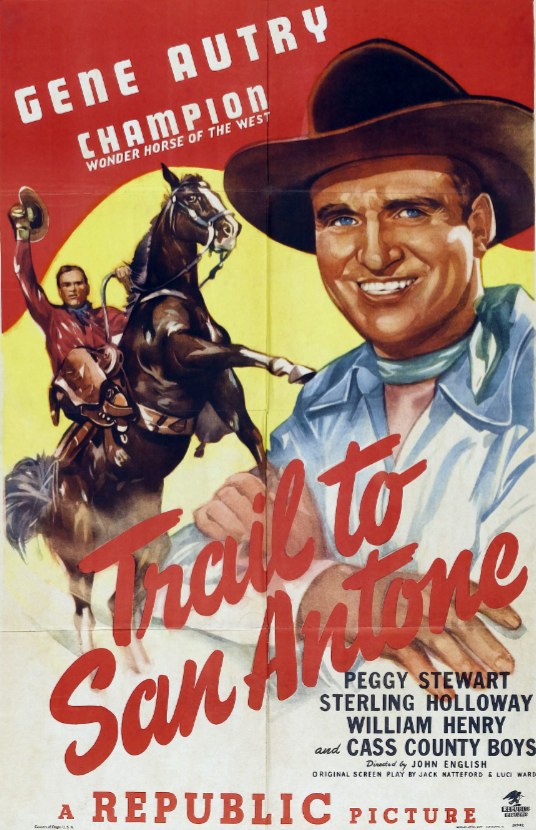
Have you ever wanted to see Gene Autry rope a stallion from the air? I hadn’t until I saw the climactic few minutes of John English’s Trail to San Antone, but as soon as Gene leaned out of the passenger side of the airplane piloted by feisty Kit Barlow (Peggy Stewart) and dropped a lariat, I said to myself, “Yee haw, Gene! Git ‘er done.”

It’s not as dangerous for the horse as it might sound. Kit doesn’t bring the plane in for a landing while Gene continues to control the horse or anything like that. As soon as the lariat is around the stallion’s neck, Gene drops the rope, which has a spare tire attached to the other end. One more good ropin’ job, and that stallion ain’t goin’ nowhere fast, pardner.

Trail to San Antone is solid entertainment for fans of Gene Autry. He’s backed up by the Cass County Boys (Fred S. Martin, Jerry Scoggins, and Bert Dodson), who do double duty as ranch hands and Autry’s back-up band. Dependable Republic Pictures heavy Tristram Coffin plays the bad guy, Cal Young, who’s attempting to derail the career of a young jockey named Ted Malloy (Johnny Duncan), whom Gene has taken under his wing. And the horrible comic relief is provided by the rubber-faced Sterling Holloway, as the cowardly and pencil-necked Droopy Stearns.

The film is bookended by performances of “Down the Trail to San Antone,” by Deuce Spriggins. Over the course of the picture, Autry and the Cass County Boys belt out plenty of pleasant country & western tunes, including Autry and Cindy Walker’s “The Cowboy Blues,” Spade Cooley’s “Shame on You,” Sid Robin’s “That’s My Home,” and Marty Symes and Joseph Burke’s “By the River of the Roses.”

Duel in the Sun (Dec. 31, 1946)

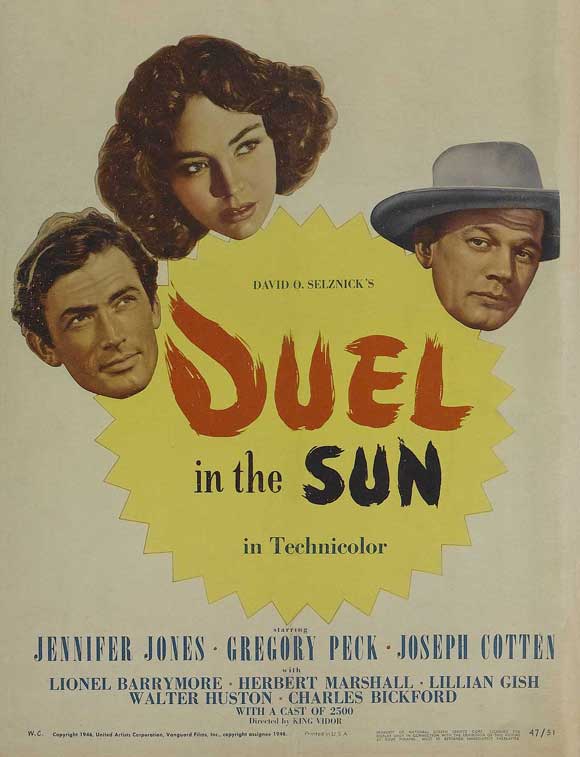
Producer David O. Selznick was never able to equal the success of Gone With the Wind (which received the Oscar for best picture in 1939), but it wasn’t for lack of trying.

His next film, Rebecca (1940), also won the Academy Award for best picture, and his films Since You Went Away (1944) and Spellbound (1945) were both nominated. With the advent of the auteur theory, Rebecca and Spellbound are remembered primarily as Alfred Hitchcock’s films, but Selznick’s power and influence in Hollywood during the ’30s and ’40s can’t be underestimated.

Selznick spent two years making Duel in the Sun, at an unprecedented cost of $6 million. He spent another $2 million on promotion, which was equally unheard-of at the time. (Some of the more novel advertising methods were 5,000 parachutes dropped at the Kentucky Derby and body stickers handed out at beaches that spelled out the title of the film on skin after a day of sunbathing.)

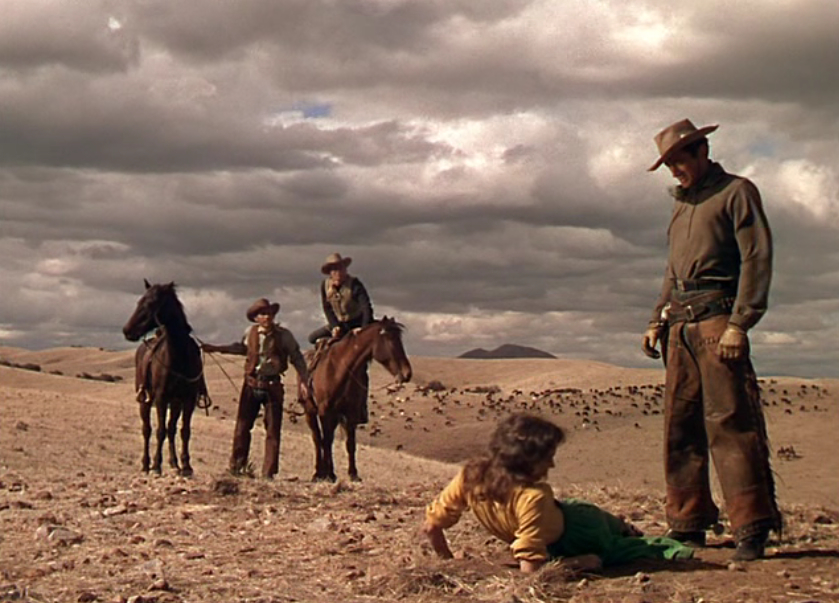
The trailer for the film proclaimed that it was “the picture of a thousand memorable moments,” and that’s true. The problem is that one memorable moment after another doesn’t necessarily add up to a single memorable film. The cinematography by Hal Rosson, Lee Garmes, and Ray Rennahan is occasionally breathtaking, and there are a few shots that are among the best I’ve ever seen on film, but there’s nothing to anchor them.

Like Gone With the Wind, Duel in the Sun was credited to a single director, but there were more directors who worked on the film who never received credit. King Vidor is the man who got his name in the credits, but Otto Brower, William Dieterle, Sidney Franklin, William Cameron Menzies, Josef von Sternberg, and even Selznick himself sat in the director’s chair at one point or another during production.

Duel in the Sun is a pretentious, overblown mess, but it’s worth seeing at least once in your life. Of course, you have to get through the “prelude” that opens the film. The word PRELUDE sits on the screen against a backdrop of a desert sunrise, accompanied by Dimitri Tiomkin’s score. As if that wasn’t enough, the prelude is followed by an overture. The word OVERTURE sits on the screen against a backdrop of a desert sunset. The narrator (an uncredited Orson Welles) gives us a taste of what we’re about to see, but it’s still 12 minutes of nothing but Tiomkin’s music and two static images. Hell of a way to start a picture.

Anyway, if you can make it through that, you can make it through anything, even an insane story about a “renegade Creole squaw-man” named Scott Chavez (Herbert Marshall) who’s hanged for murdering his lusty Indian wife and her lover. Before his execution, Mr. Chavez arranges for his half-breed daughter, Pearl (Jennifer Jones), to live with his second cousin and old flame Laura Belle (Lillian Gish).

The kind-hearted Laura Belle welcomes Pearl with open arms, but her husband, the wheelchair-bound Senator Jackson McCanles (Lionel Barrymore), is less charitable. “I didn’t spend thirty years on this place to turn it into no Injun reservation,” he growls.

Much of the film is a push-pull between the two McCanles sons, the gentlemanly Jesse (Joseph Cotten) and the brutish Lewt (Gregory Peck, in a rare role as a villain). Pearl is never really accepted into the family, and lives in servants’ quarters. Shortly after she arrives to stay, Lewt swaggers into her room one night and forces himself on her. She kisses him back savagely at the last second, so it’s not quite rape, but the implication is still there.

There are a lot of jump cuts in Duel in the Sun. Some are necessary — like when Cotten slaps Peck across the face and then the scene cuts to a closer shot in which Peck’s cheek is scratched and blood is pouring out of his mouth — but most seem like a byproduct of sloppy filmmaking, or a big-budget epic sprawling out of control.

Lewt promises to marry Pearl, but quickly backs out. When a kindly rancher named Sam Pierce (Charles Bickford) proposes to her, however, Lewt murders him. Afterward, he tells Pearl, “Anybody who was my girl is still my girl. That’s the kind of guy I am. You know … loyal.”

Duel in the Sun came to be pejoratively known as Lust in the Dust, which is a more apt title. Jennifer Jones appears in all manner of undress and compromising positions, and looks great doing it. It’s sometimes called a “Freudian” western, but I didn’t see much that was Freudian about it, except for the stunning final 10 minutes. The finale is the most overwrought and ridiculous expression of the intertwined relationship between Eros and Thanatos that I’ve ever seen.

Duel in the Sun was never a hit with critics, but it was the second biggest box office success of 1947. It ran into more censorship trouble than any film since Howard Hughes’s “roll-in-the-hay” western The Outlaw (1943), which starred Jane Russell and her enormous breasts, and at least some of the notoriety of Duel in the Sun came from the very public knowledge that Jennifer Jones and David O. Selznick were both cheating on their spouses with each other.

In 1948, Selznick retired from producing films. Duel in the Sun might not be the apotheosis of his 20 year-long career in terms of quality, but it’s probably the wildest, weirdest, sexiest, and campiest movie that the chain-smoking, amphetamine-popping Lothario ever produced. And it sure is pretty to look at.

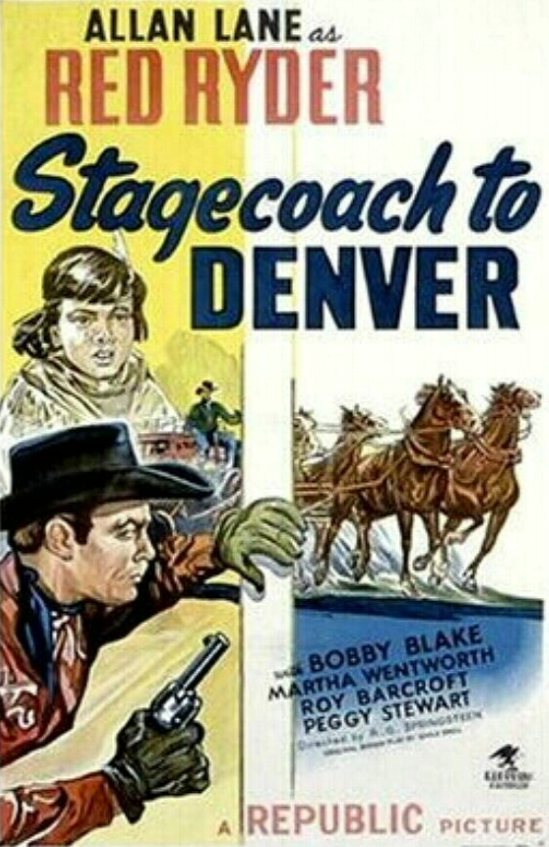
Stagecoach to Denver (Dec. 23, 1946)

Stagecoach to Denver, Allan Lane’s second outing as Fred Harman’s comic-strip cowboy Red Ryder, isn’t much different from his first. He’s a solid replacement for “Wild” Bill Elliott, but he lacks Elliott’s almost comical woodenness.

The one-hour oater takes place in a town called Elkhorn (which may or may not be in Colorado). As usual, Ryder and his aunt, the Duchess (Martha Wentworth), moved around plenty — most likely to keep the series’ titles fresh. This time around, the Duchess is running a stage line that serves all points south of Elkhorn, and her friend Big Bill Lambert (Roy Barcroft) is starting up a stage line that will serve all points north.

A little boy named Dickie (Bobby Hyatt), who has lost his parents, is getting shipped out to a relative he doesn’t know in Denver. This was the old days, when an orphan was simply told his parents “Went away on a long trip,” not that they were dead.

Dickie is caught up in the middle of nefarious doings when the sabotaged yoke of a stagecoach breaks, plunging him and the rest of the passengers into a ravine. The scheme was carried out to kill the land commissioner, who wouldn’t play ball with evil land baron Jasper Braydon (Wheaton Chambers).

Everyone on the stage dies except for Dickie, who is paralyzed from the waist down. “Doc” Kimball (Tom Chatterton) tells Ryder that he needs permission from Dickie’s nearest living relative to perform an operation that could repair his spine, but that could also kill him.

The bad guys intercept the stage carrying Dickie’s Aunt May, bind and gag her in a cabin in the woods, and replace her with a beautiful ringer (Peggy Stewart).

The fake Aunt May gives her assent, but struggles with her decision. If the boy dies, she feels it will be her fault, and she wants out of the scheme.

Meanwhile, Braydon, the evil land boss, starts forcing folks off their land in a dramatic and harrowing montage of stock footage.

Will Dickie walk again? Will he get the pony Ryder and his Indian boy sidekick Little Beaver (Bobby Blake) promised him? Will the beautiful young woman masquerading as Aunt May have a change of heart and aid the good guys? Will Emmett Lynn provide his usual brand of cornpone comic relief, this time as a character named “Coonskin”? Will Big Bill Lambert turn out to be one of the bad guys and have a furniture-destroying fistfight with Red Ryder? You’ll just have to watch it and find out.

Stagecoach to Denver is directed by dependable Republic journeyman R.G. Springsteen with his usual blend of vigor and indifference.