 A lot of men were drafted during World War II. Roy Rogers was one of them. With a 1-A classification, he expected to be shipped out in the spring of 1945. Consequently, screenwriter John K. Butler (working from a story by Leon Abrams) came up with a script to showcase Rogers’s leading lady, Dale Evans. When V-E Day rolled around, however, the draft board exempted men over the age of 30 who had children, so Rogers never had to serve. Director Frank McDonald’s Sunset in El Dorado ended up starring both “The King of the Cowboys” and “The Queen of the West,” but Evans is still the central figure, and it’s a great showcase for her sunny persona.
The film begins in the present day. Evans plays a young woman named Lucille Wiley, who works for a company called “Worldwide Tours.” In the first scene, Lucille shows a filmstrip that illustrates everything visitors will see on their western tour package. As shots of a ghost town appear on screen, Lucille says, “And this is El Dorado, in its day a roaring boomtown. The Golden Nugget, El Dorado’s most famous, or infamous, fandango hall. In its day, it rivaled the halls in Dodge City or the notorious Barbary Coast. The legendary Kansas Kate was the feature attraction here. And what a colorful attraction she was.”
Although she has a good pitch, and Kansas Kate was Lucille’s grandmother, Lucille has never been west of Hoboken. In a fit of pique, she runs off on one of Worldwide’s tour buses, determined to see the little town of El Dorado. She’s having a grand old time, singing “Go West Young Man” with her fellow passengers (Bob Nolan and the Sons of the Pioneers), when her drippy fiancé Cecil Phelps, the president of Worldwide Tours (played by Hardie Albright), and her old-maid aunt Dolly show up to spirit her away. Cecil intends to marry Lucille immediately, in Yuma, but she desperately wants to see El Dorado.
Their car breaks down on the way, and any hope Cecil has of making Lucille his wife pretty much falls off a cliff when Roy Rogers and Trigger ride up to help. He finds Lucille, off on her own, and says to her, “Well, I’ve seen mirages before, but this is the first one that ever talked back. Are you a mirage?”
Trigger tows their car to the nearest town, which happens to be El Dorado. Once there, Lucille explores the remains of the Golden Nugget and discovers a painting of Kansas Kate hanging above the bar. She’s interrupted by an ornery old coot named Gabby (George “Gabby” Hayes) who’s been dropping by the saloon for 40 years to make sure nothing happens to the painting. As Lucille stares at the picture and fantasizes about what her grandmother’s life might have been like, the movie flashes back to the old west, but the narrative continues, as everyone has a counterpart. Evans plays Kansas Kate, Rogers continues to play that character called “Roy Rogers” he played in so many movies, Gabby plays his younger self, and Cecil the drip becomes Cyril the heavy.
The plot moves at a brisk pace, and hinges on the coded map to Gabby’s gold claim being stolen by a group of bandits. Roy suspects that Kate was behind the plan, especially since she originally told him she was a schoolteacher, not a saloon owner, in order to impress him.
After Roy slugs it out with the toughest guy in the bar, a heavy named “Buster” (Roy Barcroft), he takes over Buster’s position as Kate’s bodyguard. Apparently his first duty as her bodyguard is to perform “Belle of the El Dorado” with Kate and her backup singers in a fully choreographed number.
The romantic scenes between Rogers and Evans are, as always, sweet and believable. After they take a break from riding together, she asks him, “What I can’t understand is why you took this job in the first place, particularly when you thought I swindled old Gabby out of his gold mine.”
“That’s why I took the job, to find out if you did,” he responds.
“Did you find out yet?” she asks.
“Oh, just a hunch, that’s about all,” he says, chewing on a piece of alfalfa and smiling.
I won’t be giving anything away if I tell you that everything turns out all right for Roy, Dale, Gabby, and Trigger, both in their present-day incarnations and their rootin’ tootin’ old-west versions. The only question I was left with was, since Lucille looks exactly like Kansas Kate, her own grandmother, and Roy looks exactly like the old-west character “Roy Rogers” who presumably married Kate, does that mean that the modern-day Lucille and Roy are actually cousins? Well, probably not, but it couldn’t help but cross my mind.
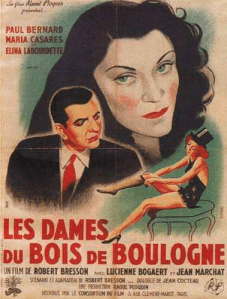 French film director Robert Bresson is famous for his use of non-professional actors. Prior to watching Les Dames du Bois de Boulogne, I had only seen one Bresson film, Pickpocket (1959), whose protagonist was most certainly not a professional actor. He shambled through the proceedings like a man on a heavy dose of tranquilizers, his movements slow, his eyes haunted. It was an interesting film, and one I may watch again some day, but it didn’t move me.
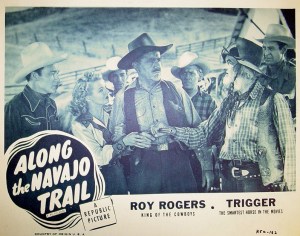 There are no Navajos to be found in this run-of-the-mill Roy Rogers picture, or American Indians of any tribe, for that matter. The title comes from a popular song that was written by Dick Charles (a.k.a. Richard Charles Krieg), Larry Markes, and Edgar De Lange in 1945, and is sung by Rogers, Dale Evans, and the rest of the gang to close the picture. No, the only people of color in Along the Navajo Trail are Spanish-speaking Gypsies, who are portrayed in much the same way Mexicans were in Hollywood westerns except that they wear funny clothes, travel in wagons, and the men wear gold hoop earrings. They also provide George “Gabby” Hayes’s character with a series of comic interludes in which he attempts to cheat the Gypsies, and is in turn cheated himself. These horse trades don’t add much to the plot, but they do result in Hayes sputtering the memorable line, “I sure have gypped that gyppin’ Gypsy!”
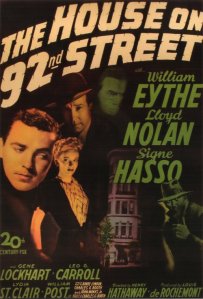 When The House on 92nd Street was released on DVD in 2005, it was as part of the “Fox Film Noir” collection. This is misleading, since it’s more of a docudrama than it is a noir. It’s a historically important film, however, since it was one of the first to feature location shooting for nearly all the exteriors, and one of the first to skillfully blend fact with fiction while presenting itself as essentially factual. (Charles G. Booth won an Academy Award for best original story for his work on this film.)
 Dead of Night is a British anthology of horror stories with many layers and a cyclical story structure. The five segments are based on stories by H.G. Wells, E.F. Benson, John Baines, and Angus MacPhail. Each is great, but the way the stories are told and the way they are linked together is the most interesting thing about the film.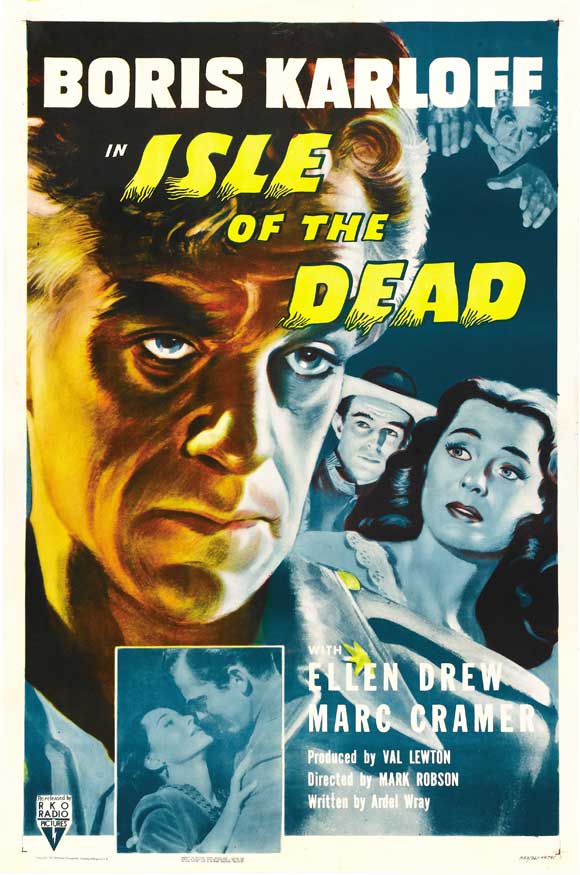
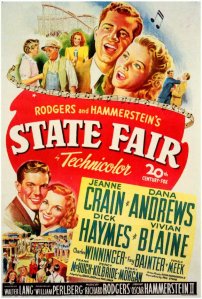 State Fair was the first musical made specifically for film by Rodgers and Hammerstein. Their two previous musical collaborations, Oklahoma! and Carousel, were both stage productions. (Although both would eventually be made into films in the ’50s.) State Fair was based on a novel by Philip Stong that had previously been made into a non-musical film in 1933 with Will Rogers.
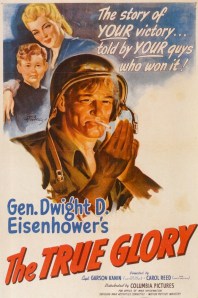 The True Glory, which was released on August 27, 1945 in the United Kingdom and on October 4, 1945 in the United States, is the granddaddy of every World War II documentary you’ve ever seen on the History Channel. Introduced by the Supreme Commander of Allied Forces in Europe, Gen. Dwight D. Eisenhower, The True Glory tells the story of America and Great Britain’s war against Germany and Italy, starting with the D-Day invasions of June 6, 1944 and ending with V-E Day, May 8, 1945.
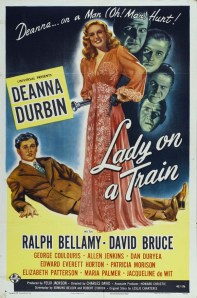 Deanna Durbin is an absolute delight in this farcical murder mystery. Durbin, a native of Winnipeg, Manitoba, was once one of the biggest stars in Hollywood, but never made a movie after 1948. (She currently lives in a small village in France, grants no interviews, and is reportedly very happy.) In Lady on a Train, she plays a young woman named Nicki Collins. When the film begins, Collins is sitting by herself in a compartment on a train entering New York on an elevated line. She has come from San Francisco to spend the holidays with her wealthy businessman father, and is currently engrossed in a mystery novel called The Case of the Headless Bride. When the train is briefly delayed, she looks out the window of her train car and witnesses a murder. Through a lighted window, she sees a young man beat an older man to death with a crowbar. She never sees the murderer’s face, however, and when she reports the murder to the police, the desk sergeant dismisses her report as the product of the overheated imagination of a girl who loves murder mysteries and can provide no real specifics of where she was when she saw the murder. Also, it’s Christmas Eve, and who want to traipse around looking for a murder that may or may not have occurred somewhere in Manhattan north of Grand Central Station?
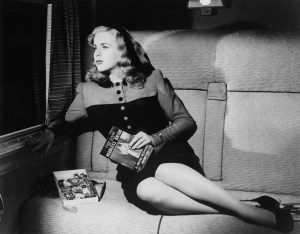 Lady on a Train is part mystery, part musical, part noir, part comedy, and part romance. The most surprising thing about this movie is that each element works perfectly, and they all complement one another. (Calling this film a noir is stretching it, but the final chase in a warehouse contains some striking chiaroscuro shot constructions, and is as tense as one could ask for.) Lady on a Train is also a delight for Durbin fetishists, since she has a different outfit and hairstyle in literally every scene. Sometimes the changes are subtle, but occasionally they’re impossible to miss, such as the scene in which she comes in out of the rain and is suddenly wearing gravity-defying, Pippi Longstocking-style braided pigtails.
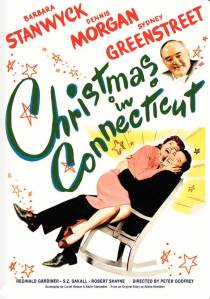 Barbara Stanwyck was a superstar of screwball comedies, and she created one of the all-time great femmes fatales in Billy Wilder’s Double Indemnity (1944). Christmas in Connecticut is one of her minor efforts, but it’s amusing enough, and if you’re specifically looking for a holiday film, you could do a lot worse.
 OCD Viewer