Author Archives: Adam Lounsbery

My Darling Clementine (Dec. 3, 1946)

My Darling Clementine
My Darling Clementine (1946)
Directed by John Ford
20th Century-Fox

“This is the west, sir. When the legend becomes fact, print the legend.” — The Man Who Shot Liberty Valance (1962)

John Ford’s My Darling Clementine is one of the most lauded westerns of all time.

Most criticism of the film is directed at its numerous historical inaccuracies, not its artistic merits. The ages of the Earp brothers are changed, for what seems no discernible reason. Characters die in the film who didn’t die until decades later. The chain of events that led up to the shootout near the O.K. Corral in Tombstone, Arizona, in 1881 is highly fictionalized. In reality, Doc Holliday was a dentist, not a medical doctor. The list goes on and on.

So to enjoy this film, it’s probably best not to watch it with a talkative history junkie.

And if you yourself are a history junkie, try to ignore all the little details and appreciate this film for what it is — one of the great westerns, full of iconic scenes, memorable performances, finely staged action, and little moments that would be copied over and over again in westerns in the decades that followed.

My Darling Clementine is a remake of Allan Dwan’s Frontier Marshal (1939), which starred Randolph Scott as Wyatt Earp. Both films are based on Stuart N. Lake’s book Wyatt Earp, Frontier Marshal, which was based on interviews with Earp, although most historians suspect that either Lake was embellishing or Earp was.

Again, it really doesn’t matter when it comes to this film. The plot is not the important thing, it’s Ford’s evocation of a frontier town. The rhythms of life, the strong feeling of nighttime, daytime, daybreak — all are perfectly realized. It doesn’t matter that the real Tombstone isn’t anywhere near Monument Valley. Ford shot there because he liked the way it looked.

Day for night shooting can look terribly fake, or just plain terrible, but in this film Ford makes it look beautiful. In one nighttime scene, Wyatt Earp appears on a rooftop, shot in low angle, firing his revolver at a man fleeing on horseback. Behind him is a dark sky full of silvery clouds. The scene clearly wasn’t filmed at night, but it’s still breathtaking.
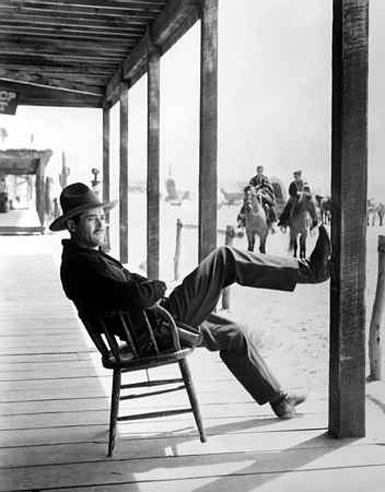
Henry Fonda

Henry Fonda’s performance as Wyatt Earp is one of the finest I’ve ever seen in a western. Protagonists in westerns tend to be stalwart men of few words, and Earp is no exception, but the humanity Fonda is able to express merely through his eyes is remarkable.

Fonda generates absolute authority in every scene. Except, of course, when he’s with the pretty Clementine Carter (Cathy Downs). The scene in which he takes her to a Sunday dance at the site where the town’s church will be built is one of the highlights of the film. As Earp walks beside Clementine, the congregation sings “Shall We Gather at the River?” (later to be paid gruesome homage to by Sam Peckinpah when he made The Wild Bunch in 1969). The budding romance between the two is palpable, and is a fine example of Fonda’s wonderful silent acting.

Walter Brennan is also great as Old Man Clanton, the vicious patriarch of a nasty clan. Brennan played a lot of cuddly, blustery sidekicks, but here he’s completely convincing as a cold-eyed villain who tells his boys things like, “When you pull a gun, kill a man.”

I’m less bowled over by Victor Mature’s performance as Doc Holliday. The oily Mature seems to be in a different picture in most of his scenes, as he drinks to escape his past and romances the tragic prostitute Chihuahua (Linda Darnell).

As I said, the liberties Ford takes with history are legion. But as Lawrence Kasdan’s Wyatt Earp (1994) showed, an accurate recitation of the facts doesn’t necessarily make for compelling drama. And who cares about the actual details of the shootout near the O.K. Corral when we have things in this film like Earp standing perfectly still as a stagecoach pulls in, then running to his left as soon as it kicks up a trail of dust, nearly invisible even to the viewer as he fires several shots and hits his target?

Producer Daryl F. Zanuck notoriously tinkered with this film. He thought Ford’s original version was too long, so he had director Lloyd Bacon shoot some new footage, and then re-edited the film himself. While some of Ford’s lost footage has been unearthed, his original version is lost. Would it have been a better film? Possibly. Is the version we are left with still a great film, and one of the greatest American westerns? Absolutely.
The Trap (Nov. 30, 1946)

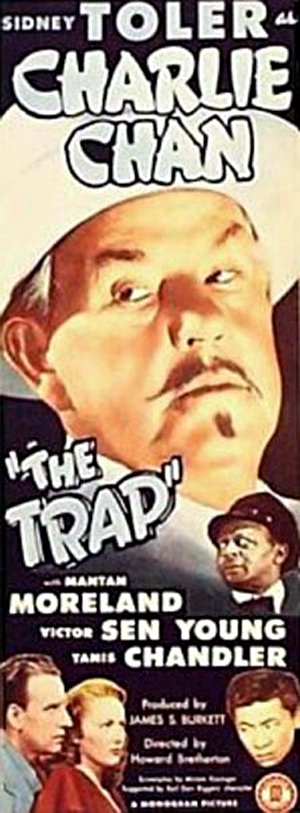
Howard Bretherton’s The Trap, produced by James S. Burkett, was Sidney Toler’s last appearance as Charlie Chan. Toler died on February 12, 1947, at the age of 72.

He inherited the role of Chan, a Chinese detective created by the novelist Earl Derr Biggers, from Swedish actor Warner Oland, who died in 1938. Oland played the venerable old detective from 1931 to 1937. He died at the age of 58 from complications due to bronchial pneumonia, possibly related to his alcoholism. (According to Yunte Huang’s recent book about Charlie Chan, Oland like to throw back a few before playing the character, as it helped his fuzzy, drawling, faux-Chinese line delivery. When Toler took over the character, the producers encouraged him to do the same thing.)

The Trap is a run-of-the-mill B mystery from Poverty Row studio Monogram Pictures. A gaggle of showgirls, their impresario, and their press agent all set up camp in a dusty old beach house in Malibu Beach.

After one of them is strangled with a silken cord, the hysterical women telephone Charlie Chan and reach his driver, Birmingham Brown (Mantan Moreland). If you enjoy politically incorrect humor, you’re in for a treat, as the bug-eyed Moreland mugs and twitches in ways black actors never would again.

Accompanied by Birmingham and his “number 2” son Jimmy (Victor Sen Yung), Chan arrives on the scene, and proceeds to unravel the mystery while spouting nonsensical aphorisms like, “Puzzle always deepest near the center.”

The Trap is a standard “old dark house” mystery, with the regular array of stock characters, such as a severe old battle-axe of a housekeeper and a doctor running away from his past. Kirk Alyn, who would go on to play Superman in two serials in 1948 and 1950, plays a tall, handsome motorcycle cop who assists Chan in his investigation, and doesn’t make much of an impression beyond his mustache and dark glasses. The beach setting doesn’t really jibe with the creepy old house — which has a basement and plenty of secret passages — and seems to exist mostly as an excuse for the pretty showgirls to go swimming whenever they can.

The Charlie Chan films remain a historical curiosity. Neither Toler’s makeup nor acting make him convincingly Chinese, but the series still has its fans, even its Chinese fans, such as Huang, the author I mentioned above.

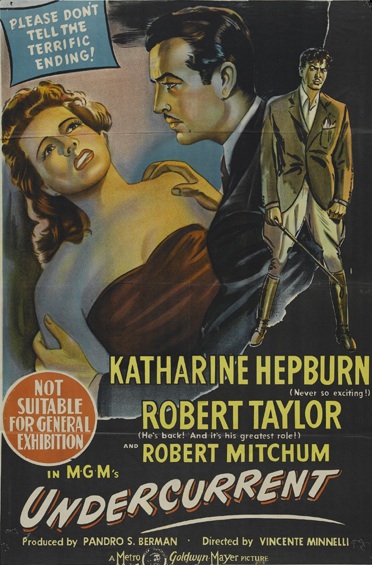
Undercurrent (Nov. 28, 1946)

Undercurrent
Undercurrent (1946)
Directed by Vincente Minnelli
Metro-Goldwyn-Mayer

The next time you and a friend see a turgid, overlong thriller with too many twists and turns, bogus storytelling, and good actors wasted, and your friend says, “They don’t make ’em like they used to,” you can show your friend Undercurrent and prove that they make ’em exactly like they used to.

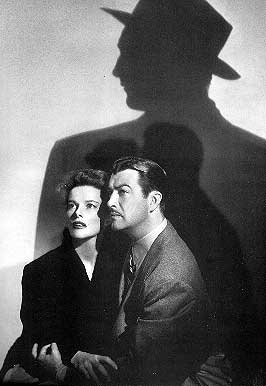
Pound for pound, Undercurrent might have boasted more talent than any other mystery melodrama in 1946. Director Vincente Minnelli and cinematographer Karl Freund were both gifted craftsmen with numerous acclaimed films under their belts. Herbert Stothart’s music is moody and evocative, especially the film’s haunting theme. Actors Robert Taylor and Katharine Hepburn were both stars of the highest magnitude, and hadn’t been seen onscreen for some time. Taylor had just finished his term of service as a flying instructor in the U.S. Naval Air Corps and Hepburn hadn’t appeared in a movie for a year and a half.

So what’s the problem? While studio tinkering could have played some part, the problem seems to mostly be Edward Chodorov’s screenplay, which was based on a story by Thelma Strabel. In a word, it’s silly. As soon as a promising situation is established, the story goes in a different direction, which serves to undercut the tension. The review of the film in the November 11, 1946, issue of Time called the plot “indigestible,” and said it was like “a woman’s magazine serial consumed at one gulp.”

Hepburn plays a young woman named Ann Hamilton who lives with her father, chemistry professor “Dink” Hamilton (Edmund Gwenn). Ann is herself chemically inclined, and prefers to spend time tinkering in the laboratory than entertaining proposals from eligible young men. All that changes when the handsome, mustachioed, and fabulously wealthy Alan Garroway (Taylor) enters her life. Alan is the inventor of the Garroway Distance Controller, which helped win the war.

Hepburn and Taylor in the shadow of Mitchum

Alan and Ann marry, and he takes her away with him to Washington, D.C., where she feels completely out of her depth in high society. Meanwhile, Alan starts making sinister insinuations about his brother Michael, who supposedly went missing years earlier with a large sum of money embezzled from the family business, and who is offscreen for most of the picture. The film seems to be setting up “What happened to Michael Garroway?” as the central mystery, but if you’ve looked at a cast list with character names, this plot thread won’t be that mysterious for you.

When Alan takes Ann away to his lovely country home in Middleburg, Virginia, the film threatens to settle down and become a solid Gothic melodrama. The estate has no phone line, and Alan’s behavior is increasingly bizarre. And as one critic noted, the central theme of Gothic fiction seems to be, “Someone is trying to kill me, and I think it may be my husband.”

True to form, however, the film goes in yet another direction, with Ann going off to explore Michael Garroway’s ludicrously appointed mansion-cum-bachelor pad, where she explores his musical instruments and books of poetry with copious underlinings, and seems to be falling in love with a man she has never met. I’m sure a good film could be made about a love triangle with one-third of the equation missing for most of the film’s running time, but this isn’t it. As Bosley Crowther said in his review of Undercurrent in the November 29, 1946, issue of the NY Times, “And if that also sounds a trifle senseless, let us hasten to assure you that it is.”

Robert Mitchum — one of my favorite actors of all time, ever since I saw him host Saturday Night Live in 1987 and asked my mom, “Who is that?” — is also in Undercurrent, but he doesn’t show up until more than halfway through the film’s running time, and only has a few scenes.

I may have made Undercurrent sound terrible. It’s not. It’s mediocre popcorn entertainment, and I had fun watching it. And it’s no worse than most of the “neo-noirs” that littered multiplexes throughout the 1990s … it’s just not much better, either.

The Best Years of Our Lives (Nov. 21, 1946)

The Best Years of Our Lives
The Best Years of Our Lives (1946)
Directed by William Wyler
RKO Radio Pictures

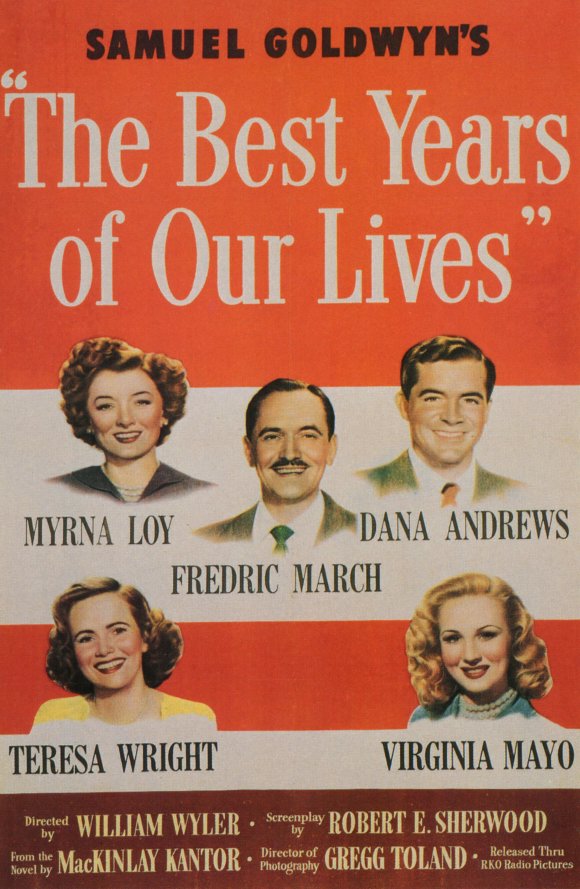
William Wyler’s The Best Years of Our Lives premiered in New York City on November 21, 1946, and in Los Angeles a month later, on Christmas day. It was a hit with both audiences and critics, and was the biggest financial success since Gone With the Wind in 1939.

The film swept the 19th Academy Awards, winning in all but one category in which it was nominated. The film won best picture, Wyler won best director, Fredric March won best actor, Harold Russell won best supporting actor, Robert E. Sherwood won for best screenplay, Daniel Mandell won for best editing, and Hugo Friedhofer won for best score. (The only category in which it was nominated and did not win was best sound recording. The Jolson Story took home that award.)

There are several reasons for the film’s financial and critical success. It perfectly captured the mood of the times. In 1946, returning servicemen faced an enormous housing shortage, an uncertain job market, food shortages, and a turbulent economy (price controls were finally lifted by the O.P.A. around the time the film premiered). Combat veterans also faced their own personal demons in an atmosphere in which discussing feelings was seen as a sign of weakness. By telling the stories of three World War II veterans returning to life in their hometown, The Best Years of Our Lives held a mirror up to American society.

The biggest reason for the film’s success, however, is that it’s a great movie. Plenty of films made in 1945 and 1946 featured characters who were returning veterans, but none before had shown them in such a realistic, unvarnished way. The Best Years of Our Lives doesn’t try to wring tragedy out of its characters’ personal situations. It’s an overwhelming emotional experience precisely because it doesn’t strain for high emotions. The film earns every one of its quietly powerful moments. Hugo Friedhofer’s score is occasionally overbearing, and a little high in the mix, but at its best it’s moving, and a fair approximation of Aaron Copland’s fanfares for common men. Gregg Toland’s deep focus cinematography is phenomenal. Every image in the film — the hustle and bustle of life in a small American city, the quietly expressive faces of its characters, and the interiors of homes, drugstores, bars, banks, and nightclubs — is fascinating to look at. (Toland was Orson Welles’s cinematographer on Citizen Kane, and he was an absolute wizard.)

Russell Andrews March

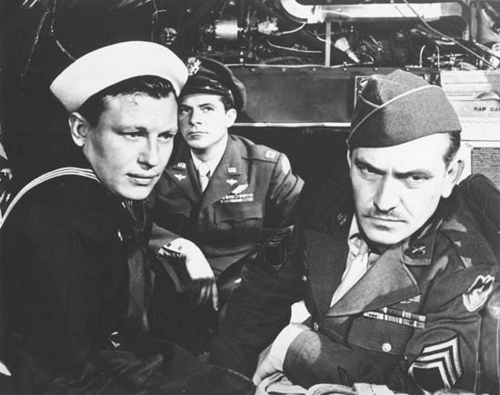
The actors in this film are, without exception, outstanding. Fredric March plays Al Stephenson, an infantry platoon sergeant who fought in the Pacific, and who returns to his job as a bank manager. Myrna Loy plays his wife, Milly, Teresa Wright plays their daughter, Peggy, and Michael Hall plays their son, Rob. Dana Andrews plays the shell-shocked Fred Derry, a decorated bombardier and captain in the Army Air Forces in Europe, who returns home to his beautiful wife Marie (Virginia Mayo), whom he married immediately before leaving to serve. Now that the war is over and they are living together, they realize they have very little in common. Harold Russell plays Homer Parrish, a sailor who lost both his hands when his aircraft carrier was sunk.

Russell was a non-professional actor who lost his hands in 1944 while serving with the U.S. 13th Airborne Division. He was an Army instructor, and a defective fuse detonated an explosive he was handling while making a training film. Russell’s performance is key to the success of the film. An actor who didn’t actually use two hook prostheses in his everyday life wouldn’t have been able to realistically mimic all the little things that Russell does; lighting cigarettes, handling a rifle, playing a tune on the piano. More importantly, Russell’s performance is amazing. From the very first scene that the camera lingers on his face as he shares a plane ride home with March and Andrews, I felt as if I knew the man.

Russell is so convincing as a man who has quickly adapted to his handicap that it’s gut-wrenching to watch as his exterior slowly breaks down, and we’re drawn deeper into his world. Homer Parrish has a darkness inside him, and he carries with him the constant threat of violence; bayonets adorn the walls of his childhood bedroom and he spends his time alone in the garage, firing his rifle at the woodpile. His next-door neighbor and childhood sweetheart Wilma (Cathy O’Donnell) keeps trying to get close to him, but he pushes her away. In a lesser film, this all might have led to a violent and melodramatic finale, but it merely simmers below the surface, informing his character. Instead, the most emotional scenes with Homer take place in smaller ways, such as when we see that he is not as self-sufficient as he seems, and needs his father’s help every night to remove his prostheses before he goes to sleep.

The Best Years of Our Lives is a great film, and should be seen by everyone who loves movies and is interested in the post-war era. It’s long — just short of three hours — but it didn’t feel long to me. The running time allows its story to develop naturally as the characters enter and re-enter one another’s lives. It also felt more real than any other movie I’ve seen this year. (I can’t think of another movie that wasn’t about alcoholism that featured so many scenes of its characters getting realistically drunk.) And despite all the personal difficulties its characters face, it’s ultimately an uplifting film, full of quiet hope for the future.

Sioux City Sue (Nov. 21, 1946)

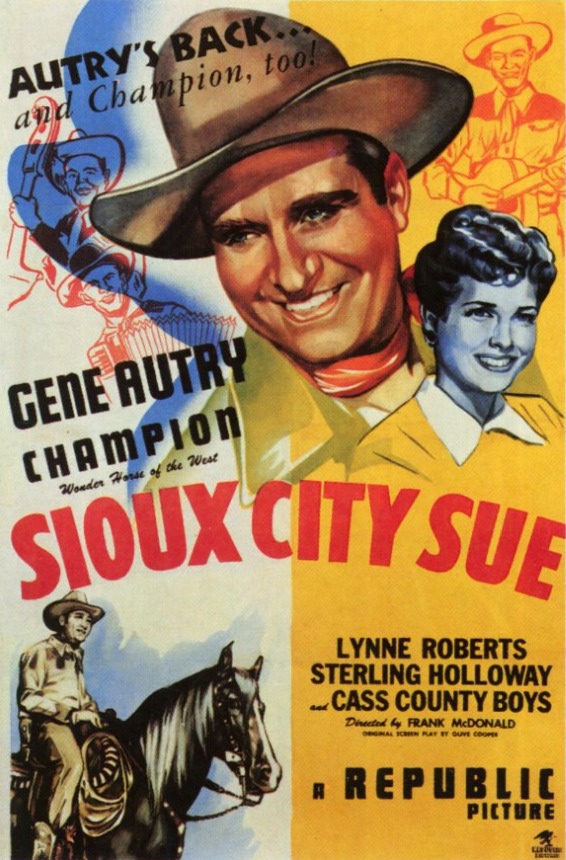
Frank McDonald’s Sioux City Sue repurposes the script from the 1939 comedy She Married a Cop and takes its title from one of the most popular songs of 1946. It was Gene Autry’s first film after he completed his service in the Army Air Corps during World War II.

More comedy than western, Sioux City Sue is lightweight fluff, but if you like Autry’s music, there’s plenty of it. (Although, if you’re like me, you’ll be a little sick of the title song by the end of the picture.)

In a plot that makes no sense if you stop to think about it for longer than half a second, a pretty blond Hollywood talent scout named Sue Warner (Lynne Roberts) casts Autry in an upcoming movie without telling him that he’ll never actually appear onscreen and is in fact voicing a singing donkey in an animated feature.

Things have changed a lot. Now, Hollywood stars regularly lend their voices to animated features. It’s nice work if you can get it; no time in the makeup chair, no difficult location shooting, and you can take your toddlers to the premiere. But in 1946, no star would ever dream of being in a cartoon. It’s hard, though, not to be delighted and amused by the premiere of the cartoon feature in Sioux City Sue. The little donkey with Autry’s voice, singing to his sweetheart on horseback, both of them wearing western duds, is pretty gosh-darned cute.

But Autry’s been lied to, and that rightly doesn’t sit well with the man. Of course, during the making of the film, Sue fell in love with him, so the big question for the second half of the picture is whether or not she’ll be able to convince him she’s sorry. She does her darnedest, quitting her job and coming to work on his ranch as a cook and general menial laborer.

This being a Republic western programmer, there’s an action-packed climax, and it’s up to Autry and his wonder horse Champion to save the day. The last few minutes of the picture, which involve a dynamited dam, a flood, and a cattle stampede, are exciting. But for the most part, Sioux City Sue is a laid-back and easygoing good time.

The Razor’s Edge (Nov. 19, 1946)

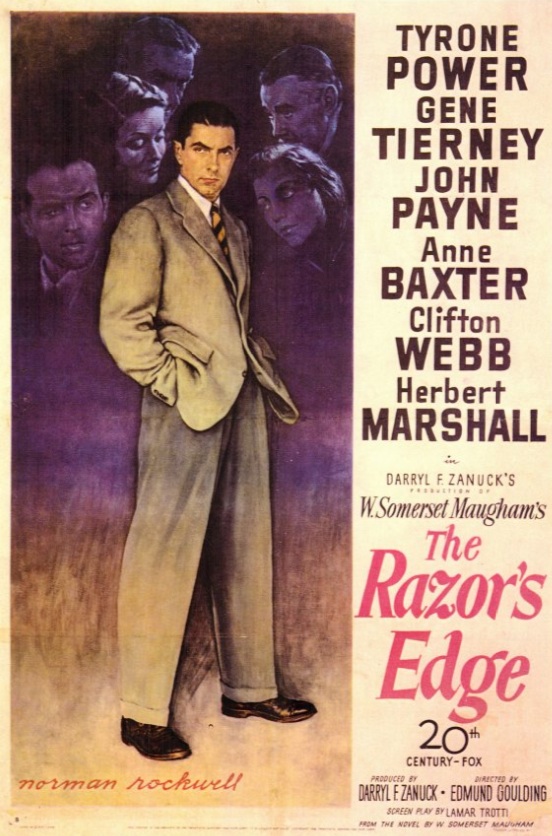
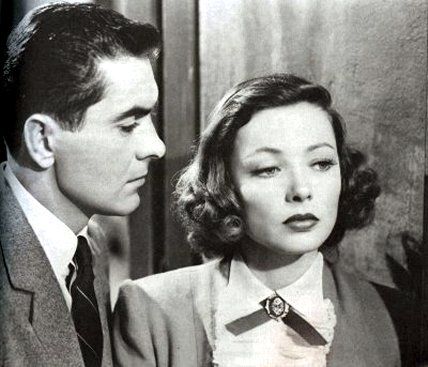
Edmund Goulding’s The Razor’s Edge, based on the best-selling 1944 novel by W. Somerset Maugham, features an Academy Award-winning performance by Anne Baxter in a supporting role, great-looking sets, deliciously bitchy acting by Clifton Webb, and a chance for Tyrone Power and Gene Tierney to show that they were better actors than they are usually given credit for.

So why didn’t I like it? Everything about this film reeks of “Oscar bait.” It’s high-minded, pretentious, and self-important, but ultimately shallow. There are a number of interesting characters in the framing sections of the film, but the central story about a young man named Larry Darrell (Tyrone Power) seeking enlightenment in Eastern spirituality falls flat, and everything else in the movie hangs on it.

Darrell is a veteran of the Great War who returns home to Chicago in 1919 questioning life after a fellow soldier — a friend of his — died saving his life. His confusion and guilt lead him to reject ordinary life and travel the world searching for meaning. He leaves behind his fiancée, porcelain-skinned beauty Isabel Bradley (Gene Tierney), as well as a sharply drawn cast of supporting characters; Isabel’s uncle, the fabulously wealthy and snobbish Elliott Templeton (Clifton Webb), the tragic hanger-on Sophie MacDonald (Anne Baxter), and “regular guy” Gray Maturin (John Payne). Just as in the novel, Maugham himself (played by Herbert Marshall) pops in and out of these characters’ lives.

When Tyrone Power first appears in the film, the character of Maugham says in voiceover, “This is the young man of whom I write. He is not famous. It may be that when his life at last comes to an end, he will leave no more trace of his sojourn on this earth than a stone thrown into a river leaves on the surface of the water. Yet it may be that the way of life he has chosen for himself may have an ever-growing influence over his fellow men, so that, long after his death perhaps, it may be realized that there lived in this age a very remarkable creature.”

Maugham’s words are prophetic. In the decades after he wrote The Razor’s Edge, many young men (and some women) would seek wisdom and enlightenment just as Larry does, traveling the world working a series of menial jobs and seeking truth in non-Christian religions.

While working in a coal mine in France, Larry plays cards and drinks with an old man who eventually turns out to be (unshockingly, based on the dialogue that passes between them) a defrocked priest running away from himself. The priest tells Larry of an Indian holy man who is vastly wise, and who may be able to set Larry straight.

Larry makes his way to India, and it was at this point that — at least for me — the movie took a nosedive. While all kinds of terrible things are happening to the other characters — Isabel is in a loveless marriage, Sophie loses her baby and becomes an alcoholic, etc. — Larry hangs out in a set that looks left over from Anna and the King of Siam and studies with an Indian guru who is ridiculously played by British actor Cecil Humphreys. The holy man speaks only of “God,” nothing specific, and certainly nothing polytheistic. His mysticism is inoffensive New Age stuff along the lines of Deepak Chopra’s vague aphorisms.

After Larry learns all he can from books, the holy man sends him on a pilgrimage to the mountains, where he receives “enlightenment” in the form of a matte painting of sun bursting out from behind the clouds and one last mealy-mouthed conversation with the guru.

All of this might have been meaningful in the novel. I can’t say, as I haven’t read it. But at least in this film, Larry’s spiritual journey is a bunch of vague nonsense that trades on the supposed exoticism of the East without actually including anything strange or specific enough to offend Peoria. Worst of all, he returns to his circle of friends, who are now bumming around Europe, with what amounts to a bag of parlor tricks. He does some hypnosis, forcing his friend Gray to drop a coin after he counts to ten and then tells Gray that he will feel pain no longer. Stuff like that. I was surprised he hadn’t learned to turn himself invisible, like Lamont Cranston in The Shadow.

When the movie ends, we’re supposed to believe that everyone who came into contact with Larry is better, somehow, because he is possessed of the most powerful force in the universe, goodness. But what is it about him makes him so good? He agrees to marry Sophie when she is in the depths of her alcoholism, which leads another character to describe him as being in the grips of self-sacrifice, which seems more apt.

Is Larry a good person because, at the end of the film, he works his way back to America on a tramp steamer? So do legions of cruder, simpler men. Does the mere fact of Larry’s enlightened attitude make his manual labor somehow nobler than the manual labor of “lesser” men? If it does, then why? The film never answers this question, but rather asks us to accept its thesis at face value.

I love all the actors in The Razor’s Edge, and they give some of the best performances of their careers in this film. But while it contains plenty of strong individual scenes, it’s a sodden, overlong snoozefest.

The Chase (Nov. 16, 1946)

Arthur D. Ripley’s The Chase is based on Cornell Woolrich’s 1944 novel The Black Path of Fear, which was adapted as a screenplay by Philip Yordan.

Chuck Scott (Robert Cummings), a sailor who was decorated during World War II, is now bedraggled and broke in Miami. While staring longingly through the window of a lunch counter at a griddle full of bacon and flapjacks, he finds a lost wallet full of $20 bills. He decides to return it to its owner, Edward Roman, whose I.D. says that he lives on Hermosa Drive, but not before he “borrows” a buck and a half to buy himself breakfast.

Eddie Roman (Steve Cochran) turns out to be a smooth-talking criminal who lives in a palatial home with his creepy right-hand man Gino (Peter Lorre) and his beautiful wife Lorna (French actress Michèle Morgan), whom he keeps a virtual prisoner. Roman is sinister right from the get-go, slapping a woman (Shirley O’Hara) who pokes him while manicuring his fingernails before he talks to Scott.

Gino and his boss seem amused by Scott’s honesty. (He even owns up to the 12 bits he liberated.) Roman asks Scott why he brought the wallet back. “Now that I’m here I wonder myself,” Scott says. “I guess I’m just a sucker.”

Roman gives “Scotty” — as he calls him — a job as a driver. Scott doesn’t like or trust either Roman or Gino, but he can’t say no to paying work. Things get weird right away. Roman has a contraption in the back seat that allows him to control the accelerator, speeding the car up to more than 100 m.p.h. to see how Scott handles himself. (My wife probably wishes all cars I drove came equipped with this feature.)

One night, Roman entertains a prominent ship owner named Emmerrich Johnson (Lloyd Corrigan), an overdressed fat man who spends most of his time laughing nervously … he can never quite tell if Roman’s joking or not. Unfortunately for Johnson, he doesn’t see the depths of Roman’s villainy and sadism. He’s never joking.

After Johnson refuses to commit to sell Roman the two ships he wants to buy, Gino takes Johnson on a tour of Roman’s wine cellar. While Johnson is excitedly fussing over a bottle of 1815 Napoleon brandy, Gino slips away and locks Johnson in the wine cellar with Roman’s vicious dog. When Johnson is attacked he drops the bottle of brandy on the floor and it runs out along the floor in a convincing approximation of blood. It’s an old cinematic trick, but a good one.

Meanwhile, Scott and Mrs. Roman are busy falling for each other. After one of their many trips to the beach, where she looks out over the water longingly as he stands behind her, waiting with the car, Lorna offers him $1,000 to take her to Havana. She thinks she can trust him, and she can’t make it on her own. He mulls it over for a little while but quickly gives in, booking passage for two on the S.S. Cuba.

They make it to Havana, but their plan to continue on to South America hits a snag, and Scott finds himself on the run, accused of murder.

Things get really weird an hour into the picture, when Scott wakes up in a room with a bottle of pills on the night table and no memory of what happened to him over the course of the past few days.

I haven’t read The Black Path of Fear, but I have read other novels by Woolrich, and blackouts, amnesia, and lost periods of time were recurring themes in his work. Like a lot of Woolrich’s booze-soaked prose, The Chase starts out as a fairly standard thriller, but by the end it’s hard to tell what’s real and what isn’t. In a better film, like Detour (1945), this could be counted as a real achievement. With The Chase, however, the confusion between dreams and reality seems more the result of slapdash filmmaking than anything else.

Cummings has a pleasant way about him, and is believable as an earnest, soft-spoken Everyman. Morgan is beautiful, but the script doesn’t give her a lot to do. Cochran and Lorre are the real gems in this film. Every scene in which they appear is full of menace. Each man has a calm exterior, but there’s always violence roiling below the surface.

If you’re looking for tight plotting or a clever climax, you won’t find it here, but The Chase has just enough oddball charm to recommend it to noir enthusiasts.

Santa Fe Uprising (Nov. 15, 1946)

R.G. Springsteen’s Santa Fe Uprising was a bittersweet viewing experience for yours truly. On the one hand, I really enjoy this series, based on Fred Harman’s comic-strip cowboy. It’s solid, fun, Saturday matinée entertainment. On the other hand, a big part of my enjoyment came from the wooden, straight-shooting acting style of “Wild” Bill Elliott as Red. Elliott’s persona was so stolid that it seemed tongue-in-cheek, and he had great chemistry with the child star who played his Indian sidekick Little Beaver (Bobby Blake, who later in life would be known as “defendant Robert Blake [9/18/33], aka Michael Gubitosi”).

After starring in 16 Red Ryder pictures from 1944 to 1946, Elliott bowed out and was replaced by square-jawed matinée idol Allan Lane. In the title sequence of Santa Fe Uprising, in which Red Ryder and Little Beaver appear in motion on the cover of a storybook, Lane bears a striking resemblance to Elliott. Up close, however, he’s more traditionally handsome and less interesting a performer.

Still, director Springsteen is a professional, and he keeps things fast-moving and exciting despite a modest budget and familiar shooting locations.

The film takes place in Bitter Springs, New Mexico, in 1894. The action kicks off when the U.S. Marshal for the territory is murdered by stagecoach robbers. The editor of the Territorial Gazette, a man named Crawford (Barton MacLane), demands that his killers be found. There is a toll road that’s safer to travel on than the main road, but the man who owns the property through which the toll road runs demands $3 a head of cattle to use it, which few ranchers can afford. When old rancher Lafe Dibble (Tom London) is killed by bandits, his son, Sonny Dibble (Pat Michaels), vows revenge.

Red takes over as U.S. Marshal of the territory, but he finds himself in hot water when it turns out that Crawford’s motives might not be as pure as they seem. When a man is murdered, and it looks as if Sonny killed him, Crawford and his boys demand that Sonny be strung up despite the fact that he professes his innocence. Things go from bad to worse when Little Beaver is kidnapped, held as a possible exchange for Sonny, after Crawford’s crew fails to bust Sonny out of jail to lynch him.

During the last part of the picture, Red is sleep-deprived after searching for Little Beaver night and day, which leads to a lot of strange acting from Lane, who keeps opening his eyes wide and half-yawning.

But if you’ve ever seen a western programmer before, you know that neither rain, nor snow, nor sleet, nor sleep deprivation shall keep the heroes from their appointed shoot-outs, from which they will always emerge victorious.

Song of the South (Nov. 12, 1946)


Song of the South
(1946)
Directed by Wilfred Jackson and Harve Foster

Walt Disney Productions / RKO Radio Pictures

Walt Disney’s Song of the South is the first movie I ever saw. (I think my mother may have taken me to some movies when I was a baby, but that doesn’t count.) Seeing it in the theater was a big deal for me. The most sophisticated piece of electronics we had growing up was a KLH radio, and the only time I saw television was at my grandmother’s house. (She had a 13″ black & white Zenith.) I don’t know exactly when I saw Song of the South, but it must have been during the film’s 1980 re-release.

Song of the South premiered in Atlanta on November 12, 1946. It was the first film to have its premiere there since Gone With the Wind in 1939.

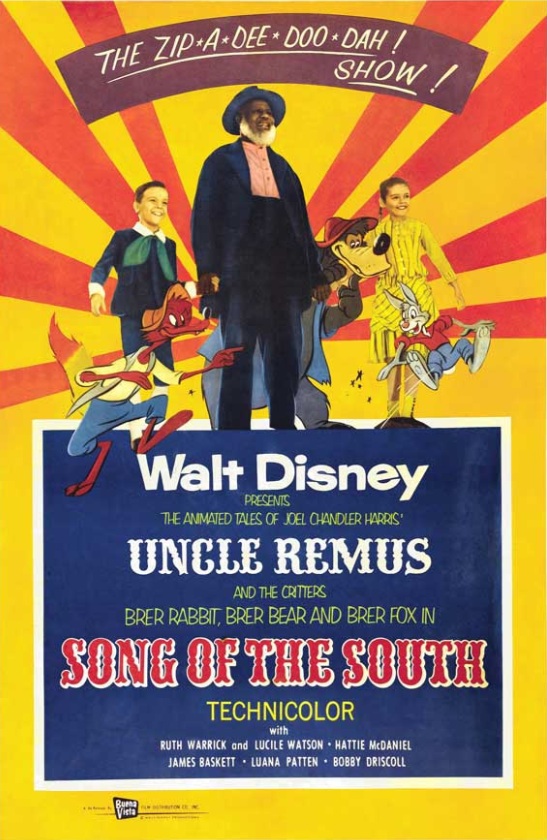
Based on Joel Chandler Harris’s books about an old storyteller named Uncle Remus, the film was controversial even before it went into production. In 1944, the Production Code Administration suggested a number of changes to Dalton Reymond’s script to minimize its potential to offend black filmgoers, including the following: that the phrase “old man” be substituted for “old darkie,” that the term “Mister John” be substituted for “Marse Jawn,” and that it be made clear that Uncle Remus belongs to a bygone era. Walt Disney did not, however, take their suggestion that it be made clear that the film takes place after the Civil War, when slavery was abolished, which is what got him into the most trouble.

Disney was not insensitive to the potential that Song of the South had to upset audiences. To deflect some potential flak, he brought in left-leaning Maurice Rapf, an emeritus director of film studies and an adjunct professor at Dartmouth College, to write a treatment of Reymond’s script that had the main white family living in a run-down farmhouse, not a beautiful plantation, and cut out scenes of black plantation workers going about their duties in a happy and docile fashion while singing uplifting spirituals. (Rapf, who was both Jewish and a Communist, denies that Walt Disney was intolerant, and said that while Disney was a conservative, he accepted the political and religious differences of the men who worked for him, many of whom were Jewish and/or leftists.)

For whatever reason, however, all of the aforementioned changes remained in their original form in the final cut of the film. In the cinema section of the November 18, 1946, issue of Time magazine, their reviewer wrote that “Tattered ol’ Uncle Remus, who cheerfully ‘knew his place’ in the easygoing world of late 19th Century Georgia … is a character bound to enrage all educated Negroes, and a number of damyankees.”

Walter White, executive secretary of the NAACP, sent a telegram to the press on November 27, 1946, that said the following: “The National Association for the Advancement of Colored People recognizes in ‘Song of the South’ remarkable artistic merit in the music and in the combination of living actors and the cartoon technique. It regrets, however, that in an effort neither to offend audiences in the north or south, the production helps to perpetuate a dangerously glorified picture of slavery. Making use of the beautiful Uncle Remus folklore, ‘Song of the South’ unfortunately gives the impression of an idyllic master-slave relationship which is a distortion of the facts.”

Ebony magazine was less tempered in their criticism of the film. They wrote, in a full-page jeremiad against the film, that Song of the South promoted “Uncle Tomism as the model of how Negroes should behave in white company.” Of the film’s star, they wrote, “James Baskett, who symbolically enough was taken from the Amos ‘n’ Andy radio show to portray Remus, is an Uncle Tom-Aunt Jemima caricature complete with all the fawning standard equipment thereof — the toothy smile, battered hat, grey beard, and a profusion of ‘dis’ and ‘dat’ talk. He lives up to his ‘lovable’ billing — certainly to Dixie audiences for whom any Negro who bows and scrapes is ‘lovable.'”

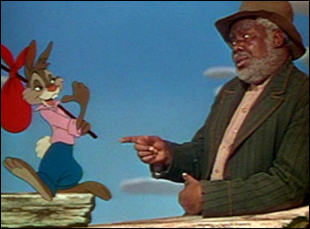
Most negative reviews of the film did, however, praise the animated sections of the film, which featured the antics of the crafty Br’er Rabbit, the diabolical Br’er Fox, and the slow-witted Br’er Bear. And the Academy of Motion Picture Arts and Sciences liked Baskett’s performance as Remus enough to give him an honorary award at the 20th Academy Awards in 1948 “For his able and heart-warming characterization of Uncle Remus, friend and story teller to the children of the world, in Walt Disney’s Song of the South.” (On the other hand, this took him out of the running for a real Oscar.)

While I don’t disagree with Ebony magazine’s assessment of the character of Uncle Remus, I do think Baskett gives a remarkable performance, full of warmth and humanity. There are some cringe-worthy moments, but overall I was moved by the character he created. It’s worth pointing out that Baskett also provided the voice for Br’er Fox, whose malevolent, mile-a-minute line delivery is so different from Remus’s slow, rich baritone that I never would have guessed it was Baskett’s voice if I hadn’t looked it up.

Remus comes into the life of a young white boy named Johnny (Bobby Driscoll) just when Johnny needs him most. Johnny’s father has left for Atlanta, and the boy wants to run away from home. Unlike Johnny’s mother, Remus understands the psychology of children, and instead of telling Johnny he shouldn’t run away, he gently steers him in the right direction by first agreeing to go with him, then telling him a story about a time when Br’er Rabbit was fed up and wanted to run away from all his troubles.

While the film presents a bucolic and idealized view of the Old South, there’s plenty of sadness, if you care to look for it. Johnny’s friendship with a black boy his own age is presented in a sweet, uncomplicated fashion, but look deeper. When the boy, Toby (Glenn Leedy), comes into Johnny’s room in the morning before a day of playing together, the first thing he does is pour water into the basin on top of Johnny’s bureau. Also, when Johnny runs off, Toby is viciously scolded by the older black servants in Johnny’s family, because it was Toby’s job to care for Johnny. Johnny is still the master and Toby is still the servant, and it’s doubtful that the two would have been able to remain friends into adolescence.

There’s also a running conflict between Johnny and two poor white boys who want to drown the puppy that Johnny got from them. While Uncle Remus scolds the two boys and runs them off when they bully Johnny, his authority only goes so far. When Johnny’s mother orders him to give back the puppy, Remus’s impotent rage is truly heartbreaking.

It’s hard to enjoy the third cartoon segment if you’re preoccupied with wondering whether or not the bad boys drowned that puppy. And while the puppy shows up for the final sequence of the film, the whole thing has a sense of unreality about it, since all the cartoon characters show up to interact with the happy children and Uncle Remus, who rubs his eyes ’cause he can’t hardly believe what he’s seeing! Br’er Rabbit right there? Yes indeed.

While Song of the South was re-released in U.S. theaters in 1956, 1972, 1980, and 1986, it has never been released in the United States on any home video format, and there are currently no plans to do so. Earlier this year, Disney CEO Robert Iger reiterated that there are no plans to release the film on DVD in the United States. He called Song of the South “antiquated” and “fairly offensive.” (Apparently this is something of an annual tradition at Disney shareholder meetings.)

Re-watching this film after 30 years was an interesting experience. While I didn’t pick up on all the subtleties when I first saw the film, I was surprised by how much I remembered. The cartoon sequences are a lot of fun, and the live-action sections contain much that is noteworthy. If Disney had taken Rapf’s advice — or if they had gone even further and removed every human actor except for Baskett and Driscoll — you’d probably be able to buy a deluxe DVD edition of Song of the South this Christmas for your kids.

It’s worth remembering, though, that no matter how the film’s themes had been presented, the star of Song of the South would not have been able to attend the film’s premiere in Atlanta. In 1946, it was still a segregated city. While Baskett would have been able to stay in one of the city’s black-owned hotels, he simply would not have been allowed to participate in any of the public events associated with the premiere.

Nocturne (Nov. 11, 1946)

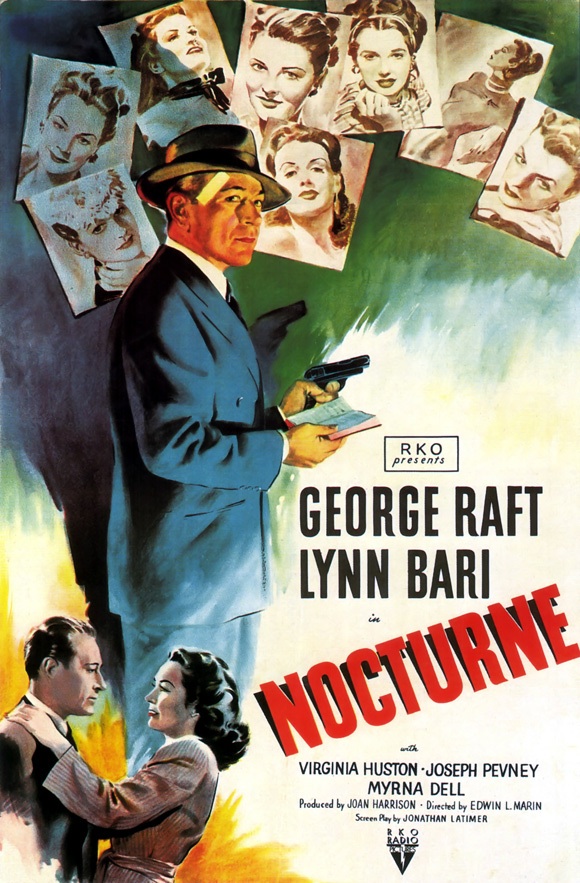
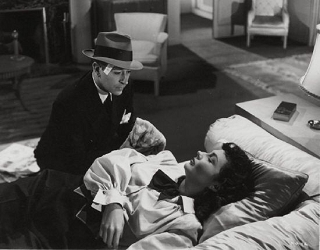
Edwin L. Marin’s Nocturne is close to being a great film noir, but not that close. It’s an entertaining mystery thriller with plenty of clipped, hard-boiled dialogue that’s fun to listen to, if not particularly credible.

George Raft plays Lt. Joe Warne of the Los Angeles police, and it’s a role that seems designed to play to the public’s perception of Raft as a gangster and a thug. Warne conducts his murder investigation with the subtlety of a steamroller, pushing a mustachioed Lothario into the pool when he gets in his way and ripping up the roll of a player piano in a diner when the owner won’t cooperate with him.

And when was the last time you saw a hard-boiled detective who lived at home with his mother? It’s the kind of oddball detail that feels as if it would be more at home in a gangster movie starring James Cagney.

Raft’s first big role was as Paul Muni’s sidekick in Howard Hawks’s Scarface (1932). After that he starred in a string of gangster pictures, and was one of the most popular actors in crime melodramas, along with Cagney and Edward G. Robinson. His boyhood friendship with gangster Owney Madden and association with men like Bugsy Siegel and Meyer Lansky aided the public’s perception of him as a hard man who didn’t just “talk the talk.”

By the ’40s, however, his star was beginning to fade. Turning down the lead roles in High Sierra (1941), The Maltese Falcon (1941), and Double Indemnity (1944) didn’t help matters. (Raft was reportedly functionally illiterate, which may have made choosing scripts difficult.) It’s safe to say that by 1946, he was getting the scripts that Humphrey Bogart used to line his birdcage.

Raft wasn’t a very expressive actor, and he had the range of a T-bone steak, but his tight-lipped acting style was perfect for B movies like Nocturne.

A flamboyant pianist and composer named Keith Vincent (Edward Ashley) is murdered, presumably by one of the nine brunettes he was running around with. He has glamour shots of all of them lining one wall of his living room, and it’s clear they were all interchangeable for him, since he called them all “Dolores.” (This may seem like a clever device to hide the identity of the murderess from the viewer, but it’s not.)

Lt. Warne investigates with ham-handed glee, and his investigative technique is as sloppy as the filmmaking. For instance, in one scene his chief (Robert Malcolm) bawls him out for bothering a character named “Mrs. Billings,” but apparently her scenes were left on the cutting room floor. This is fine, but why leave references to her in the film? Similarly confusing is the fact that Warne’s chief gives him two days to investigate Vincent’s murder on his own, but we only find this out after the two-day period is over. And it’s only after this two-day investigative blitz that Warne goes back to Vincent’s house and notices that one of the pictures is missing, since the pattern is disrupted, and there’s an enormous nail hole in the wall. Looking at the stamp on the back of one of the other pictures leads him to a sleazy photographer named Charles Shawn (John Banner). Wouldn’t a detective worth his salt have noticed all this immediately?

The most enjoyable thing about this film is the atmosphere. Lt. Warne spends a lot of time in smoky nightclubs, including the unique Keyboard Club, in which a hulking man-child named Erik Torp (Bern Hoffman) pushes a pianist named Ned “Fingers” Ford (Joseph Pevney) and his upright around on a rolling platform so they can take requests, table by table. When they get to Warne’s table, he hands Vincent’s unfinished piece “Nocturne” to Fingers to play. When he reaches the end of the handwritten sheet music, Fingers asks, “What did your friend do, run out of notes?” Warne responds, “More or less.”

Plenty of sex and sleaze run right below the surface of the picture, but it’s all pretty lighthearted. There’s a funny scene in a dance studio in which Warne can’t learn even the most basic steps (it’s mostly funny because Raft was a professional dancer), and his romance with his prime suspect, Frances Ransom (Lynn Bari), doesn’t carry much sense of danger or menace.

Nocturne is a really fun picture, despite its shortcomings. It has some of the snappiest, most hard-boiled, least naturalistic dialogue I’ve heard since I watched The Dark Corner (1946). Fans of B noirs are encouraged to seek out this picture.