Author Archives: Adam Lounsbery

Along the Navajo Trail (Sept. 15, 1945)

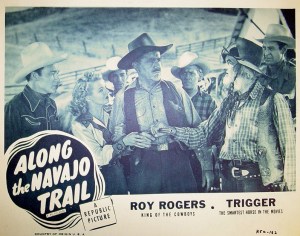
AlongTheNavajoTrailThere are no Navajos to be found in this run-of-the-mill Roy Rogers picture, or American Indians of any tribe, for that matter. The title comes from a popular song that was written by Dick Charles (a.k.a. Richard Charles Krieg), Larry Markes, and Edgar De Lange in 1945, and is sung by Rogers, Dale Evans, and the rest of the gang to close the picture. No, the only people of color in Along the Navajo Trail are Spanish-speaking Gypsies, who are portrayed in much the same way Mexicans were in Hollywood westerns except that they wear funny clothes, travel in wagons, and the men wear gold hoop earrings. They also provide George “Gabby” Hayes’s character with a series of comic interludes in which he attempts to cheat the Gypsies, and is in turn cheated himself. These horse trades don’t add much to the plot, but they do result in Hayes sputtering the memorable line, “I sure have gypped that gyppin’ Gypsy!”

In Along the Navajo Trail, Rogers plays a character named “Roy Rogers” who at first appears to be an itinerant cowpoke, but whom we later discover is a Deputy U.S. Marshal. Dale Evans plays a ranch owner named Lorry Alastair, and Hayes plays her foreman, Gabby Whittaker. Lorry is skittish about Rogers when he drifts onto her property, the Ladder A Ranch, and orders Gabby to run him off. She changes her tune, however, when she walks to his relocated campsite herself to kick him off her land, but he ends up singing to her under his tarp in the rain, making up a song as he goes, and asking her if she knows a girl’s name that rhymes with “Saskatoon.”

Lorry eventually finds the Deputy U.S. Marshal badge in his boot and realizes beyond a doubt that he’s one of the white hats. The black hats in Along the Navajo Trail are the representatives of the Santa Fe Drilling Company. There isn’t any oil on Lorry’s land, but the company needs to lay a pipeline through her property, and they’ll stop at nothing to do so.

Along the Navajo Trail is heavier on action than some of Rogers’s efforts, and it should please most fans of old B westerns. As usual, Rogers solves problems with haymakers and gunplay, but stops short of ever getting too bloodthirsty, since plot contrivances take care of the worst of the bad guys. The climax of the picture occurs when the final black hat loses control of his buckboard, and it flies over a cliff and he falls to his death (in the form of an especially noticeable dummy). Rogers rides to the edge of the cliff and surveys the destruction with the same look of mild disapproval one reserves for drunks puking in Dumpsters in the middle of the afternoon.

At the end of the picture, Rogers, Evans, and the rest of the cast gather to sing “Along the Navajo Trail,” and then they all live happily ever after. Or at least, their characters do. Rogers, Hayes, Evans, and Trigger would all be back exactly two Saturdays later, when Sunset in El Dorado was released into theaters.
The House on 92nd Street (Sept. 10, 1945)

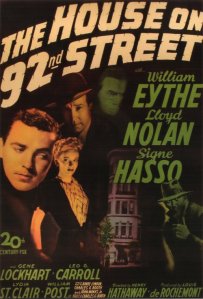
House92ndStWhen The House on 92nd Street was released on DVD in 2005, it was as part of the “Fox Film Noir” collection. This is misleading, since it’s more of a docudrama than it is a noir. It’s a historically important film, however, since it was one of the first to feature location shooting for nearly all the exteriors, and one of the first to skillfully blend fact with fiction while presenting itself as essentially factual. (Charles G. Booth won an Academy Award for best original story for his work on this film.)

The House on 92nd Street stars William Eythe as Bill Dietrich, a second-generation German-American who becomes a double agent for the F.B.I., Lloyd Nolan as his contact in the Bureau, Agent George A. Briggs, and Signe Hasso as the leader of the spy ring, Elsa Gebhardt. The film is a fictionalized account of the F.B.I.’s 1941 operation against the Nazi spy ring led by Fritz Joubert Duquesne. It was one of the largest counterspy operations in U.S. history, and led to the conviction of 33 people. In reality, however, none of them were involved in anything quite as grand as the secrets of the atomic bomb, which is the MacGuffin in The House on 92nd Street. And the real Dietrich was not the all-American boy portrayed by Eythe. He actually was a German-born man named William G. Sebold who served in the German army during World War I but became a naturalized American citizen in 1936. Presumably the war was still too fresh in the minds of the American viewing public for them to accept a German as the hero of a picture.

This film also shows the beginnings of J. Edgar Hoover’s massive publicity campaign for the F.B.I., which he disguised as a simple display of information. In reality, of course, Hoover carefully controlled the information that the public saw about the F.B.I., twisting and distorting as necessary. A good example of this information control is a scene early in the film, in which we see an indoor enclosure the size of an airplane hangar, filled with filing cabinets. The booming voice of the narrator (Reed Hadley) explains that this is the F.B.I.’s collection of 100 million sets of fingerprints, a number that seems unlikely, given that the population of the United States was fewer than 140 million people in 1945. Were they counting each finger? The message, of course, is that there is no hiding from the F.B.I. If you commit a federal crime or spy for another nation, they will find you. (This was also the message of the radio show This Is Your F.B.I., which began broadcasting dramatizations of real federal cases on American Broadcasting Company stations in the spring of 1945, all with the cooperation of Hoover, who called it “the finest dramatic program on the air,” and “our show.”)

The House on 92nd Street was directed by Henry Hathaway, but much of its style can be attributed to producer Louis de Rochemont, who created the “March of Time” newsreel series. When he lacked the footage he wanted, de Rochemont would stage clever recreations, but his newsreels were presented as wholly factual. It’s important to keep in mind that American audiences were less savvy about media trickery in 1945. After all, it had only been six years since people tuned into Orson Welles’s War of the Worlds broadcast midway through the program and thought Martians were vaporizing people in New Jersey.

The House on 92nd Street begins with a compilation of actual footage of people entering and exiting the German embassy, which is interesting. Of course, the characters in this film watch a great deal of surveillance footage. Some of it is real, some is not. It’s not that audiences in 1945 didn’t realize that the film was a blending of reenactments and actual footage, it’s the overall message they were taking away from the film that was perhaps not completely accurate. For instance, in Thomas M. Pryor’s September 27, 1945 review of the film in the New York Times, he wrote the following:

Since the picture, produced by Twentieth Century-Fox with full cooperation from the F.B.I., was completed some months ago, the secret of the atomic bomb has been revealed. Now the picture carries a simple and restrained foreword explaining that the “Process 97” which the Nazi agents are attempting to steal was in reality a part of the atomic bomb formula. It is to the producers’ everlasting credit that this information is not sensationalized in the film.

In reality, however, there is no evidence that there was a single “missing piece” of the atomic bomb process that spies were in danger of transmitting back to Nazi Germany. And of course, film by its very nature presents a sensationalized picture of reality.

Also, a big deal is made at the beginning of the picture that every person playing an F.B.I. agent, aside from the principals, is an actual F.B.I. agent. This, however, does not make what is depicted any more or less truthful than if they were played by actors, but it seems to.

The House on 92nd Street is not a bad picture by any stretch. Taken at face value, it’s tense and exciting. And director Hathaway, when not constrained by the documentary-style approach of de Rochemont, creates some great sequences, such as when Dietrich gets himself arrested just to get in touch with Briggs at the F.B.I., or the meeting between Dietrich and his co-conspirators at a waterfront dive. And the final shootout, which involves tear gas grenades and a surprising disguise, is fantastic. If you’re looking for a film that uses the framework of a docudrama to present a tense film noir, however, you’d be better off watching Anthony Mann’s excellent T-Men (1947).

Dead of Night (Sept. 4, 1945)

DeadOfNightDead of Night is a British anthology of horror stories with many layers and a cyclical story structure. The five segments are based on stories by H.G. Wells, E.F. Benson, John Baines, and Angus MacPhail. Each is great, but the way the stories are told and the way they are linked together is the most interesting thing about the film.
When Dead of Night begins, an architect named Walter Craig (Mervyn Johns) is driven to an English country estate, where he has been hired for a reconstruction project. Once he arrives, and is introduced to the group of people in the living room, he experiences déjà vu. He claims to have dreamed the room and the people in it many times. He is able to predict certain things before they happen in the narrative. A psychiatrist named Dr. Van Straaten (Frederick Valk) refuses to believe any of it, but Craig claims that he is being treated by the doctor, and works hard to dispel the doctor’s doubts. In between the stories that people tell, Craig presages disaster. Horrific events will come to pass, he keeps telling his fellow house guests.

Antony Baird tells the first tale. His character is a race car driver named Hugh Grainger who survives a smash-up on the track, but soon after has disturbing visions of a hearse driver who appears in different guises, but always at a quarter after four, and always speaking the words, “Just room for one inside, sir.” This story provides the template that was followed by every Final Destination film, and it does so in less than seven minutes.

The second story is about a young woman named Sally O’Hara (Sally Ann Howes) who attends a Christmas party. While playing hide-and-seek with the other young people, she is found by a young man who hides with her, and claims that there was a murder committed in the house in 1860 by a mad young woman. Going off on her own, she discovers a passage into a child’s bedroom, where a little boy sits, weeping. He tells her about his older sister. She puts him to bed and sings to him. When she rejoins the party, she learns that the name the little boy gave her was the name of the boy who was murdered by his sister.

In the third story, a woman named Joan Cortland (Googie Withers) recalls buying a birthday present for her fiancé, Peter Cortland (Ralph Michael), a large mirror. He starts seeing strange things in the mirror, such as a room completely different from the one in which he is standing. Increasingly disturbed by her husband’s claims and his strange behavior, Mrs. Cortland tracks down the history of the mirror, and learns that its former owner was a wealthy gentleman who groundlessly accused his wife of infidelity. He murdered his wife, and then sat down in front of the mirror and cut his own throat. Will history repeat itself?

In the fourth story, the owner of the house, and the host of the party, Eliot Foley (Roland Culver), tells a comical ghost story about his two good friends, George Parratt (Basil Radford) and Larry Potter (Naunton Wayne), who were both avid golfers. Bitter rivals on the links, they were the best of friends at all other times, until they both fell in love with the same woman, Mary Lee (Peggy Bryan). They decide to settle things with an unfriendly game of golf. When the game is finished, one of them quite unexpectedly walks into a lake and drowns himself. The winner marries Mary, but is haunted by the voice of his late friend, destroying his golf game for good. (Radford and Wayne played comically sport-obsessed British gentleman in a number of films, including Alfred Hitchcock’s 1938 film The Lady Vanishes. Their alliterative pair of names changed from picture to picture, but the schtick was the same.)

In the final story, Dr. Van Straaten tells his own tale. He was once called to examine a ventriloquist named Maxwell Frere (Michael Redgrave) who was accused of the attempted murder of an American ventriloquist, Sylvester Kee (Hartley Power). Frere’s dummy, Hugo, seemed to have a mind of its own, and threatened to leave Frere for a new owner, Kee. Dummies in horror movies had been done before, (e.g., The Unholy Three), but Dead of Night created a template that many films have used since.

Dead of Night was released on September 4, 1945 in London, and a little less than a year later in the United States, on June 28, 1946, in an edited version. Apparently the U.S. distributors felt that the film’s running time (103 minutes) was too long, so they cut out the golfing story and the Christmas ghost story, leaving only three stories. I can’t imagine seeing this film without them. The structure of the film is deliberate, and all the segments are tied together in a brilliant and surreal climax.

Isle of the Dead (Sept. 1, 1945)

IsleOfTheDead
Isle of the Dead (1945)
Directed by Mark Robson
RKO Radio Pictures

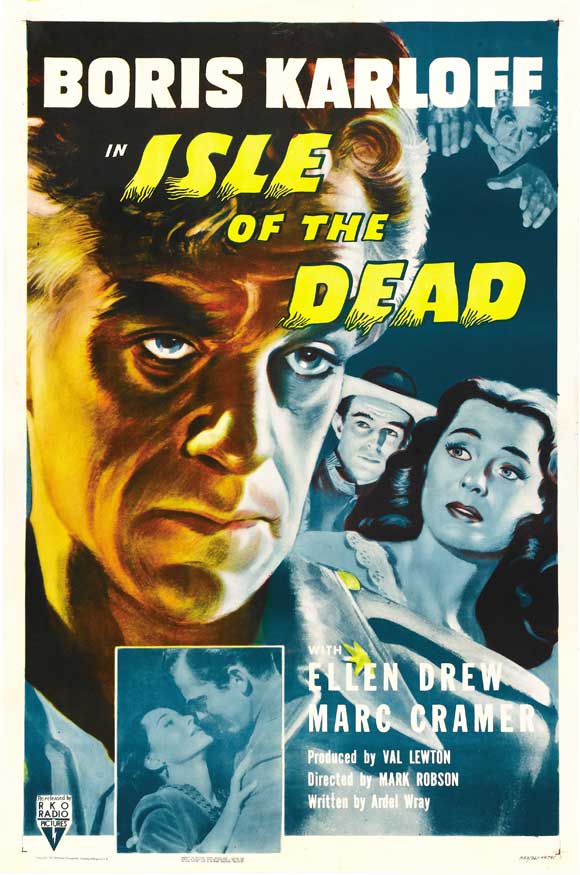
Director Mark Robson’s Isle of the Dead, which was produced by legendary horror filmmaker Val Lewton, takes place in Greece in 1912, during the First Balkan War. In it, Boris Karloff plays a cold and brutal general in the Greek army named Nikolas Pherides. Known as “The Watchdog,” Gen. Pherides is the kind of man who, when faced with an officer who has failed to complete an objective, hands the man a revolver with a single bullet in it and orders him to shoot himself.

When Gen. Pherides and some of his troops are garrisoned in a house on an island, the serving girl, Thea (Ellen Drew), refuses to pour him wine, because he once gunned down people in her district who refused to pay taxes. He confronts her in private. She denounces him for murdering people who were rebelling against unjust taxation. “Who is against the law of Greece is not a Greek,” he says. Not only is he a rigid interpreter of the law, he seems to take pleasure in wielding power. After his encounter with the girl, he tells another man, “When I went up there she wasn’t quite so impudent. She was frightened.” He says it with grim pleasure.

The next day, however, the island is faced with an outbreak of septicemic plague, and Gen. Pherides promises that the quarantine on the island will observed. Having the military, under the command of someone like him, available to enforce order falls under the category, “Be Careful What You Wish For,” and not surprisingly, there are complications. A woman named Mary St. Aubyn (Katherine Emery), who is staying on the island with her husband (Alan Napier), suffers from attacks of catalepsy. Unable to refill her medication on the mainland, she falls into a catatonic state, is presumed dead, and is buried alive.

Compounding this horrific event is a superstitious old woman named Madame Kyra (Helen Thimig), who has the general’s ear. She convinces him that Thea, the young serving girl, is a vorvolaka, a harmful undead creatures from Greek folklore, roughly equivalent to the vampires feared in neighboring Slavic countries, although blood drinking is not something they seem to engage in. In the world of the film, the vorvolakas are sent by the gods to punish humans who offend them. The combination of the plague and the apparent death of Mrs. St. Aubyn gives Kyra’s mad proclamations a certain believability, and Gen. Pherides becomes convinced that Thea was responsible for Mrs. St. Aubyn’s “death.”

After Lewton’s phenomenal success with Cat People in 1942, RKO would give Lewton a title, a maximum running time, and a budget. Most everything else was up to him. He could have been handed a script called Zombie Gut Munchers and ended up making an eerie film about the Silesian weavers’ revolt of 1844 in Prussia that was more about poverty and oppression than it was about the living dead. Starting in 1945, however, the studio also forced Karloff on Lewton, a move he reportedly wasn’t immediately happy about, since Karloff was emblematic of the Gothic and increasingly corny Universal Pictures approach to horror films that Lewton actively resisted. Karloff was an exceedingly good actor, however, and his performances for Lewton are some of the strongest of his career. (Isle of the Dead was the first to start production, but shooting was suspended when Karloff needed to take time off for back surgery, and The Body Snatcher ended up being their first collaboration to be released into theaters.)

Like The Ghost Ship (1943), which was also directed by Robson and produced by Lewton, Isle of the Dead is a meditation on the abuse of power. Unlike The Ghost Ship, however, Isle of the Dead is not just a metaphorical title, and the film delivers some truly stunning and horrific scenes in its final reel. In fine Lewton fashion, Mrs. St. Aubyn is never shown inside her coffin, desperately clawing at the wood that imprisons her. A shot of the coffin sitting on a stone bier accompanied by her screams suffices. Later, the coffin is shown again, with water dripping on it. There is no other sound. The viewer is left to wonder whether or not the woman inside is still alive, being driven mad by the sound of the water.

There is a theory that some people who were buried alive in less scientifically enlightened times may have clawed their way out of their graves and shown up in town filthy and quite possibly raving mad, and that this phenomenon is what led to folk tales and legends about vampires and their ilk. Whether or not this ever actually happened, Robson and Lewton take full advantage of the concept to fashion a denouement that is not supernatural but that still ranks among the most horrifying depictions of a person rising from the grave ever depicted on film.

What leads up to it is sometimes stilted and slow-moving, although a second viewing reveals a lot of well-done foreshadowing. Like a lot of Lewton’s films, the symbolism in this film is overt. Gen. Pherides is known as “The Watchdog.” Several times in the film there are shots of a statue of Cerberus, the three-headed dog who stopped the souls of the dead from escaping Hades back across the River Styx. Which is exactly what the general does. There are many shots of water, and of decaying marble columns and balconies that hearken back to a more enlightened time in Greece.

At the end of the film, someone says of the general, “Back of his madness there was something simple, good. He wanted to protect us.” This is a charitable description that is not entirely supported by what comes before. Karloff’s portrayal of the general is not as overtly malevolent as other roles he has played, such as Cabman John Gray in The Body Snatcher, but he has few redeeming characteristics.

State Fair (Aug. 30, 1945)

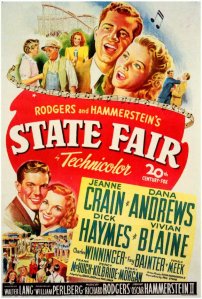
StateFairState Fair was the first musical made specifically for film by Rodgers and Hammerstein. Their two previous musical collaborations, Oklahoma! and Carousel, were both stage productions. (Although both would eventually be made into films in the ’50s.) State Fair was based on a novel by Philip Stong that had previously been made into a non-musical film in 1933 with Will Rogers.
Margy Frake (Jeanne Crain) and her brother, Wayne (Dick Haymes), go to the Iowa State Fair with their parents (played by Fay Bainter and Charles Winninger) and their prize hog, Blue Boy. Margy and Wayne are both somewhat dissatisfied with their current significant others, and each find someone a whole lot more exciting at the fair; she a cavalier reporter played by Dana Andrews and he a flame-haired singer played by Vivian Blaine. Things go well for both, but can their love affairs outlast the fair?

Musically primitive and relentlessly cheery, State Fair injects life into its clichéd proceedings with charm, humor, and some cartoonishly outsized, Technicolor images of middle-American excess. And Andrews (who played the detective in the 1944 noir classic Laura) is rakishly charming, almost but not quite a thug, and always fun to watch.

The True Glory (Aug. 27, 1945)

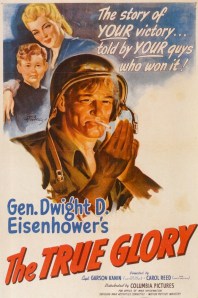
TrueGloryThe True Glory, which was released on August 27, 1945 in the United Kingdom and on October 4, 1945 in the United States, is the granddaddy of every World War II documentary you’ve ever seen on the History Channel. Introduced by the Supreme Commander of Allied Forces in Europe, Gen. Dwight D. Eisenhower, The True Glory tells the story of America and Great Britain’s war against Germany and Italy, starting with the D-Day invasions of June 6, 1944 and ending with V-E Day, May 8, 1945.
The documentary, which won an Academy Award, was pieced together from hundreds of different war photographers’ footage. Several directors worked on the film, but the most commonly credited are Carol Reed and Garson Kanin.

There is some narration, but the majority of the film is told through first-person accounts in voiceover. There are a myriad of British and American soldiers who tell their stories, but there are also the voices of a Parisian family, nurses, clerical staff, an African-American tank gunner, and a member of the French resistance. If you know your World War II history and keep your eyes peeled, you’ll recognize many prominent figures in the footage, including Gen. Eisenhower and Gen. George S. Patton.

Produced by the British Ministry of Information and the U.S. Office of War Information, The True Glory lacks a certain degree of perspective, coming so soon after the end of the war, and is primarily made to celebrate the accomplishments of the Allied forces, but that doesn’t change the fact that the footage is absolutely stunning, and occasionally horrific. The True Glory is a must-see for even the most casual of history buffs.

Lady on a Train (Aug. 17, 1945)

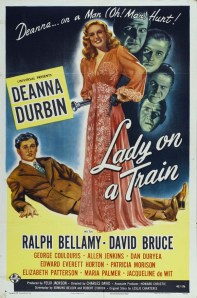
LadyOnATrainDeanna Durbin is an absolute delight in this farcical murder mystery. Durbin, a native of Winnipeg, Manitoba, was once one of the biggest stars in Hollywood, but never made a movie after 1948. (She currently lives in a small village in France, grants no interviews, and is reportedly very happy.) In Lady on a Train, she plays a young woman named Nicki Collins. When the film begins, Collins is sitting by herself in a compartment on a train entering New York on an elevated line. She has come from San Francisco to spend the holidays with her wealthy businessman father, and is currently engrossed in a mystery novel called The Case of the Headless Bride. When the train is briefly delayed, she looks out the window of her train car and witnesses a murder. Through a lighted window, she sees a young man beat an older man to death with a crowbar. She never sees the murderer’s face, however, and when she reports the murder to the police, the desk sergeant dismisses her report as the product of the overheated imagination of a girl who loves murder mysteries and can provide no real specifics of where she was when she saw the murder. Also, it’s Christmas Eve, and who want to traipse around looking for a murder that may or may not have occurred somewhere in Manhattan north of Grand Central Station?
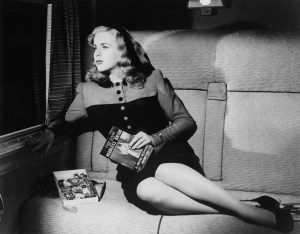
Undeterred, Collins calls up Wayne Morgan (David Bruce), the author of the mystery novel she was reading, and insinuates herself into his life, much to Morgan’s fiancée’s chagrin. After interrupting Morgan on a date at the movies, Collins see the murder victim in a newsreel, and identifies him as Josiah Waring, a shipping magnate. She heads to the Waring estate, where she is mistaken for Circus Club singer Margo Martin, who was Waring’s girlfriend. This allows her to sit in on the reading of Waring’s will, which leaves $1 to his nephew Arnold (Dan Duryea), $1 to his nephew Jonathan (Ralph Bellamy), and the rest of his substantial fortune to Martin.

Sure enough, Collins discovers that Martin has been murdered, throwing suspicion on the Arnold nephews and putting her in a tight spot, since she’s now performing at the club as the murdered girl.

DurbinLady on a Train is part mystery, part musical, part noir, part comedy, and part romance. The most surprising thing about this movie is that each element works perfectly, and they all complement one another. (Calling this film a noir is stretching it, but the final chase in a warehouse contains some striking chiaroscuro shot constructions, and is as tense as one could ask for.) Lady on a Train is also a delight for Durbin fetishists, since she has a different outfit and hairstyle in literally every scene. Sometimes the changes are subtle, but occasionally they’re impossible to miss, such as the scene in which she comes in out of the rain and is suddenly wearing gravity-defying, Pippi Longstocking-style braided pigtails.
Durbin made her film debut in Three Smart Girls (1936) at the age of 14. Apparently she was so popular that she singlehandedly saved Universal Pictures from financial ruin. Here, at the age of 23, she’s a joy to watch. Unlike a lot of former teen stars, she reached maturity while retaining all of her youthful charm, without ever seeming childish or forced.

Christmas in Connecticut (Aug. 11, 1945)

ChristmasInConnecticutBarbara Stanwyck was a superstar of screwball comedies, and she created one of the all-time great femmes fatales in Billy Wilder’s Double Indemnity (1944). Christmas in Connecticut is one of her minor efforts, but it’s amusing enough, and if you’re specifically looking for a holiday film, you could do a lot worse.
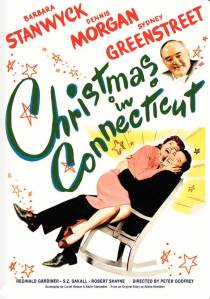
Stanwyck plays a renowned magazine food writer named Elizabeth Lane, a woman whose public persona might remind modern viewers of Martha Stewart. She writes about her perfect life in Connecticut, describing her beautiful snow-blanketed farm, her husband, her child, and the lavish meals she prepares. She has a loyal readership of both men and women. Women aspire to be like her and men dream of having a wife like her. In reality, however, Lane lives in a cramped studio apartment in Manhattan, types her columns next to a hissing radiator, and can’t boil an egg. She’s a talented writer, but that’s it. Her recipes all come from her restaurateur friend Felix (S.Z. Sakall). Her editor, Dudley (Robert Shayne), knows her secret, but her publisher, Alexander Yardley (Sydney Greenstreet), does not, and that’s where the trouble starts. Mr. Yardley thinks it would be terrific publicity to reward a handsome but malnourished young sailor named Jefferson Jones (Dennis Morgan), who survived a German U-Boat attack on his ship, with a Christmas dinner hosted by Lane and her husband. Who does not exist. At a country home that does not exist.

In classic screwball comedy fashion, confessing right away and letting the chips fall where they may does not even qualify as Plan C, so Lane enlists the help of an accomplice, her friend John Sloan (Reginald Gardiner), a pompous ass who keeps proposing to her even though she has no interest in marrying him. She agrees to finally get hitched if only he’ll go along with her deception. The fact that he owns a farm in Connecticut is key, as well. He doesn’t have a baby, but they can always borrow one from a neighbor, right?

It should go without saying that Jones and Lane are attracted to each other, but their incipient romance is complicated by the fact that Lane is pretending to be married with a child. When the film first came out, the NY Times review said that “Peter Godfrey, the director, has a good deal to learn about the art of telling a boudoir joke in the parlor and getting away with it.” Modern viewers, however, will probably find most of the jokes fairly tame. Jones’s seeming willingness to cuckold Lane’s “husband” does reach a fever pitch toward the end, but nothing very lascivious comes of it.

West of the Pecos (Aug. 10, 1945)

WestOfThePecos
West of the Pecos (1945)
Directed by Edward Killy
RKO Radio Pictures

After recently seeing early performances by Robert Mitchum in two top-notch World War II films, Thirty Seconds Over Tokyo (1944) and Story of G.I. Joe (1945), I was a little disappointed by his starring role in West of the Pecos. Mitchum is one of my favorite actors, and he’s always interesting to watch, but this movie is hard to take very seriously.

After small roles in a variety of films (including some Hopalong Cassidy westerns), and a larger role in William Castle’s B noir When Strangers Marry, Mitchum was signed to a contract by RKO, who needed a B western star in the Tim Holt mold. I haven’t seen the first western Mitchum made for RKO, Nevada (1944), which is based on a Zane Grey novel, but if it’s anything like West of the Pecos, I don’t think I’m missing too much. Like Nevada, West of the Pecos is also based on a Grey novel, and is typical “romance of the West” malarkey. In terms of plot and character development, it has more in common with 19th-century stage drama than anything else.

In West of the Pecos, Barbara Hale plays a young Chicagoan named Rill Lambeth, whose father, Col. Lambeth (Thurston Hall), is ordered out west for his health. The two of them travel by stagecoach to Texas with their French maid, Suzanne (Rita Corday). In the course of their travels, they cross paths with Pecos Smith (Mitchum), an outlaw who’s seeking revenge against the corrupt vigilantes who killed his best friend. There are plenty of western tropes in West of the Pecos, like shootouts and unconvincing portrayals of Mexican bandits (Richard Martin plays their leader), but at its heart it’s a light-hearted romance and cross-dressing farce. Soon after her arrival in Texas, Hale decides to dress as a boy to dissuade all the nasty cowboys she meets from sassing her. To say she makes an unconvincing fellow would be an understatement. Her long, flowing hair is simply piled up and pinned under a ten-gallon hat, and all she does to hide her pretty face is rub a little dirt on it.

Part of the problem is Mitchum. Even here, in one of his first roles, he’s simply too world-weary and knowing. Consequently, it’s hard to tell most of the time if his character is supposed to be convinced by Hale’s drag, or if he’s just playing along for his own amusement, like when he rubs her face and says, “You’re just a kid! I bet you haven’t even started shaving. How old are you, anyhow?” Hale petulantly responds, “Old enough.”

Their relationship is based on kidding around, but it’s so flirtatious that I was actually surprised at the end when Mitchum’s character acted shocked when he found out Hale was really a young woman. He plays all their scenes together as if he has every idea what’s going on. Take, for instance, the scene by the campfire in which Mitchum tries to convince Hale to get in his bedroll with him on account of the nighttime chill. He rolls over on his side, faces her, and throws the blanket aside.

“C’mon, kid, get in,” he says.

“But … I want to sleep alone,” she responds.

“Ah, no you don’t. C’mon. Get in and cuddle.”

“Cuddle?!?”

“Sure. Keep each other warm. And I hope you haven’t got cold feet.”

“Cold feet?” she says, too quietly for him to hear. “I got ’em right now.”

It’s interesting to see Mitchum in this type of role. Not too long after appearing in this film, he would receive the only Oscar nomination of his career, for his role in the much better film The Story of G.I. Joe. After that, his days of starring in movies like this were pretty much over. Not every picture he made was great (some of them were even pretty bad), but by 1946 he was on his way to becoming an A-list actor, and eventually a Hollywood legend.

The Woman in Green (July 27, 1945)

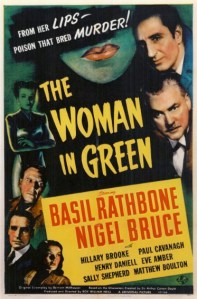
WomanGreenRoy William Neill’s The Woman in Green is the eleventh film Basil Rathbone and Nigel Bruce made together in which they played Sherlock Holmes and Dr. Watson, respectively. It’s perhaps not the best in the series, but it presents an excellent mystery, and offers everything fans of the previous Sherlock Holmes films will look for. There are gruesome yet puzzling clues, a pretty young woman who comes to Holmes for help, a bewitching femme fatale, a clever blackmailing scheme that involves hypnosis, and Professor Moriarty behind it all.

This was only the third time that Moriarty, Holmes’s archenemy and “the Napoleon of crime,” showed up in the series. The first time was in The Adventures of Sherlock Holmes (1939), when he was played by George Zucco. The second time was in Sherlock Holmes and the Secret Weapon (1943), when he was played by Lionel Atwill. Somewhat confusingly, all three men also appeared in different roles in Universal Pictures’ Sherlock Holmes series. Zucco and Daniell even appeared together as cooperating villains in Sherlock Holmes in Washington (1943). If I had my druthers, Zucco would have played Moriarty in all three films, since he’s my personal favorite, but we can’t always get what we want. And apparently Rathbone named Daniell as his favorite Moriarty, so clearly it’s just a matter of taste. Daniell was certainly one of the more dependable Hollywood villains of the ’40s. He was smooth and sophisticated with just the right touch of menace.

When The Woman in Green begins, Moriarty is presumed dead, since he is believed to have been hanged in Montevideo. Meanwhile, Holmes has his hands full in London with a series of mysterious murders. Young women are being killed, and in each case one finger is missing from the corpse. Aside from that one detail, however, there is no connection between any of the murders, and Scotland Yard can’t make heads or tails of the case. When a young woman named Maude Fenwick (Eve Amber) comes to Holmes for help, however, things start falling into place. She’s worried about her father, Sir George Fenwick (Paul Cavanagh), who has been acting very strangely ever since he took up with an alluring and mysterious woman named Lydia (Hillary Brooke). When Maude catches her father trying to bury a finger in his garden, she realizes it’s time to enlist the help of the great detective.

The way the mystery unfolds is satisfying, if somewhat fanciful. One has to suspend some disbelief in order to go along for the ride, but what else is new?