Category Archives: 1946

The Razor’s Edge (Nov. 19, 1946)

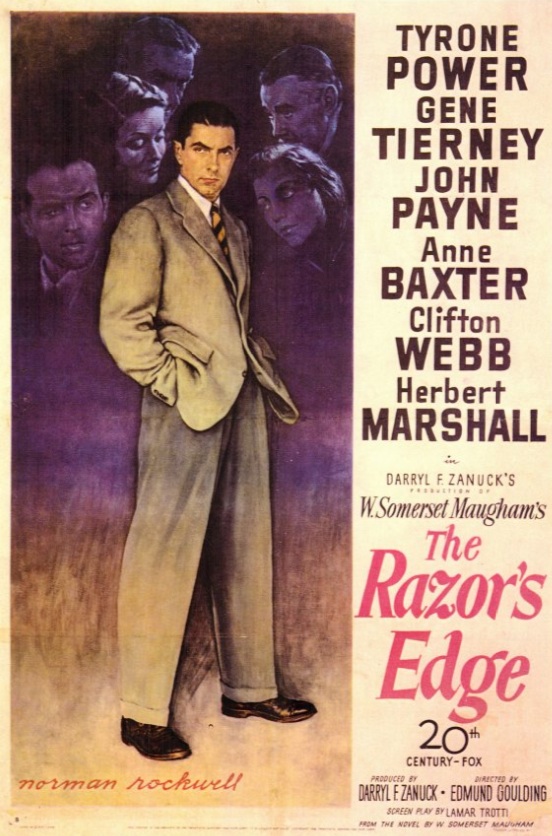
Edmund Goulding’s The Razor’s Edge, based on the best-selling 1944 novel by W. Somerset Maugham, features an Academy Award-winning performance by Anne Baxter in a supporting role, great-looking sets, deliciously bitchy acting by Clifton Webb, and a chance for Tyrone Power and Gene Tierney to show that they were better actors than they are usually given credit for.

So why didn’t I like it? Everything about this film reeks of “Oscar bait.” It’s high-minded, pretentious, and self-important, but ultimately shallow. There are a number of interesting characters in the framing sections of the film, but the central story about a young man named Larry Darrell (Tyrone Power) seeking enlightenment in Eastern spirituality falls flat, and everything else in the movie hangs on it.

Darrell is a veteran of the Great War who returns home to Chicago in 1919 questioning life after a fellow soldier — a friend of his — died saving his life. His confusion and guilt lead him to reject ordinary life and travel the world searching for meaning. He leaves behind his fiancée, porcelain-skinned beauty Isabel Bradley (Gene Tierney), as well as a sharply drawn cast of supporting characters; Isabel’s uncle, the fabulously wealthy and snobbish Elliott Templeton (Clifton Webb), the tragic hanger-on Sophie MacDonald (Anne Baxter), and “regular guy” Gray Maturin (John Payne). Just as in the novel, Maugham himself (played by Herbert Marshall) pops in and out of these characters’ lives.

When Tyrone Power first appears in the film, the character of Maugham says in voiceover, “This is the young man of whom I write. He is not famous. It may be that when his life at last comes to an end, he will leave no more trace of his sojourn on this earth than a stone thrown into a river leaves on the surface of the water. Yet it may be that the way of life he has chosen for himself may have an ever-growing influence over his fellow men, so that, long after his death perhaps, it may be realized that there lived in this age a very remarkable creature.”

Maugham’s words are prophetic. In the decades after he wrote The Razor’s Edge, many young men (and some women) would seek wisdom and enlightenment just as Larry does, traveling the world working a series of menial jobs and seeking truth in non-Christian religions.

While working in a coal mine in France, Larry plays cards and drinks with an old man who eventually turns out to be (unshockingly, based on the dialogue that passes between them) a defrocked priest running away from himself. The priest tells Larry of an Indian holy man who is vastly wise, and who may be able to set Larry straight.
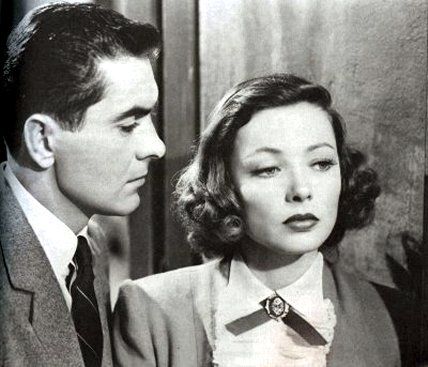
Larry makes his way to India, and it was at this point that — at least for me — the movie took a nosedive. While all kinds of terrible things are happening to the other characters — Isabel is in a loveless marriage, Sophie loses her baby and becomes an alcoholic, etc. — Larry hangs out in a set that looks left over from Anna and the King of Siam and studies with an Indian guru who is ridiculously played by British actor Cecil Humphreys. The holy man speaks only of “God,” nothing specific, and certainly nothing polytheistic. His mysticism is inoffensive New Age stuff along the lines of Deepak Chopra’s vague aphorisms.

After Larry learns all he can from books, the holy man sends him on a pilgrimage to the mountains, where he receives “enlightenment” in the form of a matte painting of sun bursting out from behind the clouds and one last mealy-mouthed conversation with the guru.

All of this might have been meaningful in the novel. I can’t say, as I haven’t read it. But at least in this film, Larry’s spiritual journey is a bunch of vague nonsense that trades on the supposed exoticism of the East without actually including anything strange or specific enough to offend Peoria. Worst of all, he returns to his circle of friends, who are now bumming around Europe, with what amounts to a bag of parlor tricks. He does some hypnosis, forcing his friend Gray to drop a coin after he counts to ten and then tells Gray that he will feel pain no longer. Stuff like that. I was surprised he hadn’t learned to turn himself invisible, like Lamont Cranston in The Shadow.

When the movie ends, we’re supposed to believe that everyone who came into contact with Larry is better, somehow, because he is possessed of the most powerful force in the universe, goodness. But what is it about him makes him so good? He agrees to marry Sophie when she is in the depths of her alcoholism, which leads another character to describe him as being in the grips of self-sacrifice, which seems more apt.

Is Larry a good person because, at the end of the film, he works his way back to America on a tramp steamer? So do legions of cruder, simpler men. Does the mere fact of Larry’s enlightened attitude make his manual labor somehow nobler than the manual labor of “lesser” men? If it does, then why? The film never answers this question, but rather asks us to accept its thesis at face value.

I love all the actors in The Razor’s Edge, and they give some of the best performances of their careers in this film. But while it contains plenty of strong individual scenes, it’s a sodden, overlong snoozefest.

The Chase (Nov. 16, 1946)

Arthur D. Ripley’s The Chase is based on Cornell Woolrich’s 1944 novel The Black Path of Fear, which was adapted as a screenplay by Philip Yordan.

Chuck Scott (Robert Cummings), a sailor who was decorated during World War II, is now bedraggled and broke in Miami. While staring longingly through the window of a lunch counter at a griddle full of bacon and flapjacks, he finds a lost wallet full of $20 bills. He decides to return it to its owner, Edward Roman, whose I.D. says that he lives on Hermosa Drive, but not before he “borrows” a buck and a half to buy himself breakfast.

Eddie Roman (Steve Cochran) turns out to be a smooth-talking criminal who lives in a palatial home with his creepy right-hand man Gino (Peter Lorre) and his beautiful wife Lorna (French actress Michèle Morgan), whom he keeps a virtual prisoner. Roman is sinister right from the get-go, slapping a woman (Shirley O’Hara) who pokes him while manicuring his fingernails before he talks to Scott.

Gino and his boss seem amused by Scott’s honesty. (He even owns up to the 12 bits he liberated.) Roman asks Scott why he brought the wallet back. “Now that I’m here I wonder myself,” Scott says. “I guess I’m just a sucker.”

Roman gives “Scotty” — as he calls him — a job as a driver. Scott doesn’t like or trust either Roman or Gino, but he can’t say no to paying work. Things get weird right away. Roman has a contraption in the back seat that allows him to control the accelerator, speeding the car up to more than 100 m.p.h. to see how Scott handles himself. (My wife probably wishes all cars I drove came equipped with this feature.)

One night, Roman entertains a prominent ship owner named Emmerrich Johnson (Lloyd Corrigan), an overdressed fat man who spends most of his time laughing nervously … he can never quite tell if Roman’s joking or not. Unfortunately for Johnson, he doesn’t see the depths of Roman’s villainy and sadism. He’s never joking.

After Johnson refuses to commit to sell Roman the two ships he wants to buy, Gino takes Johnson on a tour of Roman’s wine cellar. While Johnson is excitedly fussing over a bottle of 1815 Napoleon brandy, Gino slips away and locks Johnson in the wine cellar with Roman’s vicious dog. When Johnson is attacked he drops the bottle of brandy on the floor and it runs out along the floor in a convincing approximation of blood. It’s an old cinematic trick, but a good one.

Meanwhile, Scott and Mrs. Roman are busy falling for each other. After one of their many trips to the beach, where she looks out over the water longingly as he stands behind her, waiting with the car, Lorna offers him $1,000 to take her to Havana. She thinks she can trust him, and she can’t make it on her own. He mulls it over for a little while but quickly gives in, booking passage for two on the S.S. Cuba.

They make it to Havana, but their plan to continue on to South America hits a snag, and Scott finds himself on the run, accused of murder.

Things get really weird an hour into the picture, when Scott wakes up in a room with a bottle of pills on the night table and no memory of what happened to him over the course of the past few days.

I haven’t read The Black Path of Fear, but I have read other novels by Woolrich, and blackouts, amnesia, and lost periods of time were recurring themes in his work. Like a lot of Woolrich’s booze-soaked prose, The Chase starts out as a fairly standard thriller, but by the end it’s hard to tell what’s real and what isn’t. In a better film, like Detour (1945), this could be counted as a real achievement. With The Chase, however, the confusion between dreams and reality seems more the result of slapdash filmmaking than anything else.

Cummings has a pleasant way about him, and is believable as an earnest, soft-spoken Everyman. Morgan is beautiful, but the script doesn’t give her a lot to do. Cochran and Lorre are the real gems in this film. Every scene in which they appear is full of menace. Each man has a calm exterior, but there’s always violence roiling below the surface.

If you’re looking for tight plotting or a clever climax, you won’t find it here, but The Chase has just enough oddball charm to recommend it to noir enthusiasts.

Santa Fe Uprising (Nov. 15, 1946)

R.G. Springsteen’s Santa Fe Uprising was a bittersweet viewing experience for yours truly. On the one hand, I really enjoy this series, based on Fred Harman’s comic-strip cowboy. It’s solid, fun, Saturday matinée entertainment. On the other hand, a big part of my enjoyment came from the wooden, straight-shooting acting style of “Wild” Bill Elliott as Red. Elliott’s persona was so stolid that it seemed tongue-in-cheek, and he had great chemistry with the child star who played his Indian sidekick Little Beaver (Bobby Blake, who later in life would be known as “defendant Robert Blake [9/18/33], aka Michael Gubitosi”).

After starring in 16 Red Ryder pictures from 1944 to 1946, Elliott bowed out and was replaced by square-jawed matinée idol Allan Lane. In the title sequence of Santa Fe Uprising, in which Red Ryder and Little Beaver appear in motion on the cover of a storybook, Lane bears a striking resemblance to Elliott. Up close, however, he’s more traditionally handsome and less interesting a performer.

Still, director Springsteen is a professional, and he keeps things fast-moving and exciting despite a modest budget and familiar shooting locations.

The film takes place in Bitter Springs, New Mexico, in 1894. The action kicks off when the U.S. Marshal for the territory is murdered by stagecoach robbers. The editor of the Territorial Gazette, a man named Crawford (Barton MacLane), demands that his killers be found. There is a toll road that’s safer to travel on than the main road, but the man who owns the property through which the toll road runs demands $3 a head of cattle to use it, which few ranchers can afford. When old rancher Lafe Dibble (Tom London) is killed by bandits, his son, Sonny Dibble (Pat Michaels), vows revenge.

Red takes over as U.S. Marshal of the territory, but he finds himself in hot water when it turns out that Crawford’s motives might not be as pure as they seem. When a man is murdered, and it looks as if Sonny killed him, Crawford and his boys demand that Sonny be strung up despite the fact that he professes his innocence. Things go from bad to worse when Little Beaver is kidnapped, held as a possible exchange for Sonny, after Crawford’s crew fails to bust Sonny out of jail to lynch him.

During the last part of the picture, Red is sleep-deprived after searching for Little Beaver night and day, which leads to a lot of strange acting from Lane, who keeps opening his eyes wide and half-yawning.

But if you’ve ever seen a western programmer before, you know that neither rain, nor snow, nor sleet, nor sleep deprivation shall keep the heroes from their appointed shoot-outs, from which they will always emerge victorious.

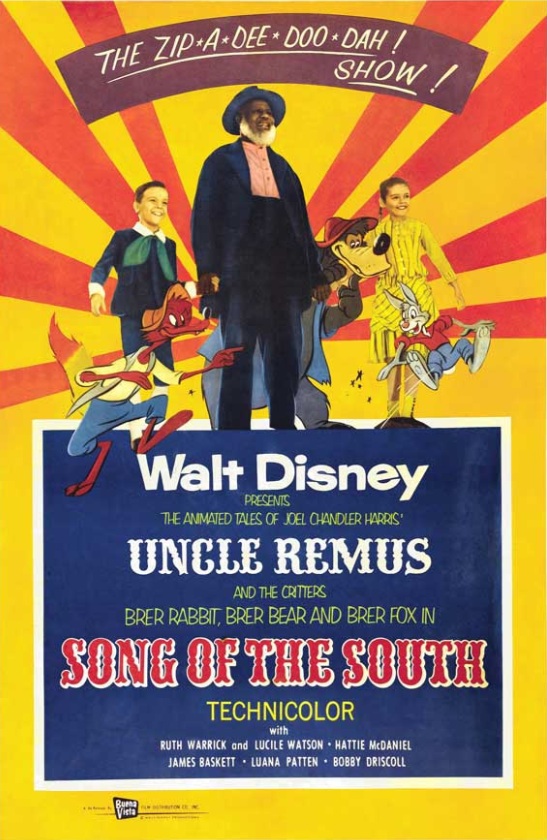
Song of the South (Nov. 12, 1946)


Song of the South
(1946)
Directed by Wilfred Jackson and Harve Foster

Walt Disney Productions / RKO Radio Pictures

Walt Disney’s Song of the South is the first movie I ever saw. (I think my mother may have taken me to some movies when I was a baby, but that doesn’t count.) Seeing it in the theater was a big deal for me. The most sophisticated piece of electronics we had growing up was a KLH radio, and the only time I saw television was at my grandmother’s house. (She had a 13″ black & white Zenith.) I don’t know exactly when I saw Song of the South, but it must have been during the film’s 1980 re-release.

Song of the South premiered in Atlanta on November 12, 1946. It was the first film to have its premiere there since Gone With the Wind in 1939.

Based on Joel Chandler Harris’s books about an old storyteller named Uncle Remus, the film was controversial even before it went into production. In 1944, the Production Code Administration suggested a number of changes to Dalton Reymond’s script to minimize its potential to offend black filmgoers, including the following: that the phrase “old man” be substituted for “old darkie,” that the term “Mister John” be substituted for “Marse Jawn,” and that it be made clear that Uncle Remus belongs to a bygone era. Walt Disney did not, however, take their suggestion that it be made clear that the film takes place after the Civil War, when slavery was abolished, which is what got him into the most trouble.

Disney was not insensitive to the potential that Song of the South had to upset audiences. To deflect some potential flak, he brought in left-leaning Maurice Rapf, an emeritus director of film studies and an adjunct professor at Dartmouth College, to write a treatment of Reymond’s script that had the main white family living in a run-down farmhouse, not a beautiful plantation, and cut out scenes of black plantation workers going about their duties in a happy and docile fashion while singing uplifting spirituals. (Rapf, who was both Jewish and a Communist, denies that Walt Disney was intolerant, and said that while Disney was a conservative, he accepted the political and religious differences of the men who worked for him, many of whom were Jewish and/or leftists.)

For whatever reason, however, all of the aforementioned changes remained in their original form in the final cut of the film. In the cinema section of the November 18, 1946, issue of Time magazine, their reviewer wrote that “Tattered ol’ Uncle Remus, who cheerfully ‘knew his place’ in the easygoing world of late 19th Century Georgia … is a character bound to enrage all educated Negroes, and a number of damyankees.”

Walter White, executive secretary of the NAACP, sent a telegram to the press on November 27, 1946, that said the following: “The National Association for the Advancement of Colored People recognizes in ‘Song of the South’ remarkable artistic merit in the music and in the combination of living actors and the cartoon technique. It regrets, however, that in an effort neither to offend audiences in the north or south, the production helps to perpetuate a dangerously glorified picture of slavery. Making use of the beautiful Uncle Remus folklore, ‘Song of the South’ unfortunately gives the impression of an idyllic master-slave relationship which is a distortion of the facts.”

Ebony magazine was less tempered in their criticism of the film. They wrote, in a full-page jeremiad against the film, that Song of the South promoted “Uncle Tomism as the model of how Negroes should behave in white company.” Of the film’s star, they wrote, “James Baskett, who symbolically enough was taken from the Amos ‘n’ Andy radio show to portray Remus, is an Uncle Tom-Aunt Jemima caricature complete with all the fawning standard equipment thereof — the toothy smile, battered hat, grey beard, and a profusion of ‘dis’ and ‘dat’ talk. He lives up to his ‘lovable’ billing — certainly to Dixie audiences for whom any Negro who bows and scrapes is ‘lovable.'”

Most negative reviews of the film did, however, praise the animated sections of the film, which featured the antics of the crafty Br’er Rabbit, the diabolical Br’er Fox, and the slow-witted Br’er Bear. And the Academy of Motion Picture Arts and Sciences liked Baskett’s performance as Remus enough to give him an honorary award at the 20th Academy Awards in 1948 “For his able and heart-warming characterization of Uncle Remus, friend and story teller to the children of the world, in Walt Disney’s Song of the South.” (On the other hand, this took him out of the running for a real Oscar.)

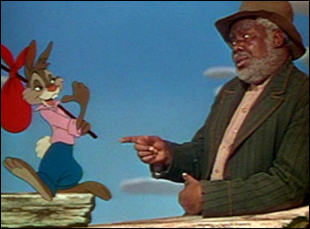
While I don’t disagree with Ebony magazine’s assessment of the character of Uncle Remus, I do think Baskett gives a remarkable performance, full of warmth and humanity. There are some cringe-worthy moments, but overall I was moved by the character he created. It’s worth pointing out that Baskett also provided the voice for Br’er Fox, whose malevolent, mile-a-minute line delivery is so different from Remus’s slow, rich baritone that I never would have guessed it was Baskett’s voice if I hadn’t looked it up.

Remus comes into the life of a young white boy named Johnny (Bobby Driscoll) just when Johnny needs him most. Johnny’s father has left for Atlanta, and the boy wants to run away from home. Unlike Johnny’s mother, Remus understands the psychology of children, and instead of telling Johnny he shouldn’t run away, he gently steers him in the right direction by first agreeing to go with him, then telling him a story about a time when Br’er Rabbit was fed up and wanted to run away from all his troubles.

While the film presents a bucolic and idealized view of the Old South, there’s plenty of sadness, if you care to look for it. Johnny’s friendship with a black boy his own age is presented in a sweet, uncomplicated fashion, but look deeper. When the boy, Toby (Glenn Leedy), comes into Johnny’s room in the morning before a day of playing together, the first thing he does is pour water into the basin on top of Johnny’s bureau. Also, when Johnny runs off, Toby is viciously scolded by the older black servants in Johnny’s family, because it was Toby’s job to care for Johnny. Johnny is still the master and Toby is still the servant, and it’s doubtful that the two would have been able to remain friends into adolescence.

There’s also a running conflict between Johnny and two poor white boys who want to drown the puppy that Johnny got from them. While Uncle Remus scolds the two boys and runs them off when they bully Johnny, his authority only goes so far. When Johnny’s mother orders him to give back the puppy, Remus’s impotent rage is truly heartbreaking.

It’s hard to enjoy the third cartoon segment if you’re preoccupied with wondering whether or not the bad boys drowned that puppy. And while the puppy shows up for the final sequence of the film, the whole thing has a sense of unreality about it, since all the cartoon characters show up to interact with the happy children and Uncle Remus, who rubs his eyes ’cause he can’t hardly believe what he’s seeing! Br’er Rabbit right there? Yes indeed.

While Song of the South was re-released in U.S. theaters in 1956, 1972, 1980, and 1986, it has never been released in the United States on any home video format, and there are currently no plans to do so. Earlier this year, Disney CEO Robert Iger reiterated that there are no plans to release the film on DVD in the United States. He called Song of the South “antiquated” and “fairly offensive.” (Apparently this is something of an annual tradition at Disney shareholder meetings.)

Re-watching this film after 30 years was an interesting experience. While I didn’t pick up on all the subtleties when I first saw the film, I was surprised by how much I remembered. The cartoon sequences are a lot of fun, and the live-action sections contain much that is noteworthy. If Disney had taken Rapf’s advice — or if they had gone even further and removed every human actor except for Baskett and Driscoll — you’d probably be able to buy a deluxe DVD edition of Song of the South this Christmas for your kids.

It’s worth remembering, though, that no matter how the film’s themes had been presented, the star of Song of the South would not have been able to attend the film’s premiere in Atlanta. In 1946, it was still a segregated city. While Baskett would have been able to stay in one of the city’s black-owned hotels, he simply would not have been allowed to participate in any of the public events associated with the premiere.

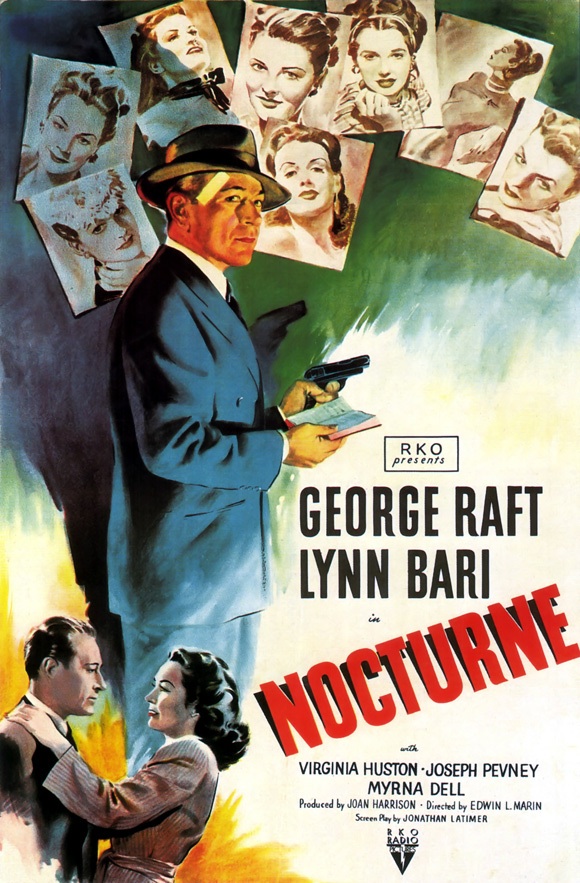
Nocturne (Nov. 11, 1946)

Edwin L. Marin’s Nocturne is close to being a great film noir, but not that close. It’s an entertaining mystery thriller with plenty of clipped, hard-boiled dialogue that’s fun to listen to, if not particularly credible.

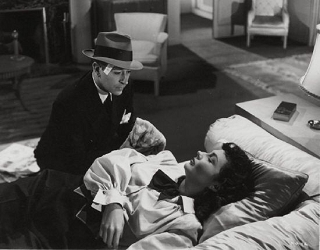
George Raft plays Lt. Joe Warne of the Los Angeles police, and it’s a role that seems designed to play to the public’s perception of Raft as a gangster and a thug. Warne conducts his murder investigation with the subtlety of a steamroller, pushing a mustachioed Lothario into the pool when he gets in his way and ripping up the roll of a player piano in a diner when the owner won’t cooperate with him.

And when was the last time you saw a hard-boiled detective who lived at home with his mother? It’s the kind of oddball detail that feels as if it would be more at home in a gangster movie starring James Cagney.

Raft’s first big role was as Paul Muni’s sidekick in Howard Hawks’s Scarface (1932). After that he starred in a string of gangster pictures, and was one of the most popular actors in crime melodramas, along with Cagney and Edward G. Robinson. His boyhood friendship with gangster Owney Madden and association with men like Bugsy Siegel and Meyer Lansky aided the public’s perception of him as a hard man who didn’t just “talk the talk.”

By the ’40s, however, his star was beginning to fade. Turning down the lead roles in High Sierra (1941), The Maltese Falcon (1941), and Double Indemnity (1944) didn’t help matters. (Raft was reportedly functionally illiterate, which may have made choosing scripts difficult.) It’s safe to say that by 1946, he was getting the scripts that Humphrey Bogart used to line his birdcage.

Raft wasn’t a very expressive actor, and he had the range of a T-bone steak, but his tight-lipped acting style was perfect for B movies like Nocturne.

A flamboyant pianist and composer named Keith Vincent (Edward Ashley) is murdered, presumably by one of the nine brunettes he was running around with. He has glamour shots of all of them lining one wall of his living room, and it’s clear they were all interchangeable for him, since he called them all “Dolores.” (This may seem like a clever device to hide the identity of the murderess from the viewer, but it’s not.)

Lt. Warne investigates with ham-handed glee, and his investigative technique is as sloppy as the filmmaking. For instance, in one scene his chief (Robert Malcolm) bawls him out for bothering a character named “Mrs. Billings,” but apparently her scenes were left on the cutting room floor. This is fine, but why leave references to her in the film? Similarly confusing is the fact that Warne’s chief gives him two days to investigate Vincent’s murder on his own, but we only find this out after the two-day period is over. And it’s only after this two-day investigative blitz that Warne goes back to Vincent’s house and notices that one of the pictures is missing, since the pattern is disrupted, and there’s an enormous nail hole in the wall. Looking at the stamp on the back of one of the other pictures leads him to a sleazy photographer named Charles Shawn (John Banner). Wouldn’t a detective worth his salt have noticed all this immediately?

The most enjoyable thing about this film is the atmosphere. Lt. Warne spends a lot of time in smoky nightclubs, including the unique Keyboard Club, in which a hulking man-child named Erik Torp (Bern Hoffman) pushes a pianist named Ned “Fingers” Ford (Joseph Pevney) and his upright around on a rolling platform so they can take requests, table by table. When they get to Warne’s table, he hands Vincent’s unfinished piece “Nocturne” to Fingers to play. When he reaches the end of the handwritten sheet music, Fingers asks, “What did your friend do, run out of notes?” Warne responds, “More or less.”

Plenty of sex and sleaze run right below the surface of the picture, but it’s all pretty lighthearted. There’s a funny scene in a dance studio in which Warne can’t learn even the most basic steps (it’s mostly funny because Raft was a professional dancer), and his romance with his prime suspect, Frances Ransom (Lynn Bari), doesn’t carry much sense of danger or menace.

Nocturne is a really fun picture, despite its shortcomings. It has some of the snappiest, most hard-boiled, least naturalistic dialogue I’ve heard since I watched The Dark Corner (1946). Fans of B noirs are encouraged to seek out this picture.

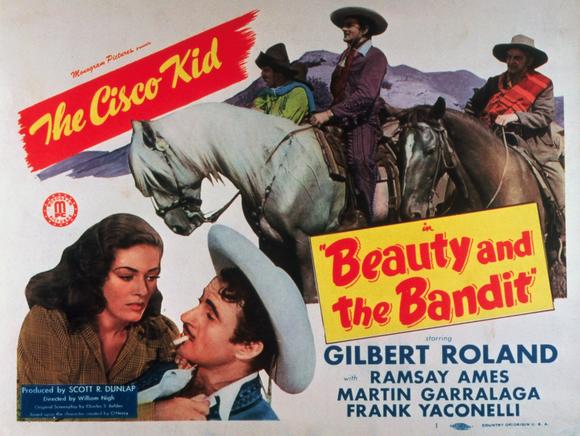
Beauty and the Bandit (Nov. 9, 1946)

Maybe I should stop watching these Cisco Kid pictures. They’re dead-on-arrival Saturday matinées from Monogram Pictures that have now thrice failed to entertain me. After sitting through The Gay Cavalier and South of Monterey, feeling like a drunk who’d fallen asleep in a grindhouse on a Friday night in 1946 and woken up the next morning surrounded by kids yelling at the screen and throwing popcorn at each other — too hungover to get up and leave — I figured I could call it quits with the series and not miss much.

But Gilbert Roland is a lot of fun to watch as Cisco. While these movies seemed pitched at a pretty young audience, his smooth line deliveries and double entendres are clearly aimed at adults. And the presence of Ramsay Ames as the heroine made it hard to say no to Beauty and the Bandit. I fell in love with Ames in the Universal horror picture The Mummy’s Ghost (1944), and will watch her in anything, although in both Cisco Kid pictures I’ve seen her in she’s skinnier, less voluptuous, and a little harder-looking than she was in her earlier horror-movie appearances in The Mummy’s Ghost and Calling Dr. Death (1943).

In the first scene of the film, Cisco (Roland) gets a tip from his old friend Sailor Bill (Glenn Strange) — who has given up a life of crime for a home, wife, and eight children — that a young Frenchman is traveling to San Marino with a chestful of silver. This young man is played by Ames, who is the least convincing young “man” I’ve seen since Barbara Hale put on drag in West of the Pecos (1945). Perhaps this is by design. If Ames was convincing as a fellow, the scene in which Roland leans forward and lights her cigarette would be the most homoerotic image of 1946, since they stare at each other with more heat and longing than you’d see during a day at the beach with Cary Grant and Randolph Scott.

Later he teaches Ames to drink tequila (with lemon and a little salt) and engages in all manner of sexual teasing, like trying to sleep in her bed and then kicking her out when she objects.

Once the idiotic cross-dressing subterfuge is done away with, Ames looks great in a pair of pants and boots. She has more swagger dressed in men’s clothes with her long hair free than she does in drag, but her accent is still all over the place, and the “n’est-ce pas” that often ends her lines sounds about as French as Steve Martin playing Inspector Clouseau. Her character, Jeanne Du Bois, is trying to buy land from the disgraced and drunken Dr. Juan Valegra (Martin Garralaga), land which was stolen, and which Cisco wishes to return to the peasants. His devotion to the Mexican people of Old California gets in the way of his romance with the headstrong Jeanne, but as usual, a good spanking fixes her right up.

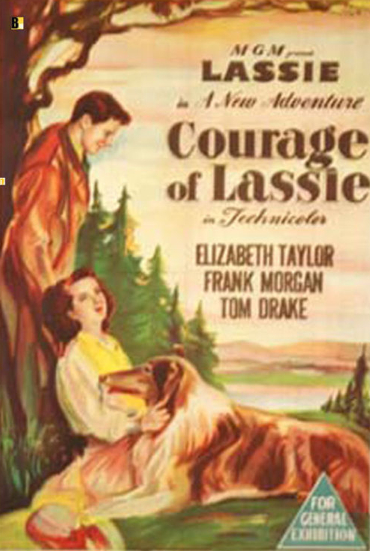
Courage of Lassie (Nov. 8, 1946)

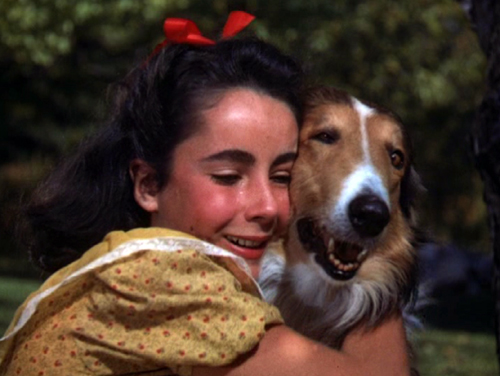
Pal rides again! In Fred M. Wilcox’s Courage of Lassie, the irrepressible little scamp from whose seed all dogs who ever played Lassie are descended plays an orphaned collie. The little guy is left behind in an idyllic, Technicolor wilderness after the old fisherman who owns Lassie rows off with her and what he thinks are all of her puppies.

There follows a delightful montage of the little collie frolicking in the woods for days with birds, other four-legged beasties, and even a big black bear. This being a kid’s movie, however, you can be sure that gut-wrenching tragedy is right around the corner. Sure enough, the collie puppy and his little fox friend are caught in stormy rapids, and the fox is washed away, presumably to his death. The puppy, balanced on a tangle of branches, safely makes it to shore. Seemingly unfazed by his little buddy’s demise, the puppy’s next move is to happily run off with Elizabeth Taylor’s pants, and a lifelong bond is formed.

Taylor was 14 years old when she appeared in this film. Just like Pal, she’s playing a different role than she played in the film Lassie Come Home (1943). I think Taylor was a fantastic child actor. Just like in National Velvet (1944), she takes material that could be laughable or treacly and performs it with such conviction that you can’t help but be swept along. As Kathie Merrick, she believes in her dog, whom she names “Bill,” even though her family doesn’t think he has what it takes to be a sheep-herding dog.

By the end of the film Bill will prove that he not only has “the right stuff” in the pasture, but that he can be drafted and serve under heavy fire just like any other red-blooded American boy.

Bill goes through a lot in this film. He’s shot by a couple of dopey young hunters with quick trigger fingers, he’s run over by a truck while herding sheep across the road (and carried off by the well-meaning driver who doesn’t realize Bill belongs to someone), he’s renamed “Duke” at Dr. Colman’s Dog and Cat Hospital in the big city, and he’s trained for war and shipped off to the Aleutians to fight the Japanese.

“Duke” performs bravely despite a bloody neck wound, dragging himself through the mud to deliver a message, then leading the reinforcements back to the troops. He saves the day, but suffers from shell shock. He escapes the train that is taking him home and runs off into the area of the country where he remembers being with Kathie. Unfortunately, his PTSD has taken a toll, and he lives as a feral animal, raiding hen houses and killing local livestock. Kathie saves him from a farmer’s bullet, but he’s still put on trial as a mad dog.

Things look pretty grim for Bill until Harry MacBain (Frank Morgan, who played Prof. Marvel and the Wizard in The Wizard of Oz) makes an impassioned plea for understanding. This is the most interesting part of the film, since MacBain has looked up Bill’s war record, and his speech is a thinly veiled reference to human veterans who may be acting differently after their service overseas. Violent, antisocial behavior and drastic personality changes can be a byproduct of serving in combat, he says, and we on the homefront shouldn’t be so quick to judge our returning veterans. Even if they’re not lovable border collies.

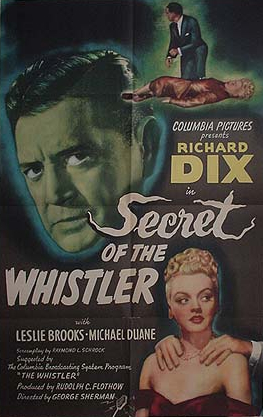
Secret of the Whistler (Nov. 7, 1946)

Secret of the Whistler
Secret of the Whistler (1946)
Directed by George Sherman
Columbia Pictures

George Sherman’s Secret of the Whistler is a solid but unremarkable entry in Columbia Pictures’ series of bottom-of-the-bill programmers based on the radio show The Whistler. Each film in the series starred Richard Dix, a he-man of the silent era whose star was fading. Dix delivered sweaty, paranoid performances in a variety of roles in The Whistler series; businessman, drifter, private investigator, homicidal maniac. His health may have been failing, but he was still a solid performer.

In Secret of the Whistler he plays a painter named Ralph Harrison who is living the high life on his wealthy wife’s dime. He throws lavish parties in his studio/bachelor pad for people who aren’t really his friends, but who don’t mind eating his food and drinking his booze. Among the many attractive young women who pose for Harrison for big money is Kay Morrell (Leslie Brooks), a beautiful blonde with gams that won’t quit.

Meanwhile, Harrison’s wife, Edith Marie Harrison (Mary Currier), lies in bed at home, at death’s door. When the film begins, Harrison seems to genuinely care for his ailing wife, and she adores him. Slowly but surely, however, Harrison begins to fall for Kay. (And after the scene in which she poses for him wearing a small one-piece undergarment, I thought to myself, “Who wouldn’t?”) He buys her expensive presents and lavishes her with attention. His wife isn’t long for this world, so what’s the harm?

The only problem is that Mrs. Harrison comes under the care of a specialist, and makes a miraculous recovery. (Her cardiologist’s course of therapy seems to mostly involve getting out of bed and taking long walks, which is still good advice today.) When she drops by her husband’s studio unannounced, however, her excitement turns to horror when she overhears her husband pitching woo to Kay. She suffers a major setback and promises to write Ralph out of her will.

Fans of The Whistler radio show will have no trouble predicting what will happen next, or the panoply of complications that will arise. True to the radio show, the Whistler himself shows up several times in the film, always as a dark silhouette or a shadow thrown on a wall, speaking directly to Harrison and revealing his murderous thoughts.

The screenplay for Secret of the Whistler by Richard H. Landau and Raymond L. Schrock is the most thematically similar to the radio show of all the films in the series I’ve seen so far. If murdering your wife was your thing, The Whistler was the best show on the air. Nearly every week it seemed as if someone’s spouse was being bumped off for an inheritance and a chance at life with a younger boyfriend or girlfriend, although things never went according to plan.

With a little more than double the running time of a typical episode of the radio show, Secret of the Whistler has more time to develop its characters and its story. On the radio, there just wouldn’t be enough time to show Ralph’s tepid devotion slowly changing to disinterest. At the same time, though, the film feels a little longer than its 65-minute running time, and while its twist ending is good, it doesn’t have the devious ingenuity of the best twists of the radio show.

Still, this is a really good mystery series, with heavy doses of noir atmosphere and performances by Dix that are always interesting to watch. Secret of the Whistler is a lesser entry in the series, but it’s still a pretty good one.

Wanted for Murder (Nov. 2, 1946)

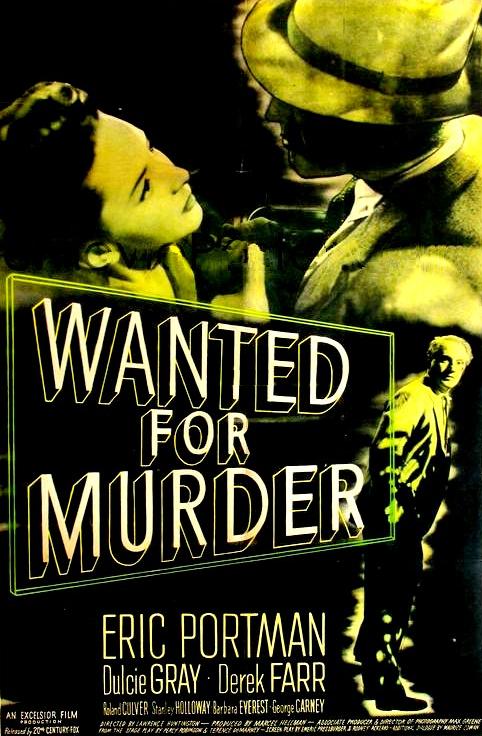
Lawrence Huntington’s Wanted for Murder, which was originally released on June 17, 1946, in the U.K., premiered in the United States on November 2, 1946. It’s an effective chiller with a dependable cast and an excellent screenplay by Rodney Ackland and Emeric Pressburger, based on the stage play by Percy Robinson and Terence de Marney.

The film boasts a terrific sense of place, with scenes filmed in Hampstead Fairground, Madame Tussaud’s wax museum, and the center of London (which, when necessary, appears as rear screen projection stock footage, a technique that can be distractingly fake-looking but here is done fairly skillfully). There are also several atmospheric nighttime murder sequences in Hampstead Heath, Regent’s Park, and Hyde Park.

Particularly effective is the music by Mischa Spoliansky, whose pop-orchestral tune “A Voice in the Night” is a motif that follows the murderer around like his shadow, and which you’ll be hard-pressed not to hum after seeing this picture.

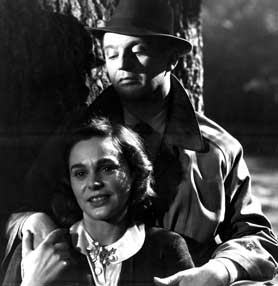
Eric Portman plays middle-class mummy’s boy Victor James Colebrooke, a man who feels haunted by the specter of his late father, William Colebrooke, an executioner to Queen Victoria whose eerie likeness stands in Madame Tussaud’s.

Colebrooke is a handsome, superficially charming gentleman who drink Hendrick’s Gin, lives at home with his mother and a servant, and whose single-breasted suits often sport a white boutonniere and a pocket square. He’s the embodiment of the British fascination with “the murderer next door” — the outwardly ordinary man whose wife’s remains are bricked up in the basement or who strangles working girls on the weekend.

Wispy brunette Dulcie Gray plays Anne Fielding, a young woman who works in a gramophone shop and is dating Colebrooke. A starry-eyed young bus conductor named Jack Williams (Derek Farr) finds her waiting at the fairgrounds and mashes her as hard as he can. She’s attracted to him, but Colebrooke is manipulative and possessive.

Rounding out the fine cast are Roland Culver as Chief Insp. Conway and Stanley Holloway as Sgt. Sullivan, the two Scotland Yard detectives who are on the trail of the killer. Their scenes are some of the film’s most light-hearted, but they are never less than professional, and are dogged in their pursuit of the strangler.

When the first murder occurs, the audience doesn’t know who the killer is, but we strongly suspect Colebrooke. It’s not long before the film removes any doubt about his guilt, which allows for a more interesting and creepy character study than in a whodunnit, where the murderer’s identity is a secret up until the climax.

Most of the film is a game of cat and mouse, with the detectives fairly certain Colebrooke is guilty, but unable to gather anything but circumstantial evidence.

Meanwhile, Colebrooke goes about his dastardly business at night in the parks, telling young women he takes out on dates and strangles that his name is “Tom Mahon.”

Colebrooke blames his sickness on his father, whose killings were all committed in the course of his duty, but whose grim pride in his work earned him the nickname “The Happy Hangman.” The Freudian-minded viewer might blame his overbearing, possessive mother, but the film itself doesn’t draw any such trite conclusions. His father is just a picture on the wall or — in one scene — a disturbingly realistic wax figure, and his mother isn’t a bad person, even encouraging him to find a nice girl and marry her.

Wanted for Murder is a first-rate thriller. Although the adjective hadn’t been invented when it was made, I’d go so far as to call it “Hitchcockian.”

Nobody Lives Forever (Nov. 1, 1946)

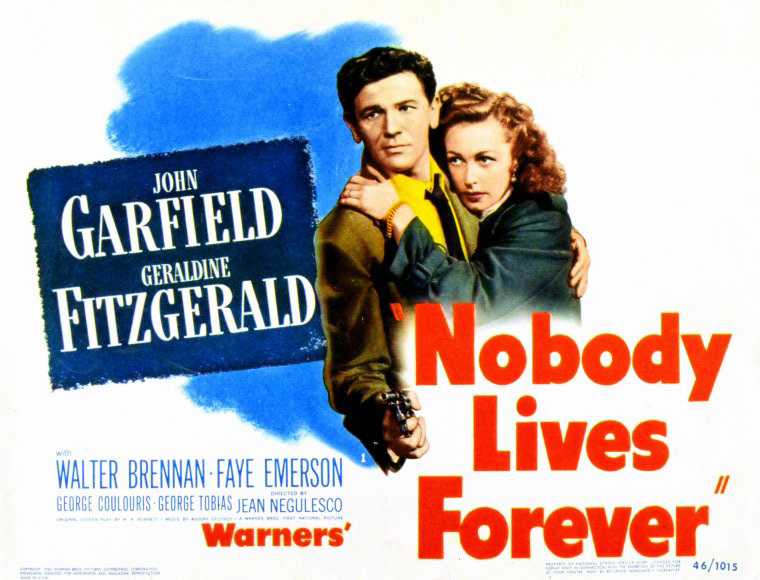
Jean Negulesco’s Nobody Lives Forever is far from a great film, but it’s crackerjack entertainment. Warner Bros. had been making crime pictures for 16 profitable years at this point. While the heyday of the Warner gangster film may have been in the ’30s, this is a fine example of the quality product the studio was still churning out in the post-war era.

The screenplay is by W.R. Burnett, whose 1929 novel Little Caesar was made into a film in 1931 starring Edward G. Robinson — the first of Warner’s great cycle of gangster movies. Nobody Lives Forever is based on Burnett’s novel I Wasn’t Born Yesterday, and while it may not be as significant as Little Caesar, it’s still a tight thriller with plenty of snappy tough-guy dialogue.

Besides the good script and excellent direction, the picture works as well as it does because of impeccable casting. When you’re looking for a hard-bitten but essentially decent con man, you can’t ask for a better protagonist than John Garfield. A kindly, doddering old mentor of cons named “Pop”? Who better than Walter Brennan? A sweaty, bug-eyed, paranoid louse named “Doc” who desperately needs one decent score to get back on top? Is George Coulouris available?

Garfield plays Nick Blake, a World War II veteran honorably discharged after being wounded in action. One of his hands doesn’t close quite right, but other than that he’s none the worse for wear. After his sidekick Al Doyle (George Tobias) picks him up from the hospital in Governor’s Island, they take the ferry back to Manhattan, where he reunites with his girl, Toni Blackburn (Faye Emerson). As she sings “You Again” in a swanky nightclub, Nick follows the mustachioed club owner Chet King (Robert Shayne) into his office to settle a beef over money. Rudi Fehr’s editing in this sequence is superb, cutting between Toni on stage, Al standing guard outside the office, and Nick bracing Chet inside.

After Toni finishes her number, Nick confronts her, then kisses her passionately, then smacks her in the face for double crossing him.

The action soon switches to California, where Al has gotten a line on a widow with a $2 million fortune, which — as Pop points out — is a lot of money, even after taxes. Nick, a handsome “diamond in the rough,” is the perfect candidate to pose as a shipping magnate and charm her out of her cash.

Unlike most long cons, Nick, Pop, Doc, Al, and the other members of their crew meet in smoky back rooms as if they’re planning a bank heist. The only problem with the job is that Nick actually starts to fall for the widow, Gladys Halvorsen (Geraldine Fitzgerald), who turns out to be younger than most widows, and a dish to boot.

When Doc pushes Nick to close the deal, he shoots back, “I’m not used to operating with a bunch of cheap, hungry chiselers who should be in the strong-arm racket. Big deals take time.”

Garfield has great chemistry with his co-stars, particularly the ladies, but the relationships take a back seat to the action, especially during the final climactic 20 minutes.

Sure, there are some holes in the plot, and there’s nothing deep about Nobody Lives Forever, but it’s a hell of a way to kill an hour and 40 minutes.