Tag Archives: 20th Century-Fox

Road House (Sept. 22, 1948)

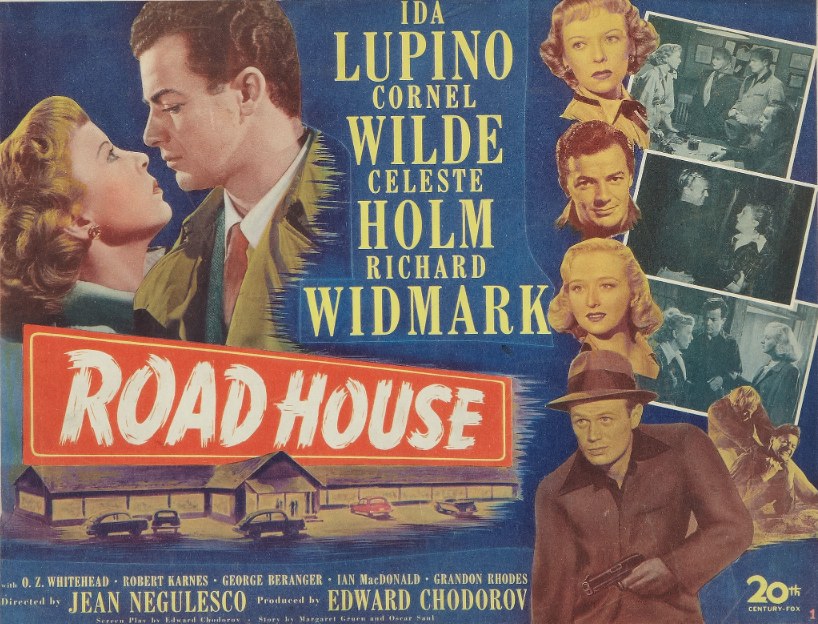
Road HouseThe second feature in our Jean Negulesco double bill is a tad less serious than the first.

Negulesco’s film Johnny Belinda (1948) is the story of a poor, uneducated deaf-mute girl played by Jane Wyman. It was nominated for 12 Academy Awards, and won one — Wyman took home the Oscar for Best Actress.

Road House, on the other hand, was nominated for zero Academy Awards.

But they’re both very good films, and watched back to back, they really show Negulesco’s facility with both A-quality material and B-quality material.

A truly good potboiler is as hard to pull off as a truly good drama is, and Road House is a truly good potboiler.

In an interview he gave in 1969, Negulesco recalled being given the assignment to direct Road House by 20th Century Fox studio head Darryl F. Zanuck. Negulesco said that Zanuck told him, “This is a bad script. Three directors have refused it. They don’t know what they’re doing, because basically it’s quite good. Remember those pictures we used to make at Warner Bros., with Pat O’Brien and Jimmy Cagney, in which every time the action flagged we staged a fight and every time a man passed a girl she’d adjust her stocking or something, trying to be sexy? That’s the kind of picture we have to have with ‘Road House.'”

Negulesco knew exactly what kind of picture he was directing, and he directed the hell out of it. The first shot of Lily Stevens (Ida Lupino) shows her with her bare leg up on a desk. She’s dealing cards alone, and there’s a smoldering cigarette next to her bare foot.

Lupino was smart, sexy, and talented, and she’s a joy to watch in Road House. When she played a singer in The Man I Love (1947), all of her performances were dubbed by Peg La Centra, but this film finally gave moviegoers an opportunity to hear her real singing voice. As Susie Smith (Celeste Holm) says in the film, “She does more without a voice than anybody I’ve ever heard.”

Lupino may not have been the most impressive chanteuse working in Hollywood, but when she sings “One for My Baby and One More for the Road” in Road House, it’s an emotional scene that tells us more about her character than pages of expository dialogue ever could.

http://www.youtube.com/watch?v=h1Q71t5D8ko

Besides the lovely Lupino and the talented Holm, Road House also features chiseled hunk Cornel Wilde. My favorite scene is the one in which he gives Lupino the angriest, most sexually charged bowling lesson I’ve ever seen in a film.

And last but not least, Road House was the third time Richard Widmark appeared on film, and it was the third time he played a memorable villain. He plays Jefferson T. “Jefty” Robbins, the owner of the juke joint that gives the film its name, and his character is a scheming chump who just can’t take no for an answer.

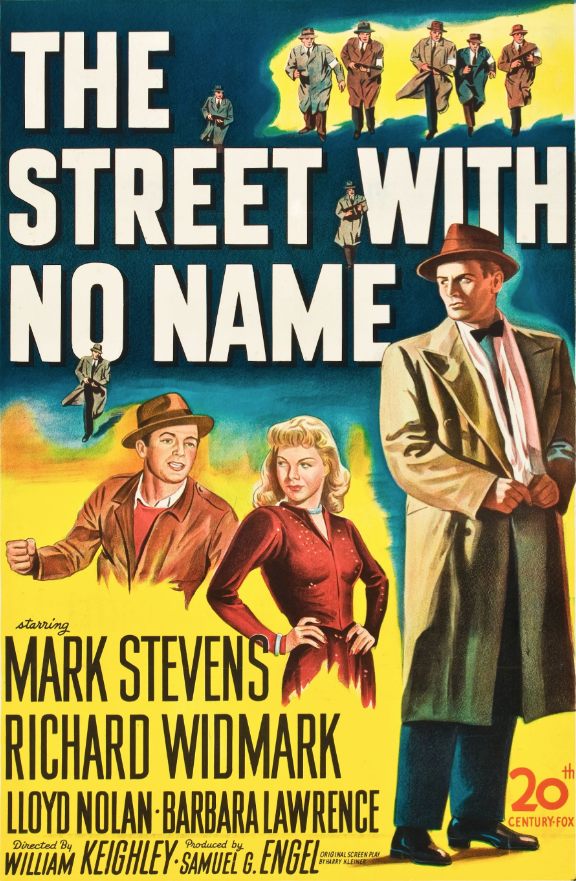
The Street With No Name (July 14, 1948)

By the time William Keighley’s The Street With No Name was released, noirish docudramas were practically a genre unto themselves. The docudrama craze began with The House on 92nd Street (1945), which was loosely based on a real case of nuclear espionage during World War II and was produced by Louis de Rochemont, the creator of the March of Time newsreels.

More “ripped from the headlines” stories followed. Spy thrillers like 13 Rue Madeleine (1947) and The Iron Curtain (1948), tales of miscarried justice like Boomerang (1947) and Call Northside 777 (1948), and even films like Kiss of Death (1947), which wasn’t based on any single real event, but presented its crime story as realistically as possible by eschewing a musical score and filming all the action on location — in prisons, schools, and city streets.

The Street With No Name begins with the following words: “The motion picture you are about to see was adapted from the files of the Federal Bureau of Investigation. Wherever possible it was photographed in the original locale and played by the actual F.B.I. personnel involved.”

Then, a quote from J. Edgar Hoover appears as it is pounded out by invisible hands on a sheet of paper stuck in a typewriter:

The street on which crime flourishes is the street extending across America. It is the street with no name. Organized gangsterism is once again returning. If permitted to go unchecked three out of every four Americans will eventually become its victims. Wherever law and order break down there you will find public indifference. An alert and vigilant America will make for a secure America.

The docudrama that I think The Street With No Name most closely resembles is Anthony Mann’s T-Men (1947), which uses the same kind of “government-approved” patriotic opening, but eventually devolves into a film noir in which the underworld setting and stylistic elements are more interesting than the clean-shaven protagonists. T-Men, however, showed its protagonists becoming drawn deeper into their undercover roles while The Street With No Name doesn’t really develop its protagonist beyond his play-acting heroics.

The Street With No Name opens with a murder at the Meadowbrook night club, a typical road house in a typical city called “Center City.” (The Street With No Name was filmed in and around Los Angeles, and while there is a neighborhood of San Diego called “Center City,” I think that “Center City” was just meant to be a generic name for “Anytown, USA.”)

A second crime by the same masked gang — the murder of a bank guard — draws the FBI into the case, since bank robberies are a federal crime. Leading the investigation is FBI Inspector George A. Briggs, who is played by Lloyd Nolan. (Briggs is the same character Nolan played in The House on 92nd Street.)

According to Briggs, these new gangs are “the juvenile delinquents of yesterday” and they are even more ruthless than the pre-war gangs. The only way to break this gang is to send in an undercover agent.

Enter Mark Stevens as FBI cadet Gene Cordell, who we know is a prime candidate for the assignment because he knows exactly which targets to shoot — and which ones not to shoot — in a Hogan’s Alley sequence filmed at Quantico, VA.

Stevens goes undercover as “George Manly” in the skid row section of Center City, which is full of pool halls, boxing gyms, and peep show machines, and where apparently the only song anyone ever plays on the jukebox is an instrumental version of “I’m Looking Over a Four-Leaf Clover.”

Despite Stevens’s total lack of proficiency in the boxing ring (he looks less competent than Charlie Chapin was meant to in City Lights), the robbery gang he’s after is impressed with his skills and takes him in as one of their own.

The gang’s leader is named Alec Stiles, and he’s played by Richard Widmark. This was Widmark’s second big-screen role, and it’s similar to his first, the psychopathic Tommy Udo in Kiss of Death. Stiles’s teeth aren’t quite as big as Udo’s were, but his maniacal leer is the same. Widmark delivers a good performance, but character details like Stiles’s germaphobia and wife-beating aren’t quite enough to make you forget Udo if you’ve recently watched Kiss of Death.

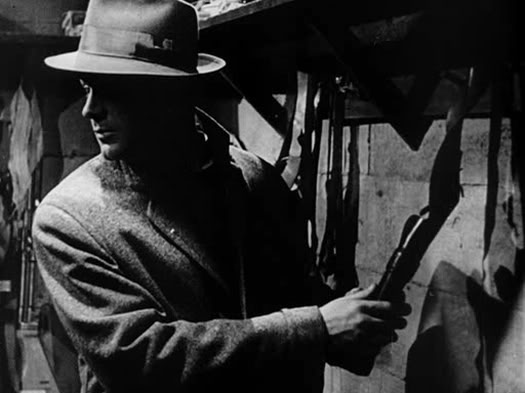
But character details and plot points aren’t what makes The Street With No Name a standout docudrama film noir. What makes the film memorable is the overriding sense of tension and the dark, shadowy cinematography of Joseph MacDonald.

Stevens isn’t as strong a protagonist as Dennis O’Keefe and Alfred Ryder were in T-Men, and the most memorable sequences in The Street With No Name are completely wordless. The first is a chase in a ferryboat station (filmed at the Municipal Ferry in San Pedro, CA) and the second follows Stevens as he tries to get ballistic evidence by breaking into the gang’s weapons cache in a warehouse with Widmark hot on his heels.

Despite a generic story and a bland protagonist, The Street With No Name has great pacing, lots of suspense, style to spare, and a solid villain. I recommend it to all fans of FBI stories and film noir.

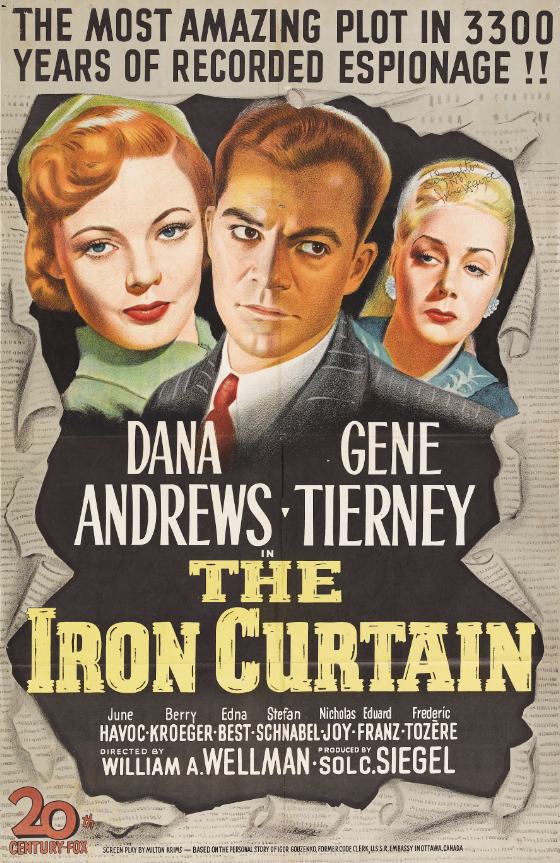
The Iron Curtain (May 12, 1948)

The Iron Curtain
The Iron Curtain (1948)
Directed by William A. Wellman
20th Century-Fox

William A. Wellman’s The Iron Curtain was the first appearance of Dana Andrews and Gene Tierney together in a film since Otto Preminger’s Laura (1944). This really has no bearing on The Iron Curtain, but I love the movie Laura and Andrews and Tierney are one of my favorite screen couples, so it was fun to see them play completely different roles.

The Iron Curtain is the fictionalized tale of Igor Gouzenko, a Soviet code clerk who was stationed at the U.S.S.R. Embassy in Ottawa and discovered that American military secrets and other products of Soviet espionage were being transmitted through his office.

There is the obligatory text preceding the film that tells the viewer that all the documents presented appear exactly as they did in actual court records, as authenticated by the R.C.M.P.

This is a standard opening for a docudrama, which in the late ’40s was sort of a subgenre of film noir, with dramatic lighting, expressionistic camera angles, and subjective storytelling applied to true stories of espionage or miscarried justice, like The House on 92nd Street (1945), 13 Rue Madeleine (1947), Boomerang (1947), and Call Northside 777 (1948). These films used actual locations, documents, and occasionally even the actual participants in historical events to add sizzle to their “ripped from the headlines” plots.

When Gouzenko first arrives in Canada he’s the perfect apparatchik, devoted to Marxism and to the Communist Party. When one of his fellow Soviet embassy workers, Nina Karanova (June Havoc), shows him her spacious, well-decorated apartment, he berates her for her laxity and for being seduced by the trappings of Western decadence. But a chain of events conspires to force Gouzenko to experience some character development. His wife, Anna Gouzenko (Gene Tierney), joins him in Ottawa, and together they experience the friendliness and good hearts of their North American neighbors, and realize that they might have more in common with their “enemies” than they thought. At work, Gouzenko is haunted by the drunken recollections of Maj. Semyon Kulin (Eduard Franz), who murdered some of his own men to force others to “volunteer” for a mission during the war.

When Gouzenko discovers that he is passing classified information from the embassy back to Moscow — American nuclear secrets, the details of a supposedly secret meeting in Canada between FDR and Churchill, details of sleeper agents — he experiences a crisis of conscience, and has to decide if he should turn documents over to the Canadian Minister of Justice and put his life and the lives of his wife and child in danger.

The Iron Curtain is a slick, well-made thriller that doesn’t generate suspense through over-the-top elements like chases or shootouts, but rather through grounded, real-life elements like the threat of the NKVD, the Soviet Secret Police.

When the story of Igor Gouzenko was originally covered by the media in February 1946, it was the beginning of public awareness of the Cold War. The revelation that our former allies were running a spy ring in North America had a profound impact that would last for decades. The Iron Curtain is the earliest film I’ve seen to tackle the looming Soviet menace, and it’s more tasteful and factually accurate than some of the outré Red Scare flicks the ’50s would give us.

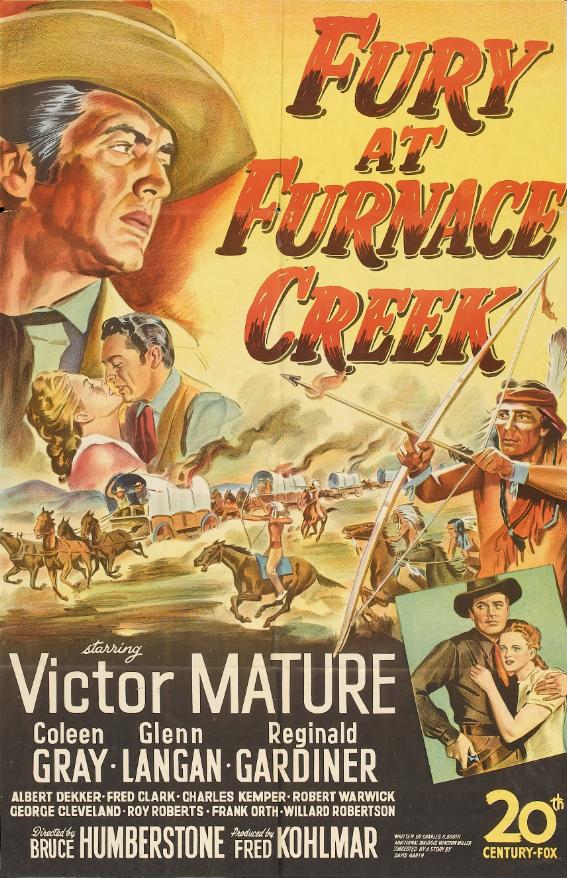
Fury at Furnace Creek (April 30, 1948)

Fury at Furnace Creek might not be a towering classic of western cinema, but I think I flat-out enjoyed it more than any other western I’ve seen recently.

I’ve never been a big fan of Victor Mature, but when he had good material to work with — My Darling Clementine (1946) and Kiss of Death (1947), for instance — he could be an engaging performer. I thought it made a lot of sense for him to play Doc Holliday in My Darling Clementine as a drunk and a gambler, since Mature always looked more at home in a saloon than he did riding the range.

Fury at Furnace Creek allows Mature to stick with this formula, more or less. He plays Cash Blackwell, a fast-on-the-draw gambler who goes undercover to clear his father’s name.

His father, General Fletcher Blackwell (Robert Warwick), died of a stroke during court martial proceedings against him, and not because things we’re going well at his trial. In 1880, the Furnace Hills were still Apache territory, but rumors that the Apaches were using silver in their bullets led to a clamor for the region to be opened to mining. Gen. Blackwell stood accused of issuing an order that left a wagon train unprotected, and the prosecutor implied that this was done purposefully to draw the Apaches into an attack, which directly led to the opening of the area to white settlement.

The evidence is there, too. There is an order, signed by Gen. Blackwell, that supports the prosecution’s case. But even faced with this evidence, Gen. Blackwell still denied ever issuing the order, and he died with the shame of guilt hanging over him.

Enter Cash Blackwell, estranged from his family, but not estranged enough that he doesn’t care about his father’s good name. He goes undercover in Furnace Creek, now a boom town of 10,000 settlers, miners, and merchants. Calling himself “Tex Cameron,” Cash ingratiates himself to the local syndicate by saving the life of Capt. Grover A. Walsh (Reginald Gardiner) at the gambling tables. A gunman named Bird (Fred Clark) planted a card on Capt. Walsh so he could accuse him of cheating and shoot him dead, but Cash sees through the ploy, and puts a bullet in Bird’s gun hand.

“When a man can knock the knuckles off a moving hand at ten paces, I want him on Mr. Leverett’s side,” says Al Shanks (Roy Roberts).

Edward Leverett (Al Dekker) is the head of the Furnace Creek Mining and Development Syndicate, and it’s clear that he’s up to no good, but it’s not clear what his connection to Gen. Blackwell was.

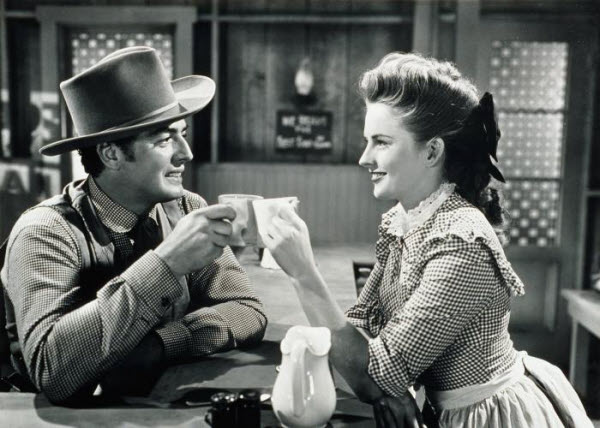
In addition to his detective work, Cash finds time to romance the pretty Molly Baxter (Coleen Gray, who also starred with Mature in Kiss of Death). Molly’s father Bruce died in the massacre at Fort Furnace Creek, and she hates Gen. Blackwell with a passion, potentially complicating things.

And before long, Cash’s brother Capt. Rufe Blackwell (Glenn Langan) also shows up in Furnace Creek with his own plan to clear his father’s name.

Fury at Furnace Creek has a lot of moving parts, but the plot never feels crowded or confusing. Full of coincidences, sure, but not confusing. It’s genuinely suspenseful, and I wasn’t sure how things were going to resolve themselves. It’s a film that occupies the same basic physical space as John Ford’s Fort Apache (1948), but it takes a completely different approach to the western genre. There’s no self-conscious myth-making or grand statements in Fury at Furnace Creek, it’s just a solid, grown-up western with good production values. The music nicely sets the scene, with strains of the cowboy ballad “Bury Me Not on the Lone Prairie” popping up frequently in the score.

The director of Fury at Furnace Creek, Bruce Humberstone (sometimes credited as “H. Bruce Humberstone”), began his career in the silent era and ended up working in just about every genre Hollywood deigned to dip its toe in; musicals, film noir, westerns, war pictures, Charlie Chan mysteries, Tarzan adventures, sports comedies … the list goes on and on. Fury at Furnace Creek is not a great work of art, but it’s made with real flair and craftsmanship. It’s exciting, action-packed, and suspenseful. I enjoyed it a hell of a lot and recommend it to anyone who likes westerns from the Golden Era of Hollywood.

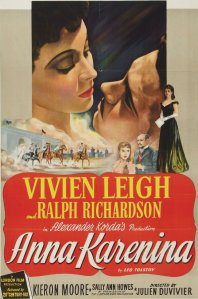
Anna Karenina (April 27, 1948)

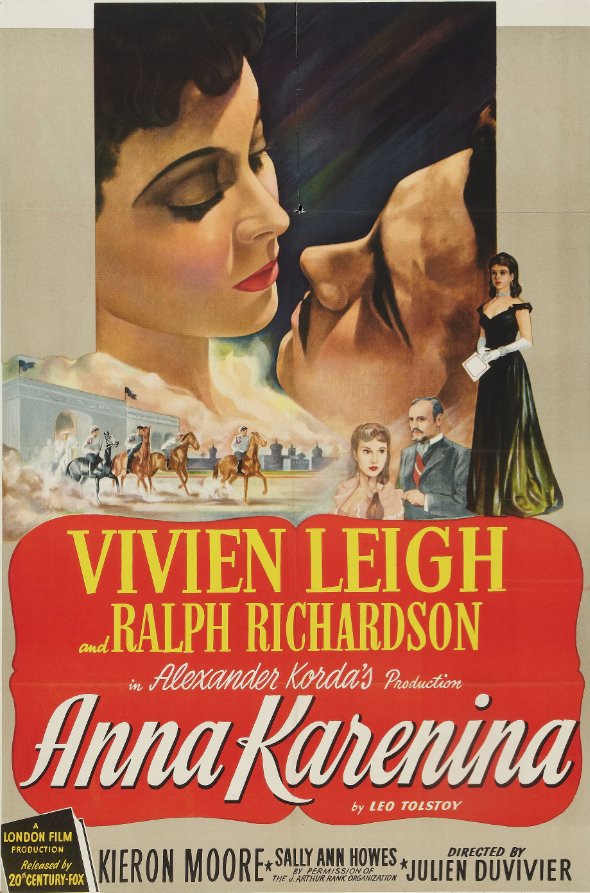
Julien Duvivier’s Anna Karenina was the second non-silent film adaptation of Leo Tolstoy’s novel. It premiered in the U.K. on January 22, 1948, and in New York City on April 27, 1948.

I originally put off watching it because I started reading the novel late last year and wanted to finish it before I saw any film versions.

Alas, I am a slow reader. After pushing Anna Karenina from its January U.K. release date to its April U.S. release date on my “to watch” list, I finally gave up on trying to finish reading Tolstoy’s novel before watching any film versions. (It’s not as if I don’t how the novel ends, and besides, caring too much about “spoilers” is a foolish preoccupation.)

As I mentioned, this was the second adaptation of the novel for sound film, but there were numerous silent versions that preceded both. The first was director Maurice Maître’s 1911 Russian version, which starred M. Sorochtina as Anna Karenina. The second was Vladimir Gardin’s 1914 Russian version, which starred Mariya Germanova. The third was J. Gordon Edwards’s 1915 American version, which starred Betty Nansen. The fourth was Márton Garas’s 1918 Hungarian version, which starred Irén Varsányi. The fifth was Frederic Zelnik’s 1919 German version.

Finally, there was Edmund Goulding’s 1927 silent film, entitled simply Love, which starred Greta Garbo as Anna and John Gilbert as her illicit lover, Count Vronsky.

The first sound version, Clarence Brown’s Anna Karenina (1935), again starred Garbo as Anna and Fredric March as Vronsky. I haven’t seen any of the silent versions, but I recently watched the 1935 version.

There seems to be a general consensus that the 1935 film is the more definitive version, while the 1948 version is well-made but essentially flawed. For me, the 1935 version played like filmed Cliffs Notes. For the first hour of the film, I recognized all the major plot points and important bits of dialogue, enacted in more or less the manner I pictured them, neither failing to meet nor exceeding my expectations. (The next 30 minutes or so went past the point I’ve read up to in the novel, so I can’t speak to them.)
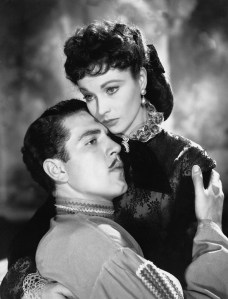
The 1948 version is a less slavishly faithful adaptation of the novel, but I found it a much more satisfying overall film experience.

The music, lighting, cinematography, set design, and costumes are all passable in the 1935 version, but they’re really stellar in the 1948 version. Duvivier’s film evokes 19th-century Czarist Russia in a more powerful and magical way than Brown’s film did. The wintry, nighttime scenes in train stations — so important in the novel — are dark, snow-swept, and full of portent. The interiors are richly appointed and realistically lighted.

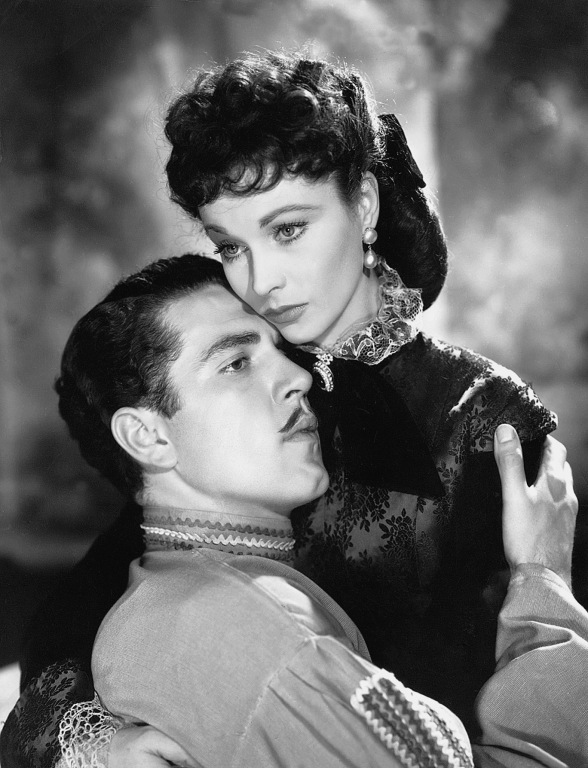
Where Duvivier’s version can’t always compete with the earlier version is in the choice of actors. Fredric March, who played Vronsky in the 1935 version, was for me the most interesting character in the film, while Kieron Moore just doesn’t make as strong an impression in the same role. He’s tall and handsome, but in the end he’s little more than a perfectly coiffed mustache in search of a personality. And Sally Ann Howes, who plays the pretty young Kitty Scherbatsky in the 1948 version, just isn’t as appealing or as good an actress as Maureen O’Sullivan.

Whether or not Vivien Leigh is as good as Greta Garbo, however, is a more difficult question. Garbo casts a long shadow, and is in some sense “untouchable.” For my money, though, Leigh gives a much more interesting performance as Anna. Garbo’s beautiful face is a sort of blank canvas onto which viewers can project their own desires, but Leigh crafts a fully realized character, whether one cares for her or not. In this sense, I think the casting of Moore as Vronsky — the man she falls in love with and destroys her marriage for — actually works quite well. Anna Karenina is not a simplistic novel in which a woman in an unhappy marriage finds true love but is constrained by rigid societal rules. Anna’s essential flaw is that she falls in love with a man who is handsome and charming, but essentially weak, and not worthy of everything she gives up for him. (I’ll still take March over Moore any day, but Moore’s uninteresting performance doesn’t really detract from the greatness of Duvivier’s film for me.)

In the 1935 version, Basil Rathbone gave a terrific performance as Anna’s cuckolded husband, Alexei Karenin, but terrific as it was, it was a one-note performance. Ralph Richardson, however, is just as officious and unlikable in the early going, but he evolves, allowing the viewer to see his pain and anguish despite the fact that Anna is a more natural point of identification.

Of course, what no film can convey is the novel’s epic scope or its meticulously crafted evocation of everyday life. Anna Karenina was published in serial fashion over the course of nearly four years, so characters with whom we spend days, weeks, months, and even years in the novel appear in the film for a few minutes here and there, giving the viewer no real sense of their importance in the grand scheme of the narrative.

But that’s how it goes in the dirty business of film adaptations of great novels.

I liked Clarence Brown’s 1935 version, and I’m glad I saw it, but Julien Duvivier’s 1948 version wove a spell over me. There are certain scenes I can’t stop thinking about, and I loved Vivien Leigh’s performance as Anna. It’s a movie I’m looking forward to seeing again some day. There are many, many film adaptations of Anna Karenina out there competing for your entertainment dollars, and I’ve only seen two of them, but of the two, I much prefer this one.
Call Northside 777 (Feb. 1, 1948)

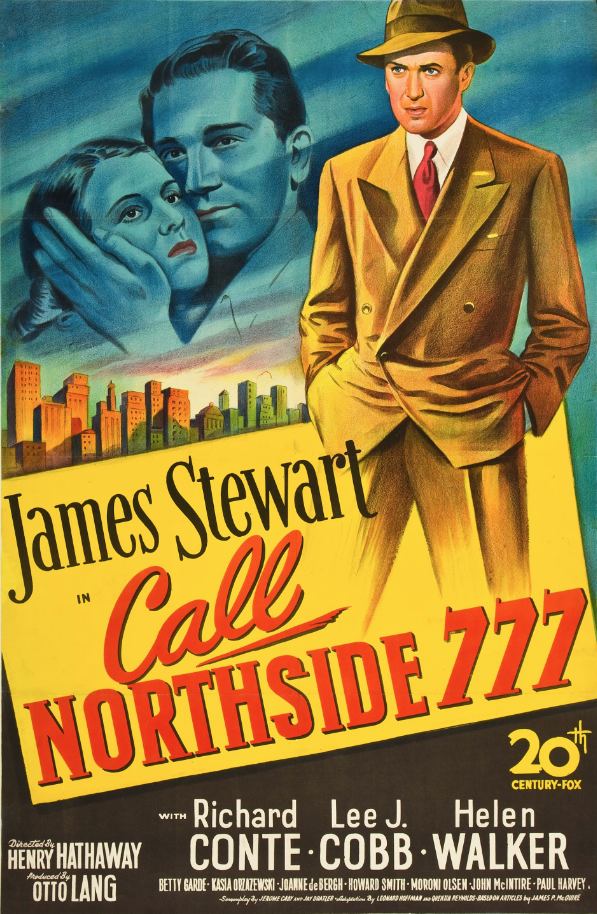
Call Northside 777 is the latest in director Henry Hathaway’s series of fact-based dramas.

Together with producer Louis de Rochemont, the creator of the March of Time series of newsreels, Hathaway made The House on 92nd Street (1945) and 13 Rue Madeleine (1947), which were both based on the wartime exploits of the OSS.

Unlike Hathaway’s previous film, Kiss of Death (1947), which was fiction, but made in a verité style and filmed on location, Call Northside 777 is more in line with Louis de Rochemont’s Boomerang (1947), which was directed by Elia Kazan.

Like Boomerang, Call Northside 777 is about a miscarriage of justice.

In 1933, Joseph Majczek and another man, Theodore Marcinkiewicz, were convicted of killing a Chicago police officer the previous year. In 1944, their convictions were overturned when a crusading reporter named James McGuire helped prove that the eyewitness who gave the testimony that sent the two men to prison had perjured herself under pressure from the police.

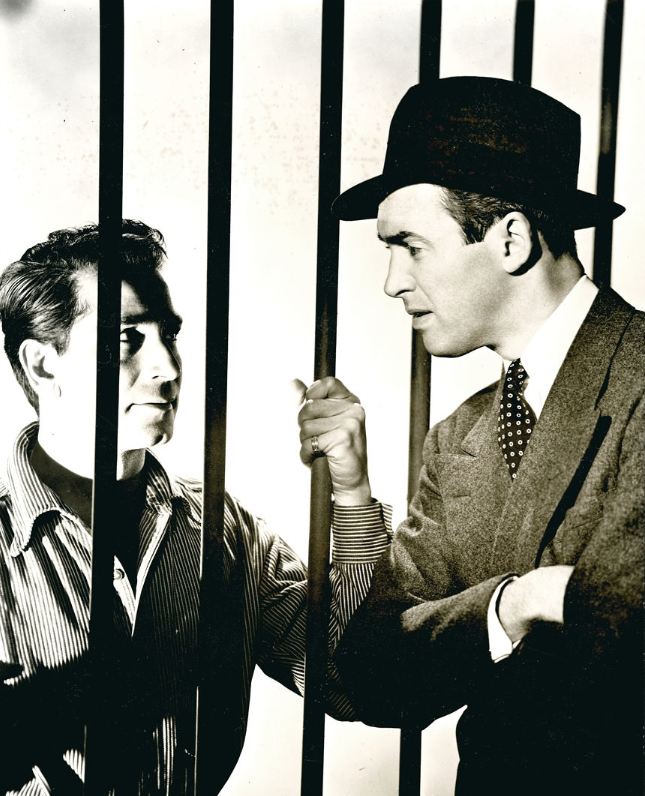
Majczek is renamed “Frank Wiecek,” and he’s played by Richard Conte. The crusading Chicago Times reporter is renamed “Jim McNeal” and he’s played by James Stewart.

McNeal’s editor, Brian Kelly (Lee J. Cobb), spots a notice in the classified section of the Times — “$5000 reward for killers of Officer Bundy on Dec. 9, 1932. Call Northside 777. Ask for Tillie Wiecek 12-7 p.m.” — and sends McNeal to investigate.

Tillie Wiecek (Kasia Orzazewski) is the convicted man’s mother. She earned the $5,000 by scrubbing floors.

After McNeal interviews Mrs. Wiecek, his wife Laura (Helen Walker) says to him, “I wasn’t thinking about the boy, I was thinking about his mother. You know what it is? It catches your imagination. Nobody knows whether she’s right or not. She’s worked so hard, she’s had such faith that, well, I want her to be right.”

McNeal, on the other hand, is hard-nosed and unsentimental about the case. As he tells Wiecek when he goes to prison to interview him, “She believes you. I need proof. This thing’s gotta have sock — mass appeal. It’s the only way we’ll be able to help you.”

Eventually, though, the evidence begins to pile up, and even the cynical McNeal is convinced of Wiecek’s innocence.

Call Northside 777 was released on DVD in 2004 as part of the Fox Film Noir collection, but there’s very little thematically that marks it as “noir.” The closest the film gets stylistically to being a film noir is toward the end of the picture, when McNeal scours the Polish neighborhoods of Chicago in search of the eyewitness in the Wiecek case, Wanda Skutnik (Betty Garde). These scenes are bathed in shadows and shot through with suspense.

For the most part, though, Call Northside 777 is lit and shot in a neutral, docudrama fashion, which is a shame, since it was the first big Hollywood production filmed in Chicago. There are a few shots of the Merchandise Mart, the Loop, and Holy Trinity Polish Mission, but most of the film takes place indoors.

It’s a good film, but since it’s mostly a hidebound retelling of established facts, it’s never as thrilling or suspensful as a piece of pure fiction like Kiss of Death. It’s interesting, for instance, that Leonarde Keeler, the co-inventor of the polygraph, plays himself in the scene in which Wiecek is given a lie detector test, but it’s not really the stuff of great drama.

The best thing about the film is Jimmy Stewart’s performance. He handles his character’s progression from a cynical reporter who’s “just doing his job” to a man who’s finally found a cause worth fighting for wholly believable and thoroughly involving.

http://www.youtube.com/watch?v=7K5G-9CIUBc

Daisy Kenyon (Dec. 25, 1947)

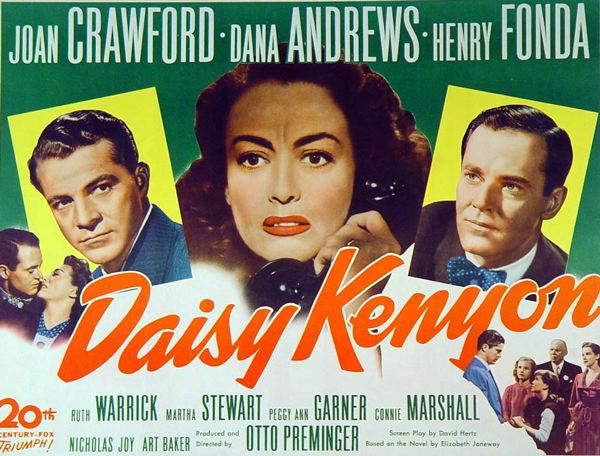
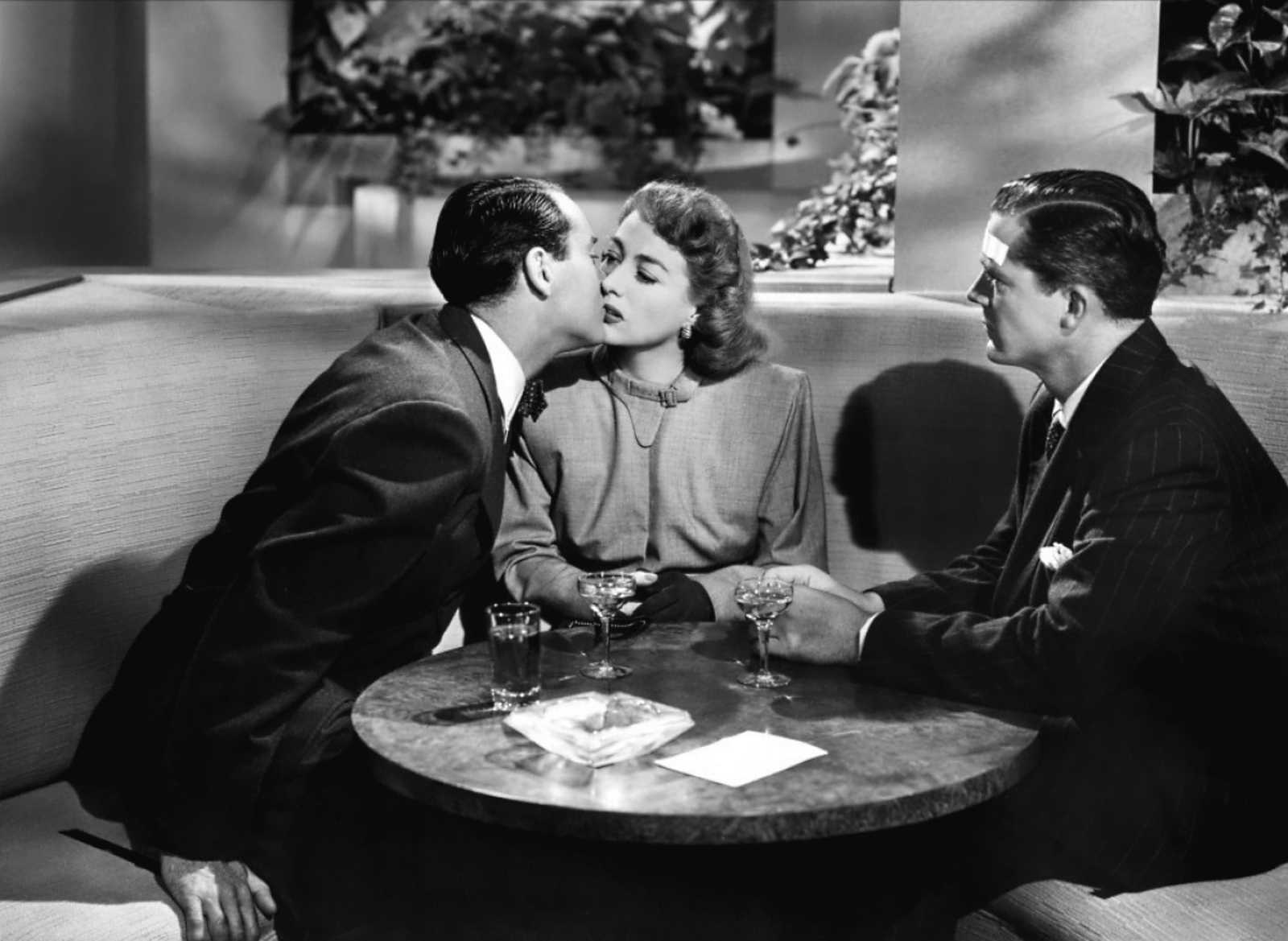
Maybe I’ve been watching too many crime melodramas, but I kept expecting Otto Preminger’s Daisy Kenyon to go in a different direction than it did. It’s a movie that’s often classified as a film noir, and the cinematography by Leon Shamroy is an atmospheric blend of light and shadow. David Raksin’s score is lush and moving. The performances of the film’s three stars are all excellent.

But I kept expecting things to devolve into murderous tragedy, and it was a little disconcerting when they didn’t. Granted, the film was based on a controversial bestseller by Elizabeth Janeway about adultery, so plenty of film-goers in 1947 and 1948 knew exactly what to expect when they bought their tickets. I, on the other hand, was thrown for a loop by how understated and mature the story ended up being.

Daisy Kenyon (Joan Crawford) is a successful commercial artist who is in a long-standing relationship with a married man, a lawyer named Dan O’Mara (Dana Andrews). When the film begins, she’s beginning to realize that Dan is never going to leave his wife for her, even though he loves Daisy very much. This opening put me in mind of Joan Crawford’s last picture, Possessed (1947), which could be why I kept expecting Daisy Kenyon to end in a murder, a suicide, or both.

Another reason is the creepy, shell-shocked performance of Henry Fonda as combat veteran Peter Lapham, the man Daisy hastily marries after she breaks off her affair with Dan.

Interestingly, Daisy Kenyon is a story in which things start to go bad not when an adulterous love affair begins, but when it ends.

Even though there is a good deal of tension in the relationships between the characters in Daisy Kenyon, I didn’t find myself very invested in the story. I did appreciate that it was a well-made film with no real heroes or villains, but it never fully captured my imagination. The last 10 minutes are really good, however, and I honestly didn’t know how it was going to end.

Daisy Kenyon is recommended for Joan Crawford devotees, Otto Preminger completists, and fans of women’s pictures.

http://www.youtube.com/watch?v=a1dRwiSNpJM

Captain From Castile (Dec. 25, 1947)

Henry King’s Captain From Castile premiered on Christmas day in New York and Los Angeles, and went into wide release in January 1948.

It’s a lavish, Technicolor epic marred by a handful of flaws. The biggest flaw is that it doesn’t have an ending, and just sort of stops halfway through. The journey to the non-ending is uneven but generally entertaining and occasionally spectacular, which makes its abruptness all the more frustrating.

Captain From Castile is based on Samuel Shellabarger’s novel of the same name, which was published in early 1945. It was originally serialized, and was incredibly popular even before its publication in book form. Darryl F. Zanuck paid $100,000 for the rights, which was a lot of cabbage in the ’40s.

The film version only covers the first half of Shellabarger’s novel. Zanuck originally planned to exhibit Captain From Castile as a roadshow presentation with an intermission, so I’m not sure if the unsatisfying end was due to budget concerns or a flawed script. Three and a half months of shooting in Mexico wasn’t cheap, and the bottom kind of dropped out of movie-going in 1947 (after 1946, which was the biggest movie-going year of all time). Captain From Castile made its money back and then some, but it wasn’t a runaway success due to its incredibly high budget.

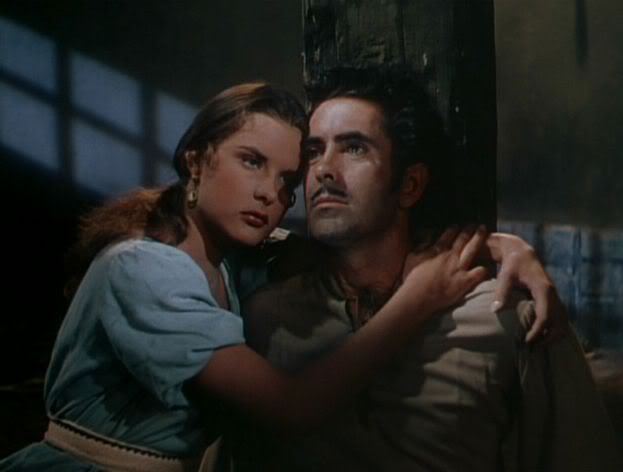
The film begins in Spain in the spring of 1518, and follows the progression of a young Castilian named Pedro de Vargas (played by Tyrone Power) from callow youth to victim of the Inquisition to seasoned soldier under the command of Hernando Cortés in Mexico. (Cortés is played to the laughing, mustache-twirling, swaggering hilt by Cesar Romero.)

Despite the presence of swashbuckling superstar Tyrone Power, Captain From Castile isn’t really a swashbuckling adventure film. It’s a historical epic in which narrative tension is nonexistent for long stretches. All sequences involving the Cortés expedition were filmed in Mexico, and often on the location associated with the actual event. Captain From Castile always looks fantastic, but its story isn’t always up to the high standards of the visuals.

I really love Tyrone Power, though, and with all due respect to Errol Flynn, I think Power is the greatest swashbuckling star of all time. I also think he’s a much better actor than he’s given credit for, and he turns in a strong performance in Captain From Castile.

But moments of real power in the film are few and far between.

There’s one sequence, however, that I think stands as one of the best of Power’s career. After Pedro de Vargas is imprisoned by the Inquisition and his roguish friend Juan Garcia (Lee J. Cobb) has secreted weapons in his cell, his mortal enemy Diego de Silva (John Sutton) — the man responsible for Pedro’s sister’s death by torture — enters to taunt Pedro. This leads to a fast, brutal sword fight in close quarters that’s one of the best and most exciting I’ve ever seen.

Pedro’s romance with the servant girl Catana (played by the very inexperienced actress Jean Peters) is romantic and sexy — especially the scene in which Pedro dances with her in front of Cortés’s entire camp. The musical score by Alfred Newman is fantastic, and was one of the first film scores to be released as a soundtrack album.

The film looks amazing. The Technicolor cinematography is great, and the Mexican locations were so cooperative that the Paricutin volcano even agreed to erupt during filming to stand in for the eruption of Popocatepetl in the 16th century.

But there’s ultimately something a little slack and unsatisfying about Captain From Castile, and it’s not just the anticlimactic ending. I’d recommend Captain From Castile to all fans of bloated historical epics, but if you’ve never seen a Tyrone Power film, it’s not the best place to start.

Gentleman’s Agreement (Nov. 11, 1947)

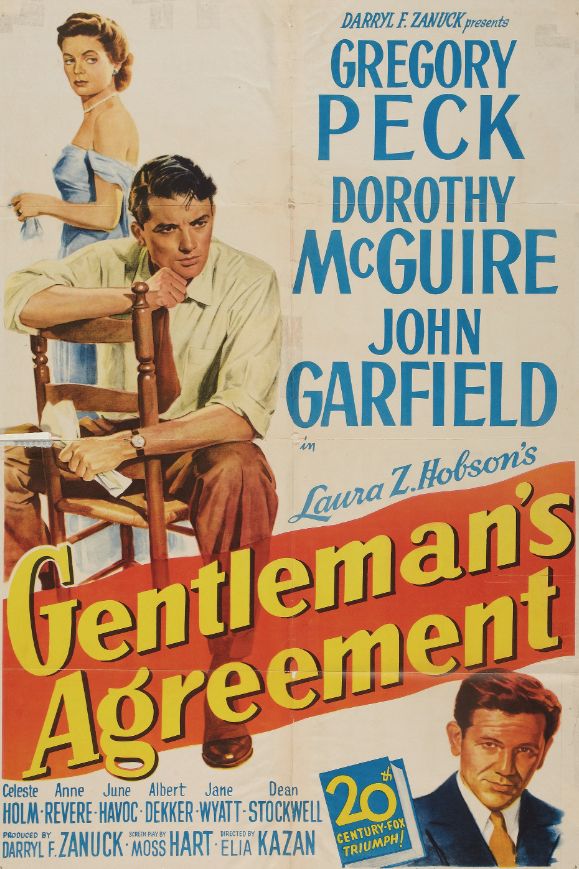
Director Elia Kazan’s fourth film, Gentleman’s Agreement, dominated the 20th Academy Awards.

It was nominated for eight Oscars and took home three — best picture for producer Darryl F. Zanuck, best director for Kazan, and best supporting actress for Celeste Holm.

It was also incredibly popular, and was the eighth highest grossing film of the year, earning more than $4 million at the box office.

This was a remarkable feat for a sober black and white drama about anti-Semitism, especially considering that most of the ten highest grossing films of 1947 were either comedies or Technicolor spectacles.

Before embarking on this project, I’d never had much desire to see Gentleman’s Agreement, despite my love of Kazan’s other films. It has a reputation for being heavy-handed, and I dislike movies with good intentions that spoon-feed the audience a simplistic message.

So I was really happy to discover that Gentleman’s Agreement is a much more subtle and thought-provoking film than its reputation suggests. It’s a little dry in stretches, but it wasn’t nearly as preachy as I was expecting.

In fact, it’s still a unique movie because it addresses not active, virulent anti-Semitism but the silent majority that allows prejudice to flourish. In other words, if there are ten people at a table and one person tells a nasty joke about Jews and the other nine people either chuckle politely or feel offended but don’t say anything, the problem is not the one anti-Semite, but the other nine people.

Most movies made after Gentleman’s Agreement still focus on active, violent hatred, which lets the audience off the hook to some degree. Someone can watch Mississippi Burning (1988) and come away with the feeling that they’re not a racist, because they’d never burn a cross in a black family’s yard or participate in a lynching.

Gentleman’s Agreement, on the other hand, never really lets the audience off the hook, and now that I’ve seen it, I suspect that part of its reputation for preachiness comes from the discomfort it causes.

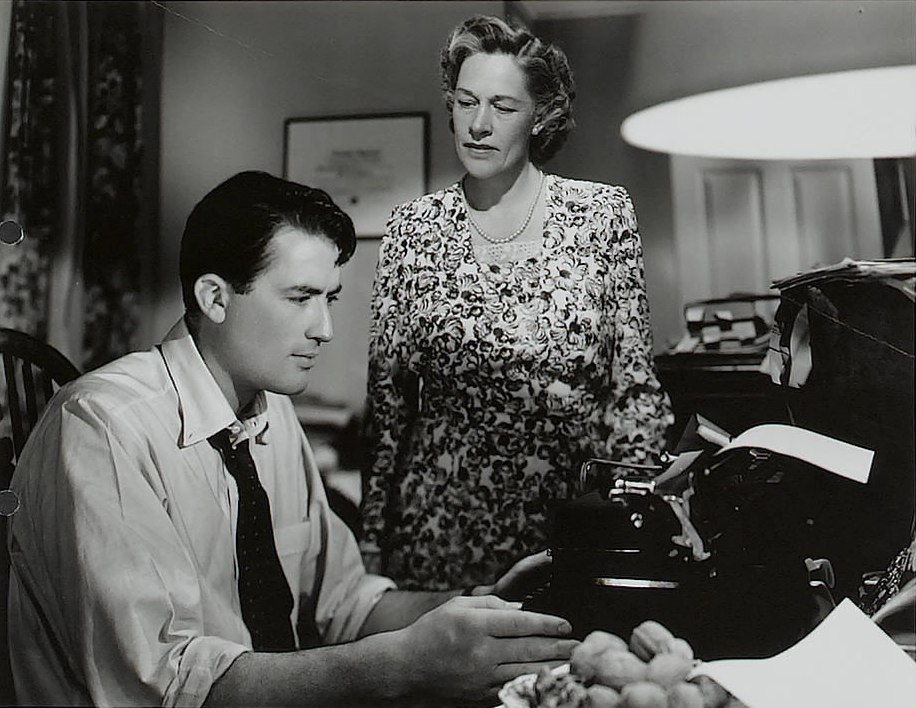
For instance, there’s a great scene in which writer Phil Green (Gregory Peck), who is pretending to be Jewish in order to write an exposé on anti-Semitism, tries to get a hotel manager to tell him if the hotel is restricted. The manager refuses to answer the question, but still steers Green out of the hotel, saying things like “Maybe you would be more comfortable in another establishment.” The viewer expects Green to get somewhere and it’s incredibly frustrating when he doesn’t. Eventually he leaves and all the people in the lobby watch him go. Probably many of them feel bad about what’s happening, but no one speaks up. It’s a maddening, intensely uncomfortable scene, and begs the question, “What would you do if no one else was speaking up?”

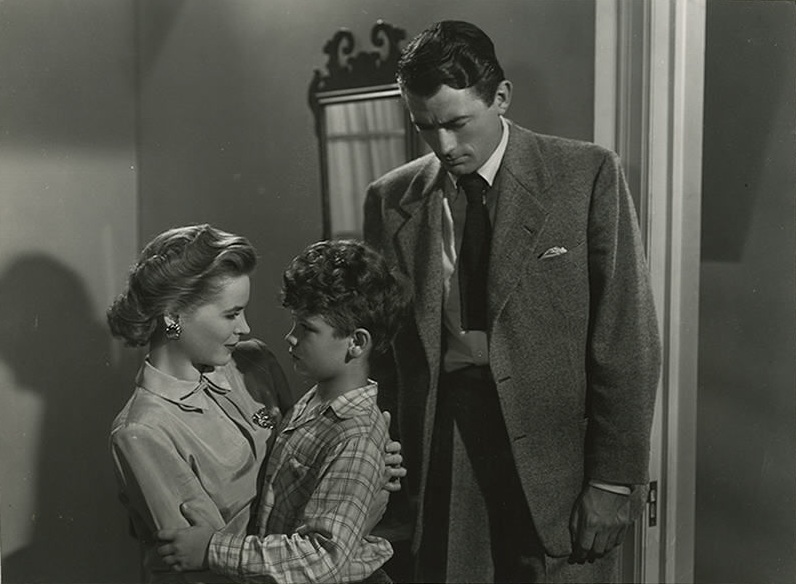
Another scene that really stuck with me was the one in which Green’s son Tommy (Dean Stockwell) comes home crying after a group of boys call him a “stinking kike” and “dirty yid.” Green’s fiancée Kathy (Dorothy McGuire) is upset, as anyone would be, but she comforts Tommy by hugging him and telling him that it’s all a mistake, and he isn’t really Jewish.

This causes Green to fly into a rage, and he lectures Kathy that her attitude is what allows prejudice to flourish unchecked.

I think that Gregory Peck’s humorless performance and holier-than-thou attitude is what turns off some viewers, but I couldn’t find fault in the logic of anything he says in the film.

His relationship with his secretary Elaine (June Havoc) is particularly interesting, since she’s Jewish but pretends not to be. Early in the film, when she still believes Green is Jewish, she expresses dismay that the magazine they work for is courting Jewish applicants. She tells Green, “Just let them get one wrong one in here and it’ll come out of us. It’s no fun being the fall guy for the kikey ones.”

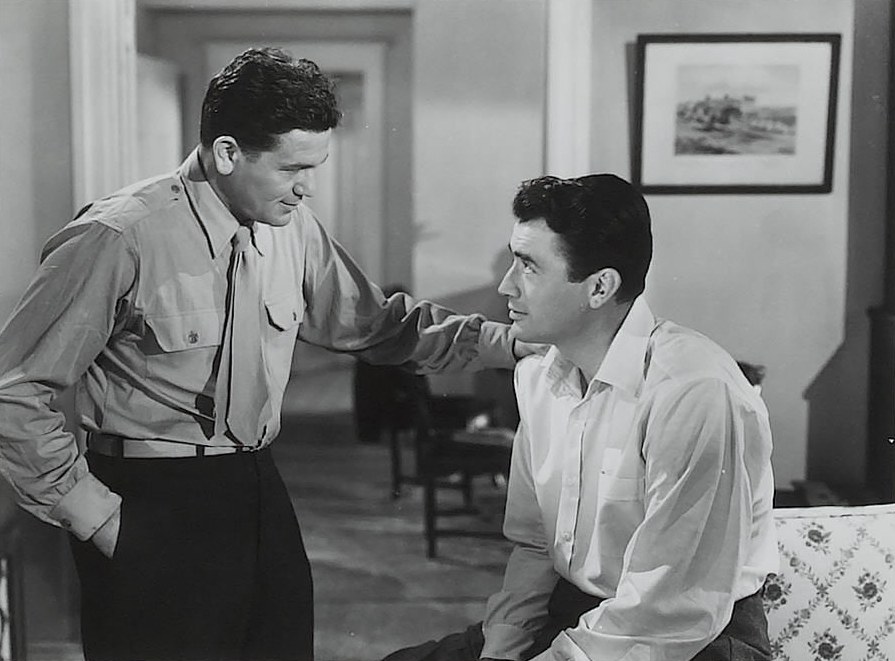
Green’s childhood friend Dave Goldman (John Garfield) tells him that he’s having such strong reactions to anti-Semitism because he’s experiencing it all at once. Dave grew up experiencing subtle prejudice, so he’s learned to filter a lot of it out. There’s something else, however, that I think is unspoken in the film, which is that Green is experiencing the passion of the newly converted.

He may not have converted to Judaism, but he’s committed to his subterfuge, and takes all the slings and arrows of anti-Semitism intensely personally.

Apparently many Hollywood studio heads, most of whom were Jewish, didn’t want Darryl F. Zanuck (who wasn’t Jewish) to make Gentleman’s Agreement. They feared that it would stir up trouble, and that directly confronting anti-Semitism would only make things worse.

One of the big themes of Gentleman’s Agreement is how wrong-headed this notion is, and that failing to confront things is never the right move.

It’s a really good movie, and not just because its philosophy is “politically correct.” The actors all play their parts perfectly, and it’s a really well-made film about people, and how people relate to each other. Most of the “big ideas” in the film are expressed the way they are in real life — by people who have opinions.

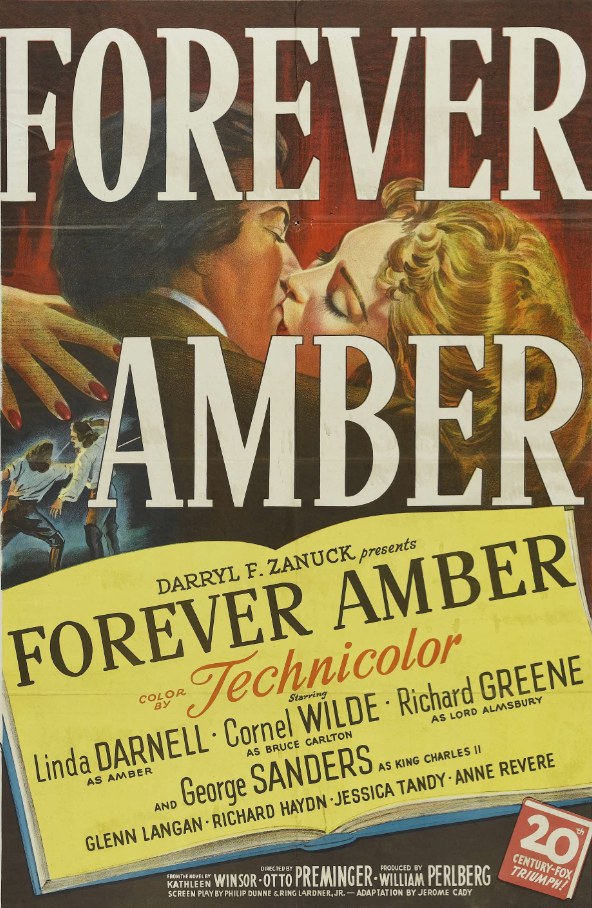
Forever Amber (Oct. 22, 1947)

Forever Amber
Forever Amber (1947)
Directed by Otto Preminger
20th Century-Fox

The review of Otto Preminger’s Forever Amber in the November 3, 1947, issue of Time magazine called it “every bit as good a movie as it was a novel,” but I’m not sure if they meant it as a compliment.

Kathleen Winsor’s 1944 period romance was the best-selling American novel of the ’40s. Forever Amber sold more than 100,000 copies during its first week on the shelves, and went on to sell more than three million copies. I haven’t read it, so I don’t know how much Winsor’s storytelling skills had to do with its popularity. What I do know is that it was banned in 14 states, and that the attorney general of Massachusetts — the first state to institute a ban — cited 70 references to intercourse, 39 out-of-wedlock pregnancies, and seven abortions, among other reasons for the ban.

So it seems clear that whatever other merits the novel had, its biggest selling point was S-E-X.

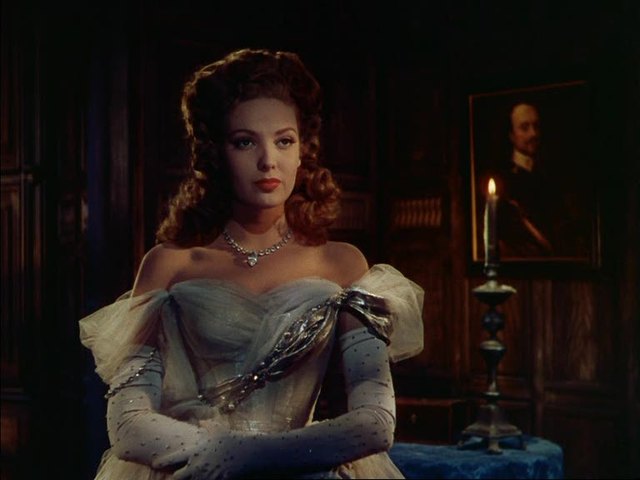
To be adapted as a film, a lot of the novel’s more scandalous bits had to be cut out, but it still has one big selling point: L-I-N-D-A. D-A-R-N-E-L-L.

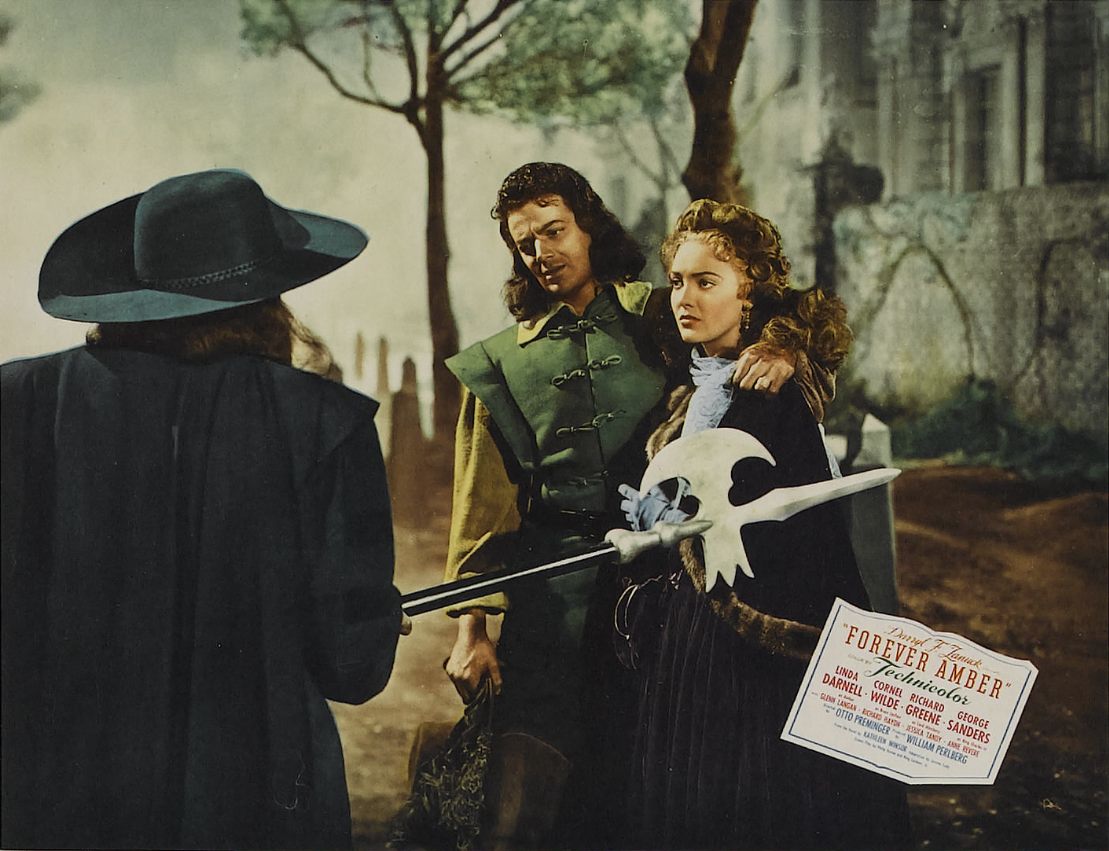
In her journey to the screen, the vain, beautiful, promiscuous, and socially climbing Amber St. Clare lost many of her lovers and innumerable shocking details and compromising situations from the novel were excised. (The film does contain one element from the novel that was extremely rare in Hollywood films of the ’40s — Amber’s out-of-wedlock pregnancy. However, the fornicating that produces the offspring occurs so far off screen that the announcement that she’s expecting comes as a complete surprise.) No matter how tame the story might be compared with the book, though, Linda Darnell’s megawatt sex appeal and unearthly beauty lend a constant sense of illicit excitement to Forever Amber.

Unfortunately, the same can’t be said of her co-star, Cornel Wilde, who plays Lord Bruce Carlton, the gentleman soldier on whom Amber sets her sights at the beginning of the film, but who never loves her quite as much as she loves him. Wilde cuts a dashing figure, but he has roughly one facial expression. He doesn’t so much act in this film as much as he exists.

Forever Amber is set during the English Restoration, when Charles II returned to the throne from exile and the monarchy was restored. The film hits all the high points of the time period, like the plague and the Great Fire of London. Also, George Sanders, who plays King Charles II, is a lot of fun to watch. His trademark indifference and supercilious charm are perfectly suited to the hedonistic monarch he’s playing.

Forever Amber is far from a great film, but I still enjoyed it a lot. It’s a beautifully filmed Technicolor epic that overwhelms the senses with its visuals and sweeping musical score. This is the kind of film in which $100,000 was spent filming a single kiss that was later cut from the film.