Tag Archives: Film Noir

Force of Evil (Dec. 25, 1948)

Force of Evil
Force of Evil (1948)
Directed by Abraham Polonsky
Enterprise Productions / Metro-Goldwyn-Mayer

Force of Evil was the first film Abraham Polonsky directed. It was also the last film he would direct for a long, long time.

Polonsky was blacklisted after he refused to testify before HUAC in 1951. He went on to write screenplays under a variety of pseudonyms, but he didn’t receive another directorial credit until he made the Robert Redford film Tell Them Willie Boy Is Here (1969).

A lot of great directors were blacklisted in the 1950s, but Polonsky’s inability to make more films seems especially tragic. Force of Evil is not only a great film, but it’s the kind of scathing critique of the foundations of America’s financial system that’s lacking from most crime films in the 1950s.

Polonsky wrote the screenplay for Robert Rossen’s boxing masterpiece Body and Soul (1947), which starred John Garfield. Body and Soul was a big hit, and it’s alluded to on the poster for Force of Evil above.

Force of Evil wasn’t as big a hit for John Garfield. There’s even some dispute over the original running time of this film, since M-G-M treated it as a B picture, and wanted it under 90 minutes so it could fit comfortably on the bottom half of a double bill.

Despite all that, it’s a film that’s aged remarkably well. It’s one of the best films Garfield ever starred in, and it’s one of the greatest film noirs ever made.

Garfield upstairs

Force of Evil is based on Ira Wolfert’s 1943 novel Tucker’s People. Polonsky collaborated with Wolfert on the screenplay.

Garfield plays Joe Morse, a lawyer for the powerful mobster Ben Tucker (Roy Roberts). The film begins with a montage of Wall Street and Joe telling the viewer, in voiceover, that he’s about to make his first million dollars.

On the Fourth of July, most of the suckers who play the numbers play “776” as a superstitious form of patriotism. Tucker has a complicated plan that will force 776 to hit on July 4th, which will put all of the smaller numbers operations out of business when they’re forced to pay out. He’ll swoop in and take control of all the numbers rackets, just like he took control of beer during Prohibition.

https://www.youtube.com/watch?v=yAm_DYb1-jo

Joe Morse is young, slick, and on the verge of being fabulously wealthy. His older brother Leo Morse (Thomas Gomez) is old, overweight, and will never be well-to-do. He runs a small, neighborhood numbers racket (or “bank,” as they are known in the film). He may be taking suckers’ money, but the stakes are small, he pays out what he promises, and he cares about the people he employs.

Joe knows what the Fourth of July has in store for Leo and everyone like him. As Tucker’s lawyer, he’s not able to tell Leo exactly what’s going to happen, but he tries to warn him. When that doesn’t work, he tries to pull strings that will force his brother out of the numbers racket before it’s too late, but it only makes things worse.

Gomez and Garfield

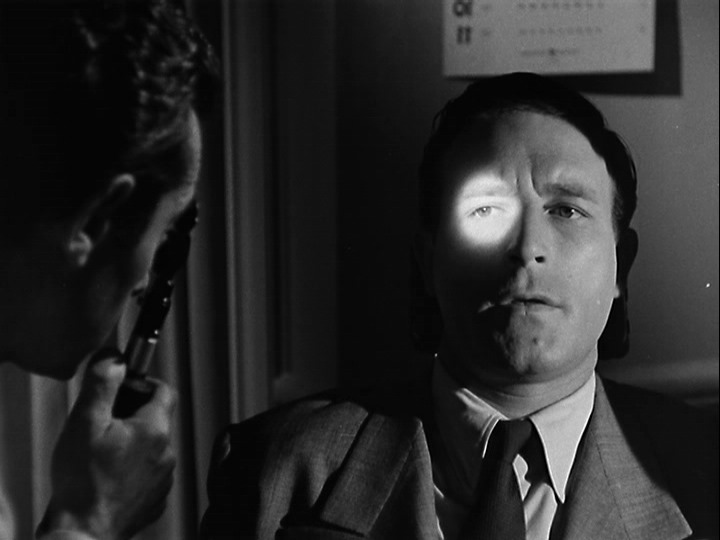
Polonsky showed his cinematographer, George Barnes, some of Edward Hopper’s Third Avenue paintings to give him an idea of how he wanted the film to look. Force of Evil uses a lot of single-source lighting and sharp focus, and it’s full of simple but beautiful compositions.

All of the actors in the film give good performances, including Beatrice Pearson as a girl who works for Leo, and whom he considers a daughter, and Marie Windsor in full femme fatale mode as Tucker’s wife Edna.

Thomas Gomez’s scenes with Garfield are especially powerful. Their dialogue wouldn’t be out of place in a stage play, since Polonsky isn’t afraid to elevate their language to poetic, mythic heights.

There’s not a lot of violence in Force of Evil, but what there is makes a tremendous impact. One sequence toward the end of the film is as good as anything Francis Ford Coppola or Martin Scorsese did in any of their gangster films. (Incidentally, Scorsese is a great admirer of Force of Evil. His video introduction to the film is the sole special feature on the gorgeous-looking Blu-ray from Olive Films.)
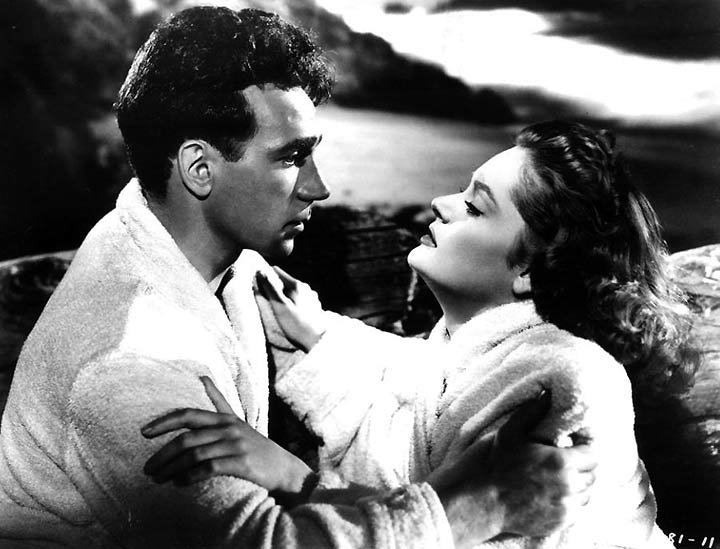
https://www.youtube.com/watch?v=NeNIu8hj3S8

Whiplash (Dec. 24, 1948)

Whiplash
Whiplash (1948)
Directed by Lewis Seiler
Warner Bros.

Sometimes a good ending is all I need.

I enjoyed Whiplash, and there’s plenty of entertainment packed into its briskly paced 91 minutes, but it’s the ending that really got me. It was a mixture of gallows humor and farce that I didn’t see coming. I don’t want to spoil it if you haven’t seen it, but it had me laughing like I haven’t laughed in a long time, and then chuckling and shaking my head at what I’d just laughed at.

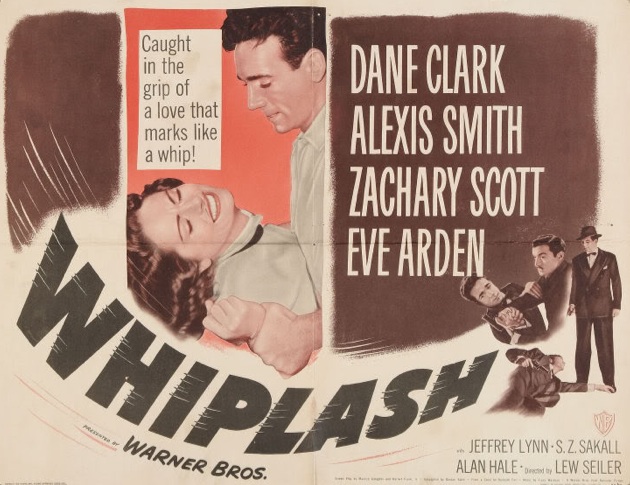
Whiplash is a B noir that stars Dane Clark as a soulful, romantic artist named Michael Gordon who also happens to be pretty handy with his fists. If you think that’s a role that sounds tailor-made for John Garfield, you’re right. Michael Gordon is in many ways an amalgam of a couple of characters John Garfield played not long before this film; the rough-hewn but sensitive concert violinist in Humoresque (1946) and the tortured boxer in Body and Soul (1947).

Since this project wasn’t prestigious enough for an actor like Garfield at this point in his career, the producers and the studio went with the next best thing: Dane Clark. Like Garfield, Clark was a native New Yorker with an appealing mix of street smarts, physical toughness, and soft-eyed sensitivity.

The film co-stars several dependable performers from the Warner Bros. stable; Alexis Smith as the beautiful and mysterious woman who captures Michael Gordon’s heart, Eve Arden as Michael’s wise and acerbic gal-pal, Zachary Scott as the shifty-eyed and power-mad villain, Jeffrey Lynn as an alcoholic doctor haunted by his past, and S.Z. Sakall as the avuncular shopkeeper who proudly displays Michael’s paintings.

Dane Clark and Alexis Smith

The first act of the film takes place in California. Michael falls for a woman named Laurie Durant (Alexis Smith) after she buys one of his paintings. Their love affair burns hot, but she runs off one day without explaining what spooked her.

In the second act of the film, he follows her to New York City and eventually finds her singing in a nightclub. He soon discovers that she is married to a wheelchair-bound man named Rex Durant (Zachary Scott). Rex was a boxer before he was paralyzed, and he still has the sweet science in his blood. If he can’t compete in the ring, he’ll do the next best thing and manage fighters.

When Michael Gordon knocks out one of Rex’s bodyguards, he proves that he’s handy with more than just a paintbrush. Rex sees potential in the young man, and he and his crew rename him “Mike Angelo” to exploit the artistic angle, and they put him on the fight circuit.

There’s a lot of interesting stuff going on in Whiplash that’s never explored to its full potential, perhaps because of the Hays Code. Rex wants to use Mike’s body for his own purposes; as a surrogate fighter. His wife wants to use Mike’s body as a surrogate for Rex. This dichotomy of sex and violence could have made for a lurid and memorable film, but the sex stuff never really gets off the ground, especially after Laurie’s marital status is revealed. I also thought that splitting the action of the film between California and New York unnecessarily complicated the story.

Whiplash was more than lurid enough for the NY Times, however. In their review of the film, published December 27, 1948, they called it “a pointless exposition of brutality,” and went on to say that “if it’s plain, old fashioned mayhem that you desire, ‘Whiplash’ most likely will be to your liking. Otherwise proceed with caution.”

Modern viewers will probably find the brutality in Whiplash pretty ho-hum, but it’s a solid little B movie with a nice, noirish score by Franz Waxman and crisp black & white cinematography by J. Peverell Marley.

And, as I said, the ending is great.

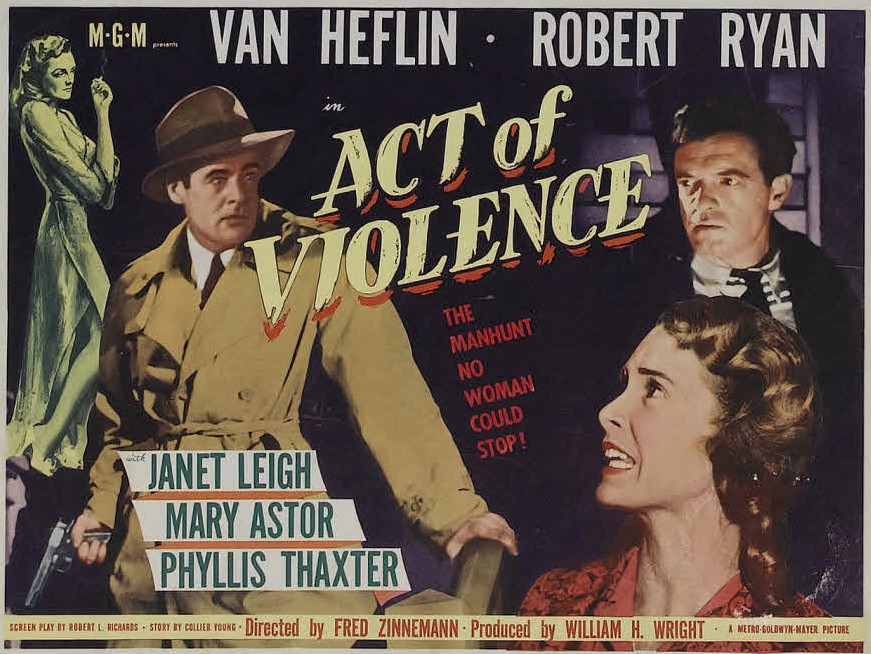
Act of Violence (Dec. 21, 1948)

Act of Violence
Act of Violence (1948)
Directed by Fred Zinnemann
Metro-Goldwyn-Mayer

Fred Zinnemann’s Act of Violence opens with a shot of New York City at night. The Chrysler Building is silhouetted against a dark gray sky. Bronislau Kaper’s musical score is ominous and intense. Robert Ryan crosses the street toward the camera. He’s wearing a hat and a trench coat, and his stride is determined despite his limp.

The sound of his limping walk is distinctive. Step, drag, step, drag, step, drag, step, drag. It’s a sound that will haunt the film.

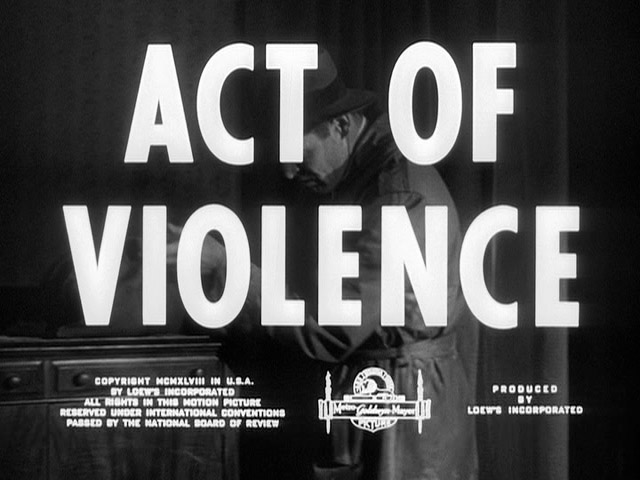
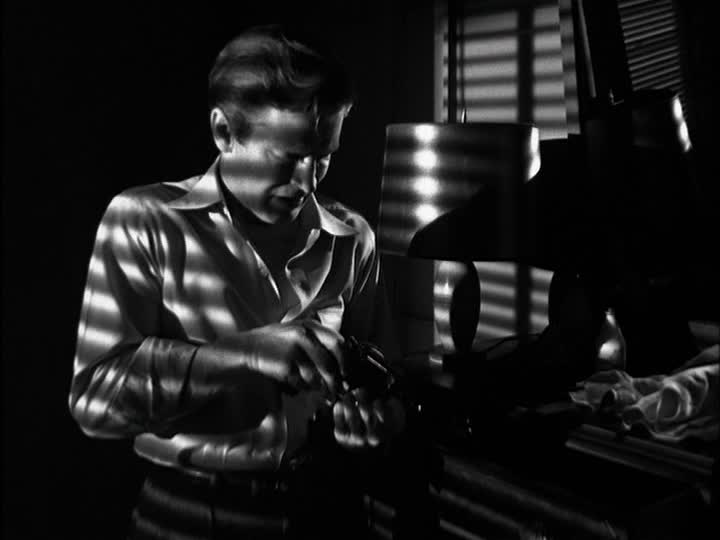
He walks upstairs to a shabby rented room and pulls a semiautomatic pistol from a dresser drawer. He slaps a magazine into the pistol, checks the barrel and the ejection port, and then the title of the film appears onscreen in block letters.

Act of Violence title

Now that’s the way to start a movie. Zinnemann, his cinematographer Robert Surtees, and his editor Conrad A. Nervig build more suspense and engagement in the first minute of Act of Violence than most movies are able to muster in their entire first reel.

It helps that the film drops us right into the action. Most movies in the 1940s began with screen after screen of opening credits; a time-honored cinematic tradition. Act of Violence and Nicholas Ray’s They Live by Night are the only films from 1948 I’ve seen that eschewed that hoary convention, and both films immediately arrest the viewer.

After the opening, Ryan’s ominous character Joe Parkson takes a Greyhound bus to California, where the viewer meets the other star of the film; Van Heflin. Heflin plays Frank Enley, a World War II veteran, housing contractor, and family man with a beautiful young wife named Edith (Janet Leigh) and an adorable baby boy. (Janet Leigh was just 21 when this film was made. Heflin and Ryan were both in their late 30s.)

We know right from the beginning that Joe Parkson wants to kill Frank Enley, but we don’t know why. For awhile, all we know is that Enley was Parkson’s CO in the war, and that Parkson has a vendetta against him.

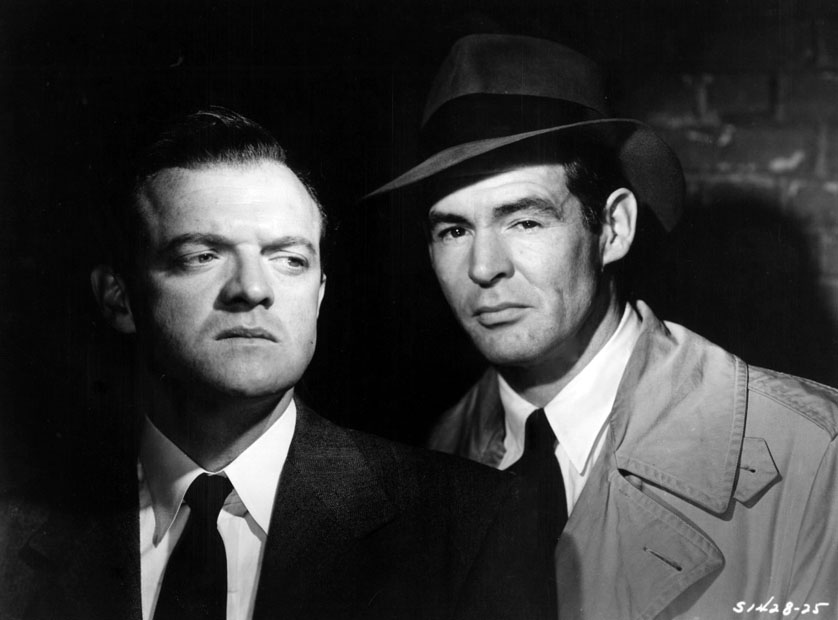
Van Heflin and Robert Ryan

M-G-M didn’t produce very many noirs, but when they did, they were glossy affairs with high productions values and great actors, like The Postman Always Rings Twice (1946), Undercurrent (1946), Lady in the Lake (1947), and High Wall (1947).

Act of Violence is a stylish thriller that looks and feels ahead of its time. The cinematography is meticulously constructed and dripping with noir atmosphere, but it never feels studio-bound and uses real-world locations beautifully. The sound effects in the film sometimes do a better job of creating suspense than any musical score could.

All the actors in Act of Violence are really good. Van Heflin was a sad-eyed Everyman, and Robert Ryan had a physically intimidating presence, but enough charisma to make even his most villainous characters magnetic. Apparently Gregory Peck and Humphrey Bogart were originally slated to star in Act of Violence, but I can’t picture anyone but Heflin and Ryan as these characters.

Janet Leigh has a pretty thankless role, but she has enough star power to make it interesting. Phyllis Thaxter doesn’t have much to do as Joe’s girl Ann, but she’s fine. Mary Astor is wonderful in an unglamorous role as a barfly obsessed with “kicks” who Frank meets on a business trip to Los Angeles, and the always-creepy Berry Kroeger is great in a small part.

I thought Zinnemann’s previous film, The Search (1948) was a minor masterpiece, and I feel the same way about Act of Violence. Zinnemann’s best work may have been ahead of him, but Act of Violence is an exceedingly well-made, visually inventive thriller with enough moral ambiguity to keep it interesting. I think our cultural views have evolved since World War II in ways that make the central conceit of the film even more ambiguous than it probably seemed when the film was first released.

I don’t want to go into more detail for fear of spoilers, but for me there’s a great deal of meaning packed into Enley’s statement to his wife, “A lot of things happened in the war that you wouldn’t understand. Why should you? I don’t understand them myself.”

http://www.youtube.com/watch?v=i0oZACCHDB8

He Walked by Night (Nov. 24, 1948)

He Walked by Night
He Walked by Night (1948)
Directed by Alfred L. Werker
Bryan Foy Productions / Eagle-Lion Films

He Walked by Night is a police procedural directed by Alfred L. Werker, with uncredited directorial assistance from Anthony Mann. The starkly lighted cinematography is by John Alton, who had previously worked with Mann on two of his most memorable film noirs: T-Men (1947) and Raw Deal (1948).

Docudrama films were a popular genre after World War II. The genre began with documentarian and newsreel producer Louis de Rochemont’s purportedly true espionage stories The House on 92nd Street (1945) and 13 Rue Madeleine (1947), as well as his fact-based legal drama Boomerang (1947).

Producer Mark Hellinger and director Jules Dassin’s film The Naked City (1948) wasn’t based on any single true incident, but it sought to depict realistic police work — a team of detectives recording the details of a crime scene, interviewing witnesses, tracking down leads, and pursuing suspects.

He Walked by Night didn’t invent the police procedural, but it’s probably the single most influential film in the genre. It featured Jack Webb in his first credited role, and his relationship with the film’s technical advisor, LAPD Sgt. Marty Wynn, led to the creation of the radio show Dragnet in 1949. (The series hit television in 1951.)

The film begins with a screen of text explaining that what you’re about to see is a true story, and is based on the case of one of the most diabolically cunning killers ever to be hunted by the police. It ends with the following sentence: “Only the names are changed — to protect the innocent.” Sound familiar, Dragnet fans?

Like every film or book that can properly be called a police procedural, He Walked by Night features a team of police officers and detectives. The lead investigator in the case, Sgt. Marty Brennan, is played by Lawrence Tierney’s little brother, Scott Brady, fresh off a starring role in another docudrama, the “ripped from the headlines” prison escape drama Canon City (1948). The other police officers include Capt. Breen (Roy Roberts), Sgt. Chuck Jones (James Cardwell), and police laboratory technician Lee Whitey (Jack Webb).

Richard Basehart

The meatiest role in the picture belongs to Richard Basehart, who plays Roy Morgan (a.k.a. Roy Martin), an electronics-obsessed former serviceman who — in the tense opening scene of the film — graduates from breaking & entering to murder.

Basehart delivers a lean, mean performance. He has some great scenes with his fence, Paul Reeves (Whit Bissell), but other than that he has very little dialogue. The film hangs on his performance, and he’s completely believable as an endlessly resourceful sociopath who’s able to elude the police through a combination of planning and luck. (The character was inspired by the real-life case of Erwin “Machine Gun” Walker, who went on a crime spree in 1945 and 1946.)

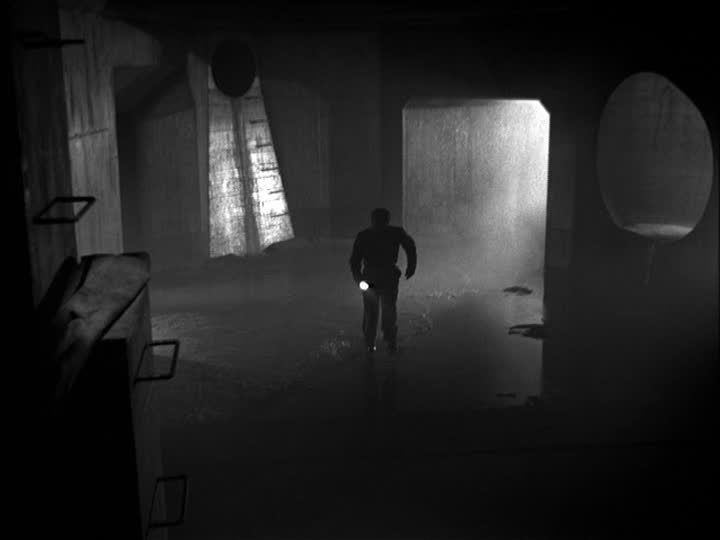
He Walked by Night in the Sewers

It’s a cliche to say that the real star of a film noir is its cinematography, but it’s usually true. John Alton’s photography consistently gives the low-budget film an intense, driving atmosphere. Nearly ever shot in the film is a masterwork of lighting and composition, culminating in the final chase through the Los Angeles sewer system.

He Walked by Night is currently in the public domain, so it can be seen on YouTube (below), and is available on DVD from a variety of companies. The only caveat is that some of them look pretty lousy, so noir fans who want to own this film on DVD are advised to pick up the disc from MGM and to avoid at all costs the cheapo disc from Alpha Video, which looks just terrible.

http://www.youtube.com/watch?v=YWWA4u7aodg

Kiss the Blood Off My Hands (Oct. 30, 1948)

Kiss the Blood Off My Hands
Kiss the Blood Off My Hands (1948)
Directed by Norman Foster
Norma Productions / Universal Pictures

Norman Foster’s Kiss the Blood Off My Hands begins with some onscreen text that could fit at the beginning of nearly every single post-war film noir:

The aftermath of war is rubble — the rubble of cities and of men. They are the casualties of a pitiless destruction. The cities can be rebuilt, but the wounds of men, whether of the mind or of the body, heal slowly.

Kiss the Blood Off My Hands is based on Gerald Butler’s bestselling 1940 novel of the same name, and stars Burt Lancaster as Bill Saunders, a tightly wound, violent man with a mysterious past. He says he was born in Canada and raised in Detroit, but he doesn’t go into much more detail. When the film begins, he’s alone in a pub in an unnamed city in England, hunched over the bar and nursing a pint. When the barman tells him that it’s closing time, he lashes out violently. His assault on the barman starts a fire that his uncontrollable rage will continue to stoke throughout the film.

The role of Bill Saunders seems tailor-made for Lancaster at this point in his career. He made his debut in The Killers (1946) as Ole “Swede” Andreson, a brutish former prizefighter. In his next film, Brute Force (1947), he played Joe Collins, the toughest man in a tough prison. In Desert Fury (1947), Lancaster played a sheriff’s deputy who was also a former bronco buster. In I Walk Alone (1948), he played a former bootlegger and all-around alpha male who was determined to exact vengeance on his former partner.

Subsequent roles in All My Sons (1948) and Sorry, Wrong Number (1948) allowed Lancaster to stretch his thespic muscles a little, but Kiss the Blood Off My Hands is a solid return to type.

Lancaster and Fontaine

In the NY Times review of the film, published on October 30, 1948, the headline was Lancaster Fights the World Again. The first paragraph of the review was as follows: “The process of humanizing Burt Lancaster obviously is not going to be easy and it is going to take time. Mr. Lancaster is handy with his fists and speaks most eloquently when using them. But to develop fully as an actor and to come over to the right side of society he will have to make a break someday, for there are only so many variations on the theme of being misunderstood and Mr. Lancaster has just about exhausted them all.”

The reviewer praised the film, however, especially its three-act structure and strong climax, two elements which the reviewer lamented were sadly absent from most current films (apparently this is not just a 21st-century problem).

I think that Kiss the Blood Off My Hands is a tremendously effective film noir. What it lacks in innovative storytelling it makes up for with strong performances — not only by Lancaster but also by Joan Fontaine as the woman who grows to love him and Robert Newton as the Cockney schemer who is determined to manipulate him through blackmail. In addition to the acting, the shadowy cinematography by Russell Metty sharpens the violence and suspense of the film, and the tense, driving score by Miklós Rózsa (who also wrote the music for The Killers, Brute Force, and Desert Fury) propels the action of the film and mirrors Lancaster’s barely controlled rage that constantly threatens to boil over.

http://www.youtube.com/watch?v=sg5EUhGXwGw

Moonrise (Oct. 1, 1948)

Moonrise
Moonrise (1948)
Directed by Frank Borzage
Republic Pictures

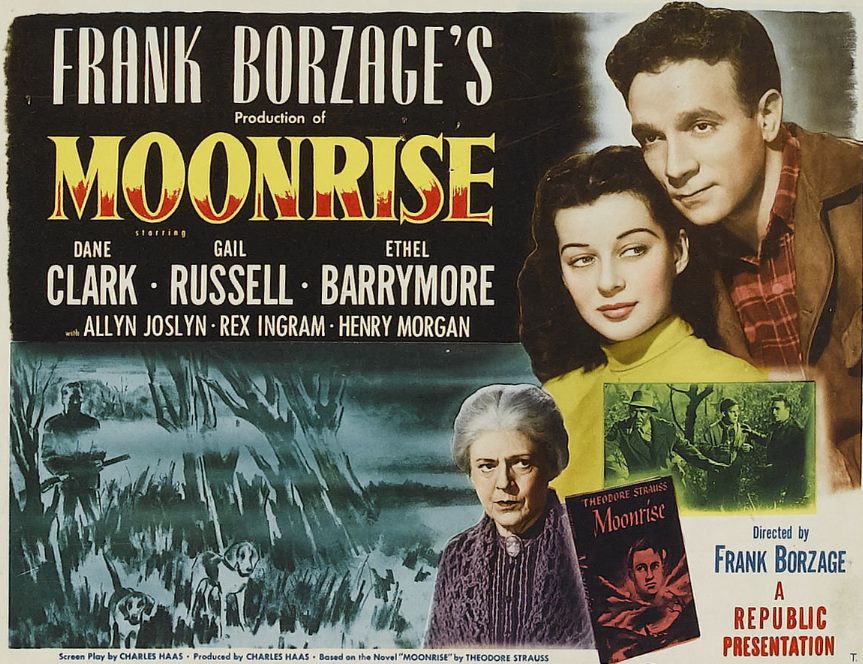
Frank Borzage’s Moonrise is a surreal Southern Gothic drenched in noir atmosphere.

Based on the novel by Theodore Strauss, Moonrise stars Dane Clark as a man named Danny Hawkins who is haunted by his father’s execution for murder. Danny has grown up in the shadow of his father’s crime, both figuratively and literally (this is a noir, after all).

In nightmarish flashback scenes, we see the young version of Danny being mercilessly taunted by his schoolmates.

In the first few minutes of the film, the grown-up version of Danny finally lashes back at the worst of the bullies, Jerry Sykes (Lloyd Bridges), who is the son of the wealthiest man in town. Danny beats Jerry Sykes to death on the outskirts of a carnival, and leaves his body to be discovered by the authorities.

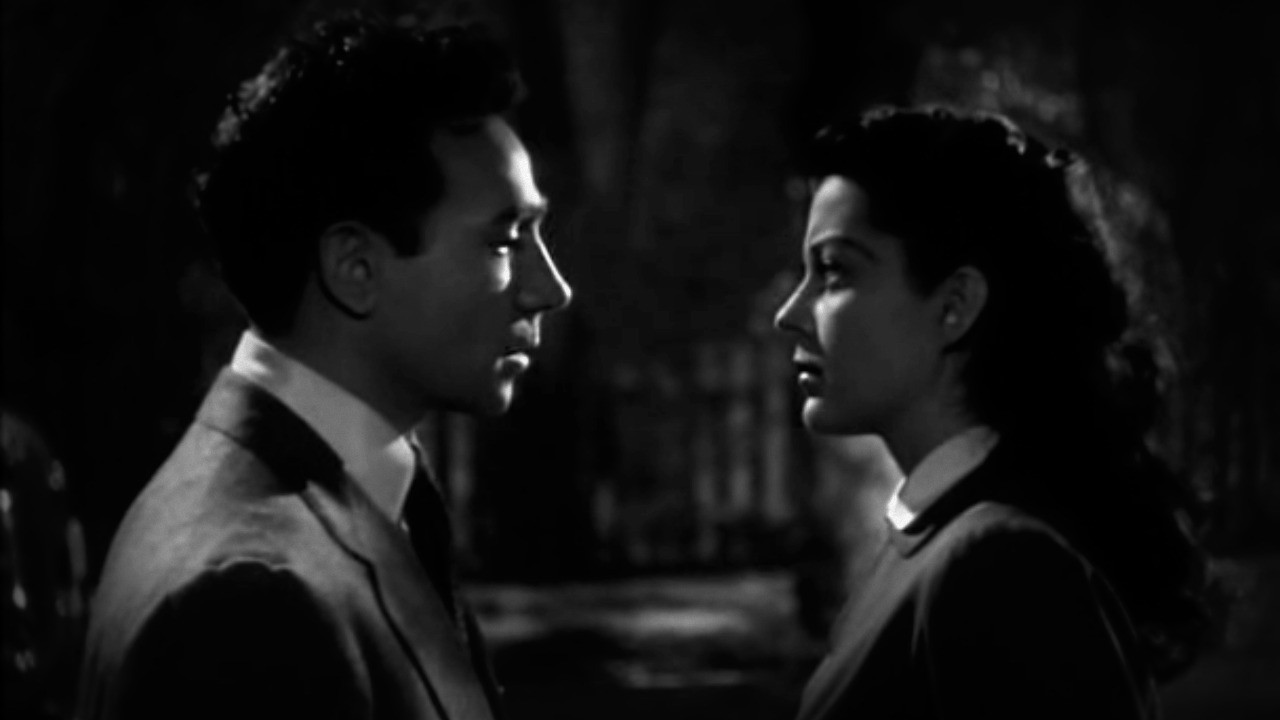
For the rest of the film, Danny is tormented by guilt but is too terrified to turn himself in. And soon after the murder, he strikes up a desperate romance with Jerry Sykes’s girl, Gilly Johnson (Gail Russell), a schoolteacher and the prettiest girl in town.

Clark and Russell

Moonrise was an attempt by Republic Pictures to break out of their Poverty Row rut and release an A picture. (The budget was $849,452, whereas the Western B pictures the studio pumped out on a regular basis usually cost around $50,000.)

It was still a modestly budgeted film by Hollywood standards, and Borzage shot the entire film on only two sound stages. Although Moonrise wasn’t a hit, I think the claustrophobic “staginess” works in the film’s favor when watched today. Lionel Banks’s art direction and John L. Russell’s cinematography give the film a dreamlike quality. Especially in the early going of the film, there are instances of dream logic — such as a terrible car accident that seems to have no consequences in the next scene — but that only contributes to the film’s hypnotic power.

Dane Clark’s performance as Danny is similar to the romantic, sad-eyed fugitive he played in Deep Valley (1947). Gail Russell is gorgeous, although her role as Gilly mostly requires her to be wide-eyed and worried.

There’s some really terrific work by the supporting cast. Lloyd Bridges only has a minute or two on screen, but his nastiness and sense of entitlement is palpable. Ethel Barrymore is wonderful, as always, as Danny’s grandmother. Allyn Joslyn grounds the film with his role as philosophical sheriff Clem Otis. And African-American actor Rex Ingram gives an amazing performance as Mose, Danny’s friend who lives deep in the swamp, raises and trains dogs, and avoids people as much as possible. The character of Mose has aspects of the “magical Negro,” but Ingram is a good enough actor — and the part is written well enough — that he mostly escapes cliché.

Moonrise is a hard film to categorize. It’s stylistically a film noir, but thematically it ranges from Southern Gothic to European art film. It’s worth seeing if you have any affinity for any of those genres, or even if you’re just someone who can appreciate a beautifully made black and white movie.

The Fallen Idol (Sept. 30, 1948)

The Fallen Idol
The Fallen Idol (1948)
Directed by Carol Reed
London Film Productions / British Lion Film Corporation

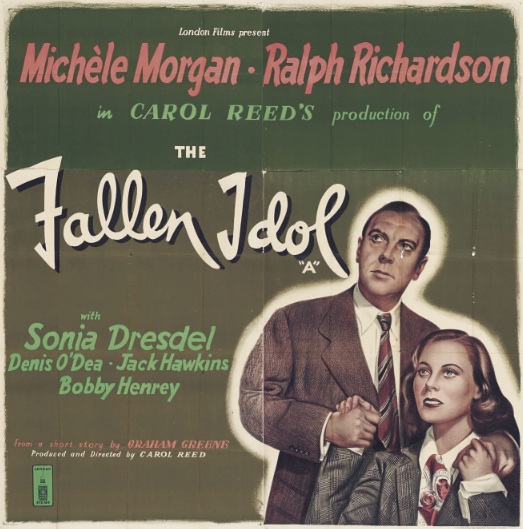
When producer Alexander Korda introduced director Carol Reed to writer Graham Greene, it was the beginning of a fruitful collaboration that would produce Reed’s most enduring film, The Third Man (1949).

But before they made that classic, Greene and Reed collaborated on an equally masterful film, The Fallen Idol, which Greene adapted from his short story “The Basement Room.” (Lesley Storm and William Templeton contributed additional dialogue to the script.)

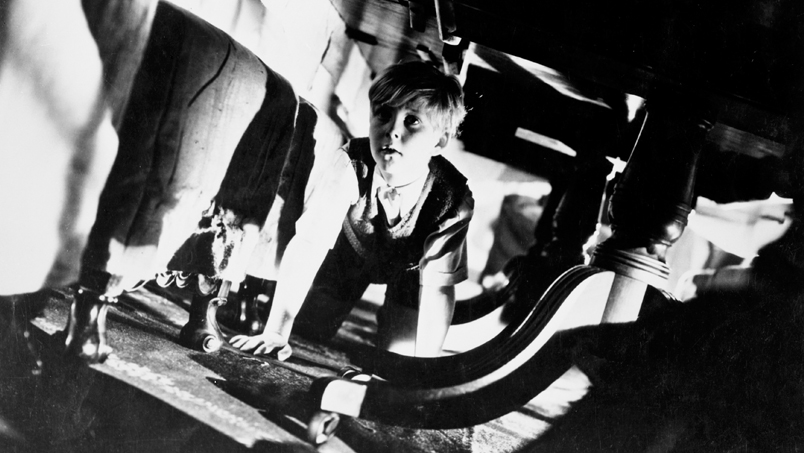
The Fallen Idol is a tale of lies, deception, and half-truths as seen through the eyes of a young boy named Phillipe who lives in the French Embassy in London.

Phillipe — or “Phile,” as he’s more commonly called (it’s pronounced the same as the name Phil) — is played by Bobby Henrey, a nonprofessional actor who was 8 or 9 years old during filming.

This was the first time I’d seen The Fallen Idol, and while I was watching it I was struck by what an unaffected and natural performance Henrey delivered. The events of the film are seen mostly from Phile’s perspective, and his performance is central to the movie’s effectiveness.

So I was surprised when I watched the 2006 documentary short A Sense of Carol Reed and learned that Henrey’s “performance” was largely created by Reed and his editor, Oswald Hafenrichter.

In the documentary, Guy Hamilton, the assistant director of The Fallen Idol, recalled of Henrey, “He couldn’t act his way out of a paper bag. Much worse was his attention span, which was of a demented flea.” According to Hamilton, they’d sometimes shoot thousands of feet of film to get just one line from Henrey.

Bobby Henrey

Reed was patient and had a tremendous facility for directing actors of all ages. He never humiliated actors or cut them down in front of the crew. If he was unhappy with a take, he’d rarely yell “Cut!” until the actor had left the frame. On the occasions that he did, he’d do it in a tricky fashion, such as taking a nail from his pocket, dropping it on the floor, then calling out, “Cut! Can we have quiet, please?” Then he’d quietly say something to the actor like, “Since we have to start over anyway, perhaps you could…” — and get the performance he wanted that way.

I don’t think The Fallen Idol would be as brilliant as it is had it starred a seasoned child actor capable of memorizing pages of dialogue. Henrey may have been frustrating to work with, but all that matters is what’s up on screen. Phile seems like a real child, not an adorable singing-and-dancing moppet with a studio contract.

Phile’s parents spend very little time with him, and his only friend in the embassy is his father’s butler, Baines (Ralph Richardson).

Phile’s nemesis is Baines’s wife, Mrs. Baines (Sonia Dresdel), a strict, cruel woman who has no patience for Phile’s antics or his little pet snake, MacGregor.

One day, Phile follows his father figure to a café, where Baines is meeting a young French woman named Julie (Michèle Morgan). And just like that, Phile becomes an accomplice to his hero Baines’s infidelity. He doesn’t fully realize what’s going on — he believes that Julie is Baines’s niece and Baines doesn’t disabuse him of the notion — but any time a child is told by an adult, “No one needs to know about this,” the child will realize that something isn’t quite right.

The film continues in this vein, and the layers of secrecy and deception build until Phile finally believes he has seen Baines do something truly horrid, and he clumsily tries to help his friend by lying to the police for him.

Ralph Richardson

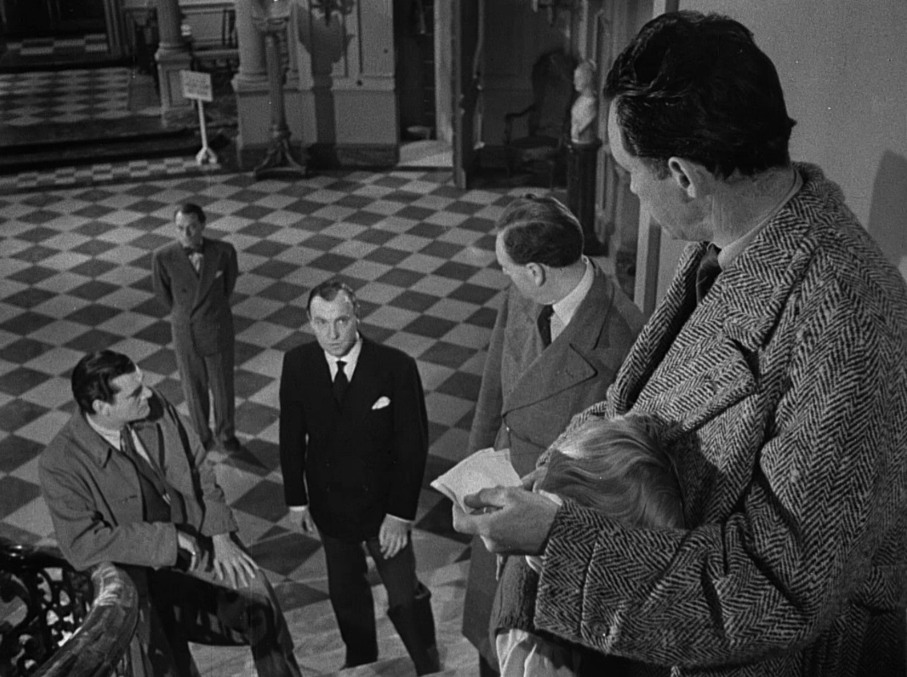
The Fallen Idol is a great film. Vincent Korda’s set design is marvelous, and the spacious interiors of the embassy are as much a character in the film as any of the actors. Georges Périnal’s cinematography is full of unsettling Dutch angles and gorgeous chiaroscuro lighting. All the actors are wonderful, but Ralph Richardson’s performance is pitch perfect — he’s so kind and charming that we can easily see why Phile idolizes him, and when we begin to see the small, tragic man beneath the warm exterior, it’s heart-breaking.

The Fallen Idol is tragic and moving in parts, but Reed and Grahame also have a very light, wry touch, and there’s a great deal of humor and irony in the film. If you’ve never seen it, by all means do so. If you want to make a triple bill of it, first watch Odd Man Out (1947), then The Fallen Idol (1948), and finally The Third Man (1949). They’re as brilliant a trio of films as any director has ever made.

Road House (Sept. 22, 1948)

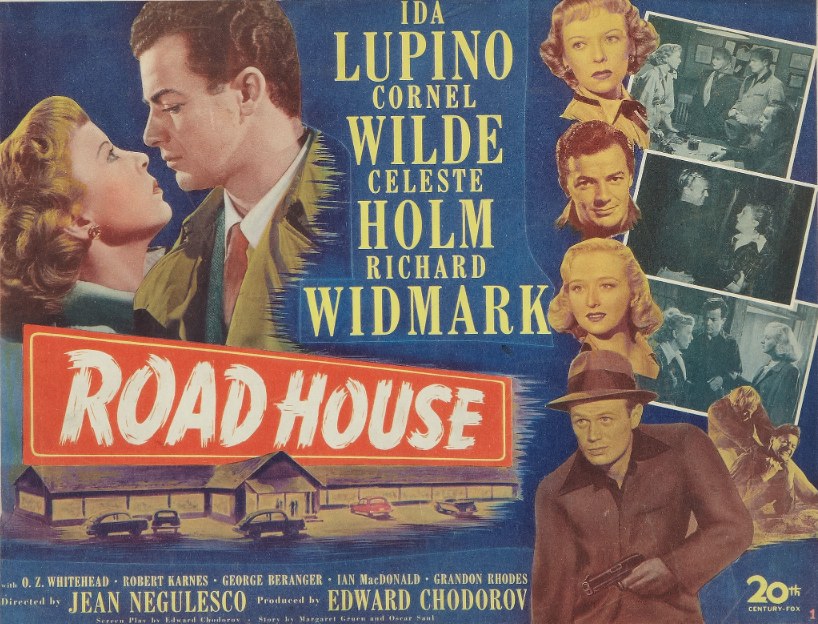
Road HouseThe second feature in our Jean Negulesco double bill is a tad less serious than the first.

Negulesco’s film Johnny Belinda (1948) is the story of a poor, uneducated deaf-mute girl played by Jane Wyman. It was nominated for 12 Academy Awards, and won one — Wyman took home the Oscar for Best Actress.

Road House, on the other hand, was nominated for zero Academy Awards.

But they’re both very good films, and watched back to back, they really show Negulesco’s facility with both A-quality material and B-quality material.

A truly good potboiler is as hard to pull off as a truly good drama is, and Road House is a truly good potboiler.

In an interview he gave in 1969, Negulesco recalled being given the assignment to direct Road House by 20th Century Fox studio head Darryl F. Zanuck. Negulesco said that Zanuck told him, “This is a bad script. Three directors have refused it. They don’t know what they’re doing, because basically it’s quite good. Remember those pictures we used to make at Warner Bros., with Pat O’Brien and Jimmy Cagney, in which every time the action flagged we staged a fight and every time a man passed a girl she’d adjust her stocking or something, trying to be sexy? That’s the kind of picture we have to have with ‘Road House.'”

Negulesco knew exactly what kind of picture he was directing, and he directed the hell out of it. The first shot of Lily Stevens (Ida Lupino) shows her with her bare leg up on a desk. She’s dealing cards alone, and there’s a smoldering cigarette next to her bare foot.

Lupino was smart, sexy, and talented, and she’s a joy to watch in Road House. When she played a singer in The Man I Love (1947), all of her performances were dubbed by Peg La Centra, but this film finally gave moviegoers an opportunity to hear her real singing voice. As Susie Smith (Celeste Holm) says in the film, “She does more without a voice than anybody I’ve ever heard.”

Lupino may not have been the most impressive chanteuse working in Hollywood, but when she sings “One for My Baby and One More for the Road” in Road House, it’s an emotional scene that tells us more about her character than pages of expository dialogue ever could.

http://www.youtube.com/watch?v=h1Q71t5D8ko

Besides the lovely Lupino and the talented Holm, Road House also features chiseled hunk Cornel Wilde. My favorite scene is the one in which he gives Lupino the angriest, most sexually charged bowling lesson I’ve ever seen in a film.

And last but not least, Road House was the third time Richard Widmark appeared on film, and it was the third time he played a memorable villain. He plays Jefferson T. “Jefty” Robbins, the owner of the juke joint that gives the film its name, and his character is a scheming chump who just can’t take no for an answer.

Bodyguard (Sept. 4, 1948)

Bodyguard
Bodyguard (1948)
Directed by Richard Fleischer
RKO Radio Pictures

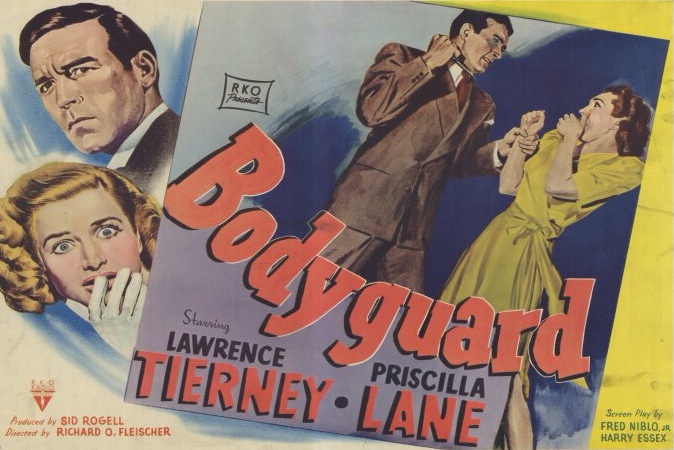
Richard Fleischer’s Bodyguard features Lawrence Tierney doing what Lawrence Tierney did best — knocking down everyone and everything that gets in his way.

In the first sequence of the film, LAPD detective Mike Carter (Tierney) is reprimanded by his lieutenant (played by Frank Fenton) for using his knuckles instead of his brain. Before Mike even has a chance to plead his case to the captain, the lieutenant informs him that he’s already talked to the captain on Mike’s behalf and that Mike is suspended effective immediately.

So Mike uses his knuckles instead of his brain and gets into a glass-breaking fistfight with his lieutenant.

When Mike and the lieutenant are gearing up to throw punches, the film cuts back and forth between the two men as they both step closer to the camera, eventually getting so close their noses are almost touching the lens.

After Mike is bounced from the force, a man named Freddie Dysen (Phillip Reed) approaches him with a proposition. He’ll pay Mike a $2,000 retainer to act as bodyguard to his aunt, Mrs. Gene Dysen (Elisabeth Risdon).

Who can say no to a $2,000 retainer?

Well, apparently Mike Carter can. He’s got better things to do, like spending time with his cute blond fiancée, Doris Brewster (Priscilla Lane, in her final film role), and playing the ponies down at the track.

But when Mike is framed for murder, he’s forced to get into the action. What do Mrs. Dysen and her meat-packing plant have to do with the murder Mike’s been framed for? And was the accidental death of a plant inspector really accidental?

One thing I love is when a B movie gives its peripheral characters interesting lives that in no way advance the plot. For instance, Bodyguard features a scene in an arcade where Mike tries to get the counter girl’s attention as she chats with a couple of sailors. He doesn’t succeed for awhile, and when he finally does, one of the sailors tries to start a fight with him. Bodyguard runs for barely longer than an hour, and has a dense, twisty plot, but it still finds time for entertaining little moments like that.

It also features a ton of location shooting in Los Angeles and great noir cinematography by Robert De Grasse. Bodyguard is unmistakably designed to be the second feature on a double bill, but it’s well-made, well-acted, and holds up as superior entertainment.

The director, Richard Fleischer, had a long career in Hollywood. He was born in 1916 and Bodyguard was only his fourth feature film (he made a number of documentary shorts in the 1940s as well). To put things into perspective, this is the same man who would go on to make The Narrow Margin (1952), 20,000 Leagues Under the Sea (1954), Fantastic Voyage (1966), Soylent Green (1973), Mandingo (1975), and Conan the Destroyer (1984).

Bodyguard is also notable for being the first time acclaimed director Robert Altman got his name in the credits. The screenplay is credited to Fred Niblo Jr. and Harry Essex, and the story is credited to George W. George and Robert B. Altman.*

Tierney

*Altman also worked on the script for Edwin L. Marin’s Christmas Eve (1947), which starred George Raft, but Altman’s name didn’t appear in the credits.

Sorry, Wrong Number (Sept. 1, 1948)

Sorry Wrong Number
Sorry, Wrong Number (1948)
Directed by Anatole Litvak
Hal Wallis Productions / Paramount Pictures

Lucille Fletcher was the greatest playwright who ever worked in the medium of radio.

Fletcher had an instinctive understanding of radio’s limitations and possibilities. Her dramas were often confined to a single location, never had more characters than the listener could keep track of, and exploited simple but primal fears like helplessness, confinement, and being alone in the dark.

Her most famous radio play was “Sorry, Wrong Number,” which was first broadcast on May 25, 1943, as an episode of the CBS anthology series Suspense. It starred Agnes Moorehead as a bedridden invalid who accidentally overhears a phone conversation between two men who are planning a murder. Distraught, she tries to get the operator to find out where the call came from. When that doesn’t work, she calls the police, but without specific information — she didn’t hear any names or exact places — there isn’t much they can do.

It’s a brilliant setup. Since all the action takes place in a single bedroom and all of the dialogue takes place over the phone, there’s never any confusion about who’s who, or what’s happening. Also, the fact that the story is told completely through sound creates a terrifying sense of intimacy.

“Sorry, Wrong Number” was the most popular episode ever broadcast on Suspense. It was so popular that it was performed seven more times, each time starring Agnes Moorehead; again in 1943, in 1944, in 1945, in 1948, in 1952, in 1957, and for the final time in 1960. (Suspense was on the air from 1942 to 1962.)

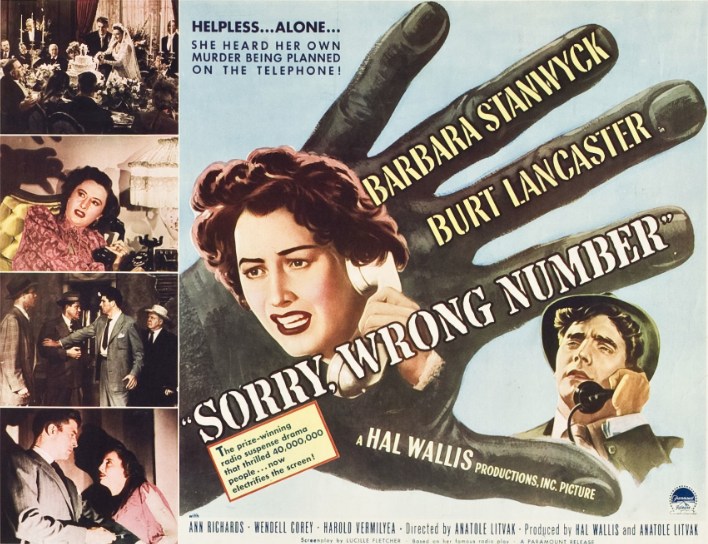
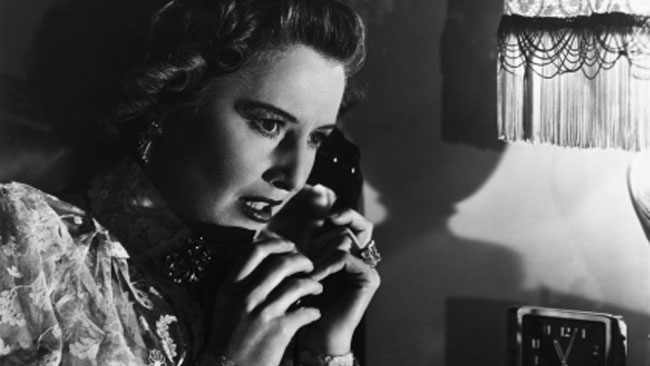
Stanwyck

It’s natural that such a popular radio play would be adapted for the big screen, but I wasn’t sure how well it would work expanded to three times its length for a visual medium.

People seem to have mixed feelings about Anatole Litvak’s film version, but I thought it was pretty good. I love Barbara Stanwyck, and she’s a more likeable protagonist than Agnes Moorehead was in the same role on the radio.

I found Sorry, Wrong Number similar in some ways to Robert Siodmak’s film The Killers (1946), which was adapted from the short story by Ernest Hemingway. Both films take a small, perfect little piece of art and expand it into a feature film by adding a bunch of characters and a whole lot of plot that’s not even suggested in the original work. (Incidentally, both films star Burt Lancaster and feature William Conrad in a small but important role.)

How well this works is up to the individual viewer, but I thought that Sorry, Wrong Number worked pretty well as a film. It doesn’t have the same impact as the radio play, but the integrity of the original story remains intact, even though it only occupies the first 15 minutes and the last 10 minutes of the film. The film version also humanizes her husband (played by Lancaster) and turns him into a victim of sorts, which is drastically different from the radio play, in which he is mostly an off-stage presence.

Anyway, I love Lucille Fletcher’s work for radio, so I thought I’d compile a list of some of the shows she wrote scripts for. You can click on the titles below to stream the shows or right-click to download them.

The Hitchhiker (first broadcast November 17, 1941)
This is the June 21, 1946, broadcast of the show on Orson Welles’s Mercury Summer Theatre on the Air. Welles reprises his role as a man driving cross-country who repeatedly see the same hitchhiker on the side of the road, even though there is no possible way the man could be moving from place to place so quickly. The chilling music is by Fletcher’s husband at the time, Bernard Herrmann. Like “Sorry, Wrong Number,” this play was done for radio several times, and was even adapted as an episode of The Twilight Zone in 1960.

The Diary of Sophronia Winters (first broadcast April 27, 1943)
Sophronia Winters (Agnes Moorehead), an unmarried middle-aged woman who is feeling liberated after her father’s death, meets a man named Hiram (Ray Collins) whose sister-in-law was also named “Sophronia.” Hiram marries Sophronia and begins to torment her with tales of the other Sophronia, an ax murderess. This is a claustrophobic, suspenseful story that evokes Charlotte Perkins Gilman’s story “The Yellow Wallpaper,” as well as memories of the real-life case of Lizzie Borden.

Sorry, Wrong Number (first broadcast May 25, 1943)
The original radio version stars Agnes Moorehead and is one of a handful of absolutely indispensable shows if you have any interest in radio drama.

Fugue in C minor (first broadcast June 1, 1944)
Ida Lupino plays a woman in the late Victorian era who is introduced to a widower with two young children. The widower, played by Vincent Price, is a composer, and his children believe that he murdered their mother, and that her spirit is trapped in their father’s organ.

The Search for Henri LeFevre (first broadcast July 6, 1944)
Paul Muni stars as a classical composer who believes his work has been plagiarized and broadcast on the radio by a man named “Henri LeFevre.”

The Furnished Floor (first broadcast September 13, 1945)
Don DeFore plays a man whose wife has died. He moves back into the apartment he used to share with his wife and restores it to exactly the way it was when his wife was still alive. Mildred Natwick plays his landlady.

Dark Journey (first broadcast April 25, 1946)
Nancy Kelly and Cathy Lewis play a pair of old friends who reunite after years apart. One of them is obsessed with a man who has spurned her, and believes that she can make him love her through sheer force of will.

The Thing in the Window (first broadcast December 19, 1946)
Joseph Cotten plays a man who thinks he can see a corpse in the apartment across from him, but he can’t be certain if his mind is playing tricks on him.

As I said, I love Lucille Fletcher’s work, and I hope you will too.