The Man I Love (1947)
Directed by Raoul Walsh
Warner Bros.
Loving the popular music of the ’30s and ’40s isn’t a prerequisite for enjoying Raoul Walsh’s The Man I Love, but it sure helps.
If you don’t like old pop standards (I do, and found myself humming “The Man I Love” constantly for about a day after I watched this movie), then you’d better like “women’s pictures,” because that’s what this is. (I’ve seen The Man I Love called a film noir, but it’s not. Half the movie takes place in nightclubs, and there’s a hint of criminal malice every now and then, but that alone does not a noir make.)
The most prominent tune is the one that gives the film its title, George and Ira Gershwin’s sublime “The Man I Love” — both as a smoky nightclub number and as a constant refrain in Max Steiner’s lissome score — but there are plenty of other great songs, like Jerome Kern and Oscar Hammerstein’s “Why Was I Born?” and James P. Johnson and Henry Creamer’s “If I Could Be With You.” There are also tunes just tinkled out on the piano, like George Gershwin’s “Liza (All the Clouds’ll Roll Away)” and Johnny Green’s “Body and Soul,” suffusing the film with a nostalgic languor that’s a nice counterpoint to all the melodrama.
When New York nightclub singer Petey Brown (Ida Lupino) packs her bags for Los Angeles to visit her siblings, she’ll find love, lose love, flirt with danger, and leave things a little better off than she found them. The poster for The Man I Love features the following tagline: “There should be a law against knowing the things I found out about men!” This is a bit of an overstatement, since most of what Petey finds out about men in this picture is what most clear-eyed women already know; most of them are rotten, some are crazy, some are sweet but naive and dim-witted, and the few you fall for are probably in love with another dame who they’ll never get over.
Petey’s sister Sally Otis (Andrea King) has a young son and a husband, Roy Otis (John Ridgely), who’s languishing in a ward for shell-shocked soldiers. Sally lives with the youngest Brown sister, Ginny (Martha Vickers), who’s 18 and should be enjoying life, but instead spends most of her time caring for the infant twins of their across-the-hall neighbors, Johnny and Gloria O’Connor (Don McGuire and Dolores Moran). Joe Brown (Warren Douglas) — the girls’ brother — is hip-deep in trouble. He’s working for a slimy nightclub owner named Nicky Toresca (Robert Alda) and seems destined for a one-way trip to the big house.
There are a few potentially interesting stories that never really go anywhere, such as Ginny’s attraction to Johnny, whose wife is two-timing him, and Sally’s relationship with her mentally ill husband. For better and for worse, Lupino is the star of The Man I Love, and her dangerous dealings with Nicky Toresca and her doomed romance with a pianist named San Thomas (Bruce Bennett) who’s given up on life dominate the running time of the picture.
The actors are all fine, and the stories are involving, but it’s the music that elevates this picture. Ida Lupino expertly lip synchs her numbers, which were sung by Peg La Centra (who can be seen in the flesh in the 1946 film Humoresque, singing and playing the piano in two scenes in a dive bar).
There’s also at least one allusion to a popular song in the dialogue. When Petey sees the twins and asks “Who hit the daily double?” Gloria responds gloomily, “Everything happens to me,” which is the title of a Matt Dennis and Tom Adair song first made popular by Frank Sinatra when he was singing for Tommy Dorsey’s band. There are probably other little in-jokes like that sprinkled throughout, but that was the only one I caught.
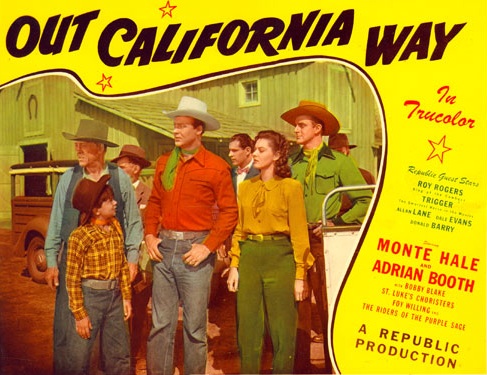
In the grand tradition of singing cowboys, Monte Hale plays a character in Out California Way named “Monte Hale.”
Out California Way is filmed in “Trucolor,” a two-color film process owned by Republic Pictures, and throws Hale into a metafictional world that pulls back the curtain and allows boys and girls at the Saturday matinée to see what might be going on behind the scenes at Republic with all of their favorite cowboy stars.
Hale doesn’t sit quite as tall in the saddle as Republic’s big boys, Gene Autry and Roy Rogers, but he’s self-effacing and charming enough to be believable when he says he’s “just a plain cowboy trying to break in” to the movies.
He’s assisted by little Danny McCoy (Bobby Blake, famous for playing Little Beaver in the Red Ryder series), who’s trying to get his horse Pardner into the movies.
Opposing them is the prima donna Rod Mason (John Dehner), who’s a big radio star as the “Robin Hood of the Range,” and has a career in pictures, too. Little Danny McCoy is president of the Rod Mason Fan Club, but that changes pretty fast after he actually meets the guy. Not only is Mason temperamental and nasty to his co-stars, but he hates children and animals. After threatening to whip Pardner if Danny doesn’t get him off the set, it’s clear that Danny has room in his heart for another cowboy actor. For that matter, so does his young, pretty mother, Gloria (played by Lorna Gray, who’s just 16 years older than Blake).
Hale’s an expert horse trainer, and together he and Pardner form a great team. Originally cast as stunt actors on one of Rod Mason’s pictures, they do such a good job that every rewrite comes back with a bigger role for Hale and a smaller part for Mason.
Mason and his sidekick, stunt rider Ace Hanlon (Fred Graham), are typical black hats, so they stop at nothing to foil Hale and Pardner’s success. While performing a stunt, Ace throws short-fuse dynamite at Hale that doesn’t kill him, but totally blows Pardner’s nerves.
Hale takes time off to retrain Pardner and help him over his trauma, but Mason and Ace immediately undo his hard work by sneaking into the corral at night and freaking out Pardner all over again by repeatedly firing a revolver near his head.
On his journey from “plain cowboy” to movie star, Hale is joined by special guest stars Allan Lane, Don “Red Barry,” Dale Evans, Roy Rogers, and horse Trigger, all members of Republic Pictures’ stable of western stars, and all playing themselves in the sequence in which Hale gives Gloria a tour of the studios. Roy and Dale perform a nice rendition of “Ridin’ Down the Sunset Trail” for them. Not bad for a first date.
John Dehner, who would later be a recurring actor on Gunsmoke (both the radio and TV versions), was a fine actor and makes for a great villain in this picture. While Out California Way isn’t substantively different from any of the hundreds of other oaters put out by Republic Pictures, it was fun to see a slightly different plot than the dependable old “evil land baron makes a grab for smaller ranchers’ land.”
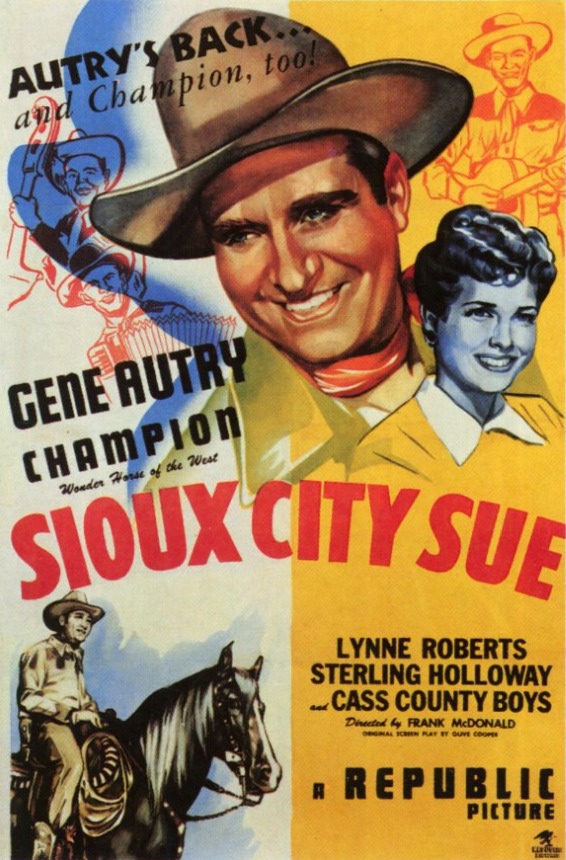
Frank McDonald’s Sioux City Sue repurposes the script from the 1939 comedy She Married a Cop and takes its title from one of the most popular songs of 1946. It was Gene Autry’s first film after he completed his service in the Army Air Corps during World War II.
More comedy than western, Sioux City Sue is lightweight fluff, but if you like Autry’s music, there’s plenty of it. (Although, if you’re like me, you’ll be a little sick of the title song by the end of the picture.)
In a plot that makes no sense if you stop to think about it for longer than half a second, a pretty blond Hollywood talent scout named Sue Warner (Lynne Roberts) casts Autry in an upcoming movie without telling him that he’ll never actually appear onscreen and is in fact voicing a singing donkey in an animated feature.
Things have changed a lot. Now, Hollywood stars regularly lend their voices to animated features. It’s nice work if you can get it; no time in the makeup chair, no difficult location shooting, and you can take your toddlers to the premiere. But in 1946, no star would ever dream of being in a cartoon. It’s hard, though, not to be delighted and amused by the premiere of the cartoon feature in Sioux City Sue. The little donkey with Autry’s voice, singing to his sweetheart on horseback, both of them wearing western duds, is pretty gosh-darned cute.
But Autry’s been lied to, and that rightly doesn’t sit well with the man. Of course, during the making of the film, Sue fell in love with him, so the big question for the second half of the picture is whether or not she’ll be able to convince him she’s sorry. She does her darnedest, quitting her job and coming to work on his ranch as a cook and general menial laborer.
This being a Republic western programmer, there’s an action-packed climax, and it’s up to Autry and his wonder horse Champion to save the day. The last few minutes of the picture, which involve a dynamited dam, a flood, and a cattle stampede, are exciting. But for the most part, Sioux City Sue is a laid-back and easygoing good time.
The Jolson Story (1946)
Directed by Alfred E. Green
Columbia Pictures
Alfred E. Green’s Technicolor extravaganza The Jolson Story purports to tell the story of Al Jolson, one of the most popular singers in the United States in the 1920s and ’30s.
What it actually does is take the bare bones of Jolson’s life story and tell a mostly fictionalized show-biz story of a man’s unalloyed love of music and his tireless quest to touch the hearts of every man, woman, and child in America. That he often touches their hearts while wearing blackface makes The Jolson Story a tricky movie to watch and review in the 21st century.
Apologists for Jolson’s use of blackface usually point to two things; one, Jolson was Jewish, a minority group that itself suffered a great deal of discrimination in the U.S., especially before World War II; two, he genuinely loved the black musical forms that he appropriated. (There are also claims that he fought against segregation on Broadway, but I was unable to find any hard evidence of what he did or when he did it. If anyone has more information, please let me know.)
Unlike the white actors in blackface in D.W. Griffith’s The Birth of a Nation (1915), who blacked up to portray their characters as brutes, villains, and rapists, or the minstrel-show comedians who used burnt cork on their faces to portray “those funny little darkies” as shiftless and uneducated objects of ridicule, Jolson used blackface strictly in the context of musical performance, and there was never anything deliberately mean-spirited about it.
But no matter what the context, it’s hard today to look at a white person with black makeup covering every part of their face except a wide area around the mouth meant to convey the impression of big fat lips and not cringe.
Born Asa Yoelson in 1886, Jolson emigrated from his native Lithuania with his mother and his siblings in 1894. They joined Jolson’s father, Moses Yoelson, who had been rabbi and cantor at the Talmud Torah Synagogue in Washington, D.C., since 1891. Late in 1894, Jolson’s mother died, which had a profound effect on him, and he reportedly became completely withdrawn for seven months. In 1895, however, he was introduced to show business by entertainer Al Reeves, and by 1897, he and his brother Hirsch (whose stage name was “Harry”) were singing on street corners. The brothers continued in show business for several years, but eventually “Al” and “Harry” had a falling out.
Jolson first appeared in blackface in 1904 in a show at Keeney’s Theatre in Brooklyn. According to John Kenrick, blacking up created in Jolson “a sense of freedom and spontaneity he had never known before.” His blackface performances, and his black character, “Gus,” became wildly popular. Jolson probably wasn’t the first American popular musician who ironically experienced feelings of “freedom” by appropriating the appearance and attitude of a black man, but he was the first and perhaps most significant of the century that also gave us Benny Goodman, Elvis Presley, the Beastie Boys, Vanilla Ice, and Justin Timberlake.
Jolson’s popularity grew and grew in the ‘teens and ’20s, culminating in his appearance in the film The Jazz Singer (1927), which was the first “talkie,” or film with a synchronized soundtrack. There wasn’t much dialogue in The Jazz Singer, and most of the sound came from Jolson’s songs, but when he said, “You ain’t heard nothin’ yet” (a phrase he had already made famous in his stage performances), Jolson carved his place into history.
The Jazz Singer tells a fictionalized version of Jolson’s own life. Jolson’s character, Jake Rabinowitz, sings jazz music as “Jack Robin,” and even debuts on Broadway, but he is forever in conflict with his deeply traditional father, who wants Jake to be the sixth generation of Rabinowitz men to sing as cantors in the synagogue. The dramatic conflict is eventually resolved when he nearly misses his Broadway debut to sing the Kol Nidre in the synagogue, allowing his father to die a happy man, and then follows it up with his appearance on the stage, in blackface, in which he goes down on one knee to sing “My Mammy” to his mother, who is sitting in the front row.
In his book Black Like You, John Strausbaugh writes of this scene that, “there’s barely a hint of the racist mockery that’s supposed to be the corrupt heart of blackface entertainment. It’s much more like watching Mick Jagger or Eminem — not mockery, but the sincere mimicry of a non-Black artist who loves Black culture (or what he thinks is Black culture) so dearly he can’t resist imitating it, even to the ridiculous point of blacking up.”
As I said earlier, The Jolson Story takes a lot of liberties with the facts. It begins in Washington, D.C., at the turn of the century. Little Asa Yoelson (Scotty Beckett) is the only boy in the audience at a burlesque theater who sings along with the vaudevillian Steve Martin (William Demarest) when he asks the audience to sing along with him as he performs “On the Banks of the Wabash.” Martin cries, “Give that boy a spotlight!”
Of course, Asa’s Old World parents don’t approve of his love of popular song, especially his father, the cantor (Ludwig Donath). His mother (Tamara Shayne) is a little more understanding.
Little Asa hops a train to Baltimore to follow Martin, who wanted to make him a part of his act, but he gets picked up by a copper and taken to St. Mary’s Home for Boys. His parents come up to collect him, but when they hear him singing “Ave Maria” in the boy’s choir at the orphanage, their hearts soften.
“Singing without his cap on,” Cantor Yoelson tsks-tsks. “It’s not so much what’s on the head, as what’s in the heart,” says Father McGee (Ernest Cossart).
With his parents’ support, Asa goes on the road with Steve Martin. “Give that boy a spotlight” becomes the whole act, with Asa as Martin’s ringer in the audience. When his voice breaks during a performance, Jolson turns it into a whistling performance. He’s a consummate performer, and the show must go on.
The transition from childhood to adulthood in The Jolson Story is nicely done. Scotty Beckett and Larry Parks (who plays Jolson as an adult) look eerily alike, which helps. There’s a montage of Jolson’s performances across the nation represented as postcards sent home to his parents. He performs in all the big cities, as well as smaller towns, like Walla Walla, Washington, “the town so nice they named it twice.” Less than a half hour has gone by, and already his parents (both of whom remain living for the entire picture) are completely supportive of his musical career. The Jolson Story is pretty short on dramatic conflict.
At the half hour mark, we finally see Parks as Jolson black up when he substitutes for a performer named Tom Baron (Bill Goodwin) in Churchill Downs, Kentucky, after Tom wins a “snootful” at the tracks and gets good and drunk. This is Jolson’s breakout moment, and it’s worth noting that the blackface and nappy wig make him anonymous, and indistinguishable from a completely different-looking white performer once he corks up.
Only one person, Lew Dockstader (John Alexander) realizes the deception, and offers him a place in Dockstader’s Minstrels. (A real performing group that Jolson worked with early in his career.)
It’s not long before Jolson bristles against the mawkish and old-fashioned music he performs for Dockstader as part of the chorus. When the group performs in New Orleans, Jolson wanders off into the black part of town. This sequence features the only real black people you’ll see in The Jolson Story, although none of them have speaking parts. Jolson hears genuine ragtime music as he sits in with a band (sans blackface, of course) loving what he is hearing. He goes back to Dockstader and says, “I heard some music tonight called ‘jazz.'” But Dockstader is happy with the show the way it is. “Son, minstrels have been doing fine for fifty years, and we take pride in doing it the way it’s always been done,” Dockstader tells him.
Jolson goes off on his own, and enters a period of creative exploration. He calls the music he’s been listening to and working on, “Music nobody ever heard of before, but the only kind I want to sing.”
By “nobody,” he means, of course, no white people, since the (presumably black) composers and musicians he refers to are never shown. It could have been interesting to see Jolson work with and collaborate with black artists, but after that brief scene in New Orleans, we never see another black person.
Jolson gets a call from good old Tom Baron, and Jolson tells him he has all kinds of music that just needs to be “polished up” a little (no pun intended) and makes his debut on Broadway, singing “Mammy,” in blackface, down on one knee. Interestingly, he does so without a nappy wig — just his dark hair slicked back — and he sounds “blacker” than he ever did before.
Jolson is depicted as a man who is always desperate to make a connection with his audience. During his show “Honeymoon Express,” he even has the house lights turned up, so he can see everyone in the audience. This was also the scene in which I felt that his blackface looked the most insane. There’s a superimposition of his face singing over a left-to-right pan of the crowd, and the closeup shows just how crazy his blackface looks, with a wide area around his lips un-made up, showing the white skin around his mouth, his pink lips, and his small yellow teeth. His eyes are nearly maniacal, he’s clearly sweating under his makeup, and he’s superimposed over a crowd of laughing, happy white people. It’s the stuff of nightmares.
When it comes to Jolson’s personal life, this picture makes Jolson seem like a singing monk, when in reality he was an inveterate womanizer. In The Jolson Story, he has no relationships with women except for his lifelong chaste romance with childhood friend Ann (Jo-Carroll Dennison).
As soon as she marries another man, however, he meets his future wife, producer Florenz Ziegfeld’s newest female sensation, Julie Benson (Evelyn Keyes). He spots her in the audience at one of his shows, and asks her to request a song. After she says, “April Showers,” he practically lies down on the stage in front of her and sings his heart out. Interestingly, this is the first time in the picture he sings a really heartfelt number without blackface on. Maybe it would have been too strange for audiences of the time to see him romance a white woman while blacked up.
After the show, he finds her mimicking his performance of “California, Here I Come,” perfectly copying his resonant voice and wild arm and leg gesticulations, and he falls, hook, line, and sinker.
Even though “Julie Benson” is a complete fabrication, I would have liked to have seen even more of her. Keyes only gets one proper musical number, showing her in action as part of the Ziegfeld Follies, but her dancing and singing were impressive, not to mention the fact that she has one of the best pair of gams I’ve ever seen.
As I said, there’s not much dramatic tension in this picture. Marrying a shiksa doesn’t raise an eyebrow on either one of his parents’ faces, and the only real conflict comes later in the film, as Julie encourages Jolson to quit show business so they can have a quiet life together, but he clearly misses the limelight, even though he claims he is happy.
Jolson was something of a has-been in 1946, and he was no longer one of the most popular singers in America, but this film was a huge hit, and revitalized interest in his music. It even spawned a sequel, Jolson Sings Again (1949). Larry Parks was nominated for an Academy Award for best actor, but didn’t win. Parks was a relatively unknown B-movie actor before he was cast in this role, which launched him into stardom. Not too many years later, however, his career would be destroyed by the House Un-American Affairs Committee, when he admitted under pressure that he had once been a member of the Communist Party. He testified against his will in 1951, and was never officially blacklisted, but his career hit the skids.
His performance in The Jolson Story really is excellent. He lip-synched all of the songs to recordings of Jolson’s voice, and the effect is seamless. He plays Jolson as a man who is pathologically addicted to stardom, but never makes him seem maniacal or inhuman.
The Jolson Story took home two Oscars in 1947. Morris Stoloff won one for best musical score, and the film also won an Oscar for best sound recording. William Demarest for nominated for best supporting actor, and Joseph Walker was nominated for best color cinematography (the only other nominee in this category, The Yearling, ended up winning).
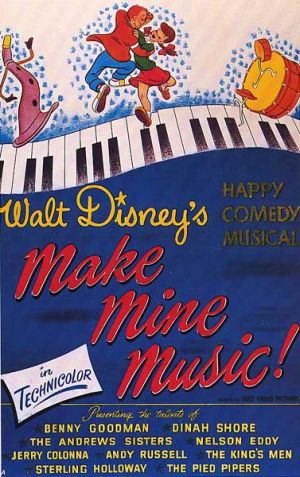
Make Mine Music (1946)
Directed by Robert Cormack, Clyde Geronimi, Jack Kinney, Hamilton Luske, and Joshua Meador
Walt Disney Productions / RKO Radio Pictures
From 1937 to 1942, Walt Disney Pictures produced some of their best and most famous animated features — Snow White and the Seven Dwarfs (1937), Pinocchio (1940), Fantasia (1940) Dumbo (1941), and Bambi (1942).
During World War II, however, the U.S. Army contracted Disney to make training and instruction films like Victory Through Air Power (1943), as well as propaganda shorts like Education for Death: The Making of the Nazi (1943), which is still an effective and chilling piece, and Der Fuehrer’s Face (1943), in which Donald Duck has a nightmare and imagines himself a factory worker for the Third Reich. (Have you ever wanted to see Donald Duck read Mein Kampf and give the Sieg Heil salute while quacking “Heil Hitler!” over and over? Of course you have. Check it out if you haven’t already seen it.) These films didn’t generate any income for the studio, so in the post-war years Disney’s feature-length animated films were inexpensive repackagings of short subjects; Make Mine Music (1946), Fun and Fancy Free (1947), and Melody Time (1948).
Like any compilation, Make Mine Music is a mixed bag. It begins with “a rustic ballad,” as the title card tells us. The King’s Men sing “The Martins and the Coys,” a comedic take on the famous Hatfield and McCoy feud of the late 19th century. Sadly, hillbilly humor is something we’ve lost in this country. As cable TV has spread to the farthest reaches of the nation and more people have moved from remote rural areas to suburbs, barefooted hicks who tote shotguns, sleep with their arm around a pig, drink “mountain dew” (a.k.a. moonshine), and never wear a shirt under their overalls have gone the way of the dodo. In 1946, however, there were still plenty of those “reckless mountain boys” running around, and this segment lampoons them in grand style. The Martins and the Coys blast one another to pieces with shotguns until their clans are each left with just one representative. One a young man, the other a young woman. The punchline? They fall in love, get married, and then the bickering and the feuding start all over again, while their deceased ancestors watch with approval from their perches on clouds up in hillbilly heaven.
The second feature is “a tone poem.” The Ken Darby Chorus sing “Blue Bayou” while what appears to be an egret lazily flies around a blue bayou full of dark, dripping colors. Eventually the egret meets a second egret and they slowly disappear into the sky together. This short is audiovisual heroin, and I felt as if I was being shot up against my will.
Luckily, the third feature, “a jazz interlude” featuring Benny Goodman and his Orchestra called “All the Cats Join In,” really knocks it out of the park. Stylized images are created in a sketch book by an oversized pencil and then come to life. First a cat is drawn, then erased, then replaced by an Archie Andrews lookalike. There are even a few risqué images, with a bobby soxer jumping in the shower to get ready for a date, then running around barely covered by a towel, then jumping into her clothes and exposing her frilly underthings while bent over and rummaging around in her closet. All the while her younger sister mimics her every move. Then it’s into the jalopy with the rest of the gang and off to the malt shop. The music in this one is genuinely good, and the animation style looks about 15 years ahead of its time.
At this point, the structure of Make Mine Music becomes clear, as this fun and jazzy number is followed by another mawkish piece of visual barbiturate — “a ballad in blue” — featuring Andy Russell singing “Without You.” Rivulets of water running down a windowpane create one maudlin image after another, none of them memorable, but all designed to evoke a sense of pretty desolation — trees without leaves against a sunset, etc. Eventually we come back in through the window and the piece ends with the image of a dark blue sky surrounded by black with a single star in the sky, mirroring the lyrics of the song. This short is not recommended for the clinically depressed or anyone who’s just been dumped.
True to the established pattern, the next short is tons o’ fun. It’s “a musical recitation” by Jerry Colonna of “Casey at the Bat.” It opens with a series of turn-of-the-century stills and enlightened lyrics like, “The ladies don’t understand baseball a bit, they don’t know a strike from a foul or a hit,” followed by typical goofy “humorous” Disney animation. It’s all silly fun, and the final strikeout sequence is especially over the top.
Unsurprisingly, this is followed by a “ballade ballet” with animated versions of dancers Tania Riabouchinskaya (listed in the credits as just “Riabouchinska”) and David Lichine, accompanied by Dinah Shore singing “Two Silhouettes.” The white silhouetes are clearly based on real figures, and are gag-inducing, but can’t hold a candle in the gorge-rising department to the chubby white cherub silhouettes who fly in at the very end to drape the dancers with something or other.
Next up is “a fairy tale with music,” which is a version of Prokofiev’s “Peter and the Wolf” narrated by Sterling Holloway. If you took a field trip to the symphony when you were a child, chances are “Peter and the Wolf” was on the program, since it’s a great way to introduce young people to a variety of instruments and the concept of musical motifs. Like “Casey at the Bat,” this segment is serviceable, but not wildly memorable.
Following this is the Goodman Quartet performing “After You’ve Gone.” Little anthropomorphic instruments dance around. It’s short and sweet.
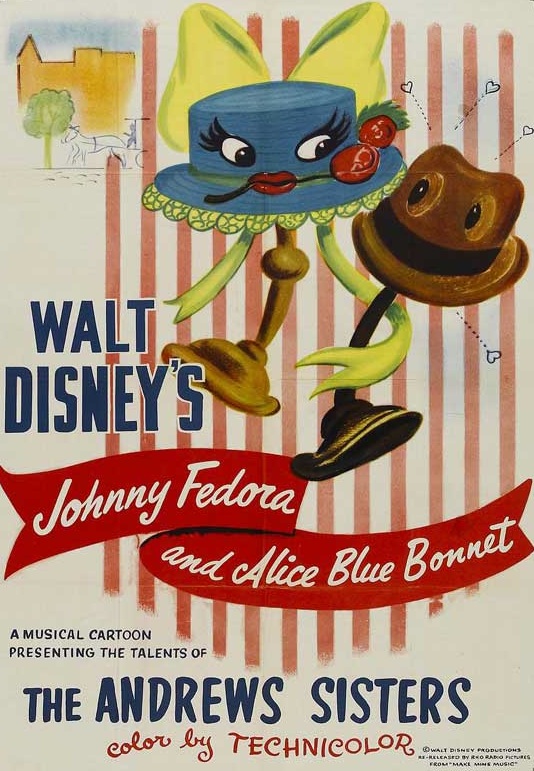
The high point of Make Mine Music is “a love story” sung by the Andrews Sisters, “Johnnie Fedora and Alice Bluebonnet.” This one is just adorable. Anthropomorphic hats have the potential to be really creepy, but they’re both pretty cute — especially Johnnie, whose expressive eyes are formed from the divets in the front of the fedora above the hat band. Long story short, Johnnie Fedora and Alice Bluebonnet sit next to each other in a department store window, fall in love, are separated, and eventually find each other again.
Make Mine Music was the first movie my mother remembers seeing. When I was a little kid, I asked her about the first movie she’d ever seen, and the only thing she specifically remembered was “Johnnie Fedora and Alice Bluebonnet.” She even sang the first few bars of the song, and got the melody just right, although not with the Andrews Sisters’ adenoidal twang.
The final short is an “opera pathetique” performed by Nelson Eddy, who does all the voices for the “tragic story” of “The Whale Who Wanted to Sing at the Met.” An impresario from the Met named “Teti Tati” takes off after Willie the whale after reading about him in the newspaper, because he believes that an opera singer has been swallowed by the whale, like Jonah. When Teti Tati discovers that Willie can sing in three voices, he believes that the whale has swallowed three different opera singers. (We get to see a whole lot of Willie’s three vibrating uvulas.) There follows a fantastic dream sequence in which Willie imagines himself in a variety of roles, his bulk spilling out over the stage. He showers himself with “tears” from his blowhole while singing Pagliacci. He appears in flames as Mephistopheles. But unfortunately, it’s all a fantasy, and eventually the impresario succeeds in harpooning Willie. Unlike the duck in “Peter and the Wolf,” however, Willie doesn’t come back. Sure, the conclusion shows us that he’s in heaven singing in “a hundred voices,” but what consolation is that to a five-year-old? Or to a thirty-five-year-old, for that matter?
If you like this movie enough to rent or purchase it on DVD, you’ll find that the first short, “The Martins and the Coys,” has been completely cut out, and the King’s Men have been deleted from the opening credits. Why? Because as a corporate entity, Disney constantly rewrites its own artistic history. When Melody Time was released for the home video market in 1998, a cigarette dangling from Pecos Bill’s mouth was digitally removed. Also, lyrics in the opening song of Aladdin (1992) were altered under pressure from the American-Arab Anti-Discrimination Committee.
This is nothing new. When Fantasia was re-released in the late ’40s, some incredibly racist caricatures were excised. Were they offensive? Of course. Should Disney be allowed to get away with whitewashing (no pun intended) their own work? I don’t think so.
Why was “The Martins and the Coys” removed, anyway? A common explanation given is that it contains gunplay, but so does “Johnnie Fedora.” Was it because of stereotypes of rural Americans? What about the Italian stereotypes in “The Whale Who Wanted to Sing at the Met”? Or the chauvinistic lyrics in “Casey at the Bat”?
Will some day the wonderful “All the Cats Join In” be removed from prints of this film under pressure from the fat-acceptance crowd, since in one scene a bobby soxer is drawn a little heavy in the hips, leading a boy to shake his head until the pencil and eraser come back in to “fix” her?
At least when Disney released Der Fuehrer’s Face on DVD as part of the Walt Disney Treasures — On the Front Lines collection, they didn’t mess with it. All you have to do is suffer through Leonard Maltin explaining that during wartime, stereotypes were sometimes used and abused. (And you do have to suffer through it every time you watch it. The DVD is programmed so you can’t fast forward past it.) Disclaimers like that are fine with me. Rewriting history is not.
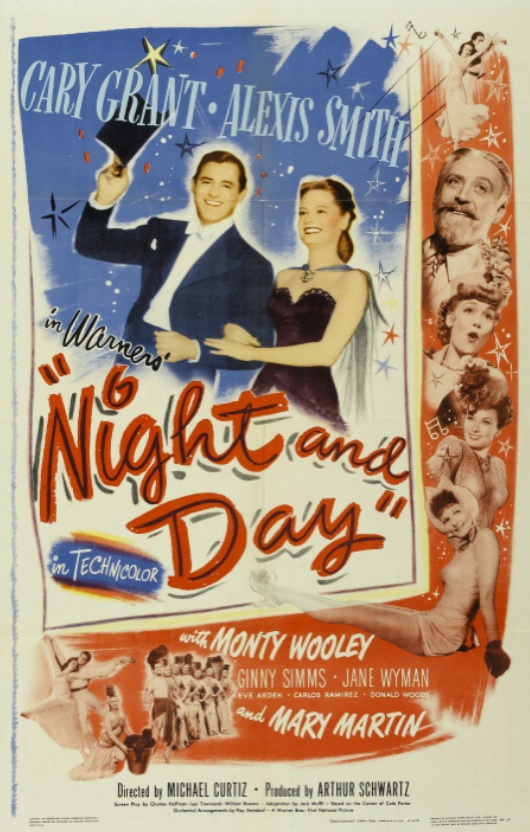
If you’re looking for a biopic about Cole Porter that tells the real story of his life, Michael Curtiz’s Night and Day is not for you. If, however, you’re merely looking for a sumptuous Technicolor musical extravaganza starring Cary Grant with great songs throughout, then it fits the bill.
The film was made with Porter’s supervision and full approval, so failures early in his career are blamed on everything but mediocre songwriting and production, and questions about his sexuality are never addressed.
The more recent Porter biopic, De-Lovely (2004), which starred Kevin Kline, implied that he was bisexual, but plenty of other sources claim he was gay, which makes more sense. His 35-year marriage to Linda Thomas was successful, if sexless, but all that means is that the two shared a genuine friendship and enjoyed each other’s company. Also, the seamier details of Porter’s parties during his time in Paris in 1917 and 1918 — “much gay and bisexual activity, Italian nobility, cross-dressing, international musicians, and a large surplus of recreational drugs” — wouldn’t have been appropriate material for a Hollywood production in the ’40s, even if Porter had been completely open about them.
Porter was an undeniably great songwriter — and one of the few Tin Pan Alley composers to write both music and lyrics — but even here the movie sanitizes things, since Porter’s lyrics were notoriously risqué. For instance, when the song “Let’s Do It” is played, you’ll heard about how “educated fleas” do it, but nothing about how roosters do it “with a doodle and a cock.” And musically, Ray Heindorf’s orchestrations tend toward the saccharine. By the end of the picture I felt as if I’d heard the same piece played over and over again.
Some of the whitewashing in Night and Day is purely ridiculous, though. Why was Porter’s first Broadway production, See America First, which was written with his Yale classmate Monty Woolley, a flop? Not because it was a critical disaster, according to this movie, but because the opening night crowd was drawn out into the streets by late-edition newspapers carrying word of the Lusitania sinking. Never mind that in real life, the New York American called the play a “high-class college show played partly by professionals.” In the world of Night and Day its failure was wholly due to a disaster outside of Woolley and Porter’s control. (Incidentally, Woolley plays himself in Night and Day, but perhaps owing to his age, his character is recast as one of Porter’s Yale professors instead of his contemporary.)
While there is no intimation that Porter may have ever produced mediocre work, there are gay undertones in the picture, if you care to look for them. Alexis Smith as Porter’s wife Linda spends a lot of the film looking dissatisfied and neglected. And the dramatic arc hits its climax at the 90-minute mark when Cole and Linda are pulled apart by the pressures of success. “You’ve put me in a small corner of your life, and every once in awhile you turn around and smile at me,” she tearfully tells him. In the film, their marital difficulties are resolved, but in an unconvincing, wordless final scene.
While the drama of Night and Day may be dishonest, the music is not, and it’s a great-looking movie.
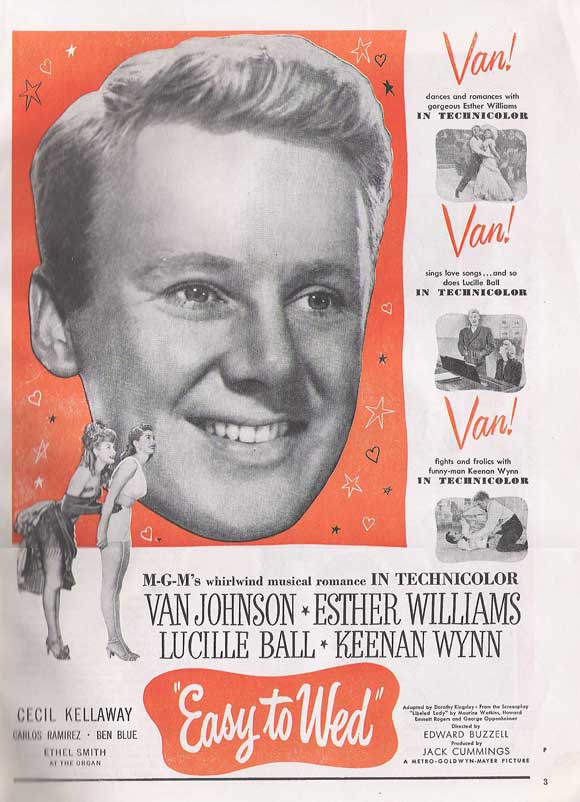
Easy to Wed is a remake of Jack Conway’s 1936 comedy Libeled Lady, which starred Jean Harlow, William Powell, Myrna Loy, and Spencer Tracy. No actors of that caliber appear in Edward Buzzell’s update, which is a lightweight affair from start to finish.
I haven’t seen Libeled Lady, but it was nominated for an Oscar for best picture, and is generally well-regarded in the pantheon of screwball comedies. Easy to Wed is generally regarded as a crummy piece of fluff, and that’s exactly what it is. Like the last MGM Technicolor extravaganza I saw, Ziegfeld Follies (1946), this movie is too long, is jam-packed with everything but a compelling plot and interesting characters, and its humor is mostly of the “painfully unfunny” variety.
The plot can be synopsized on the back of a cocktail napkin. Warren Haggerty (Keenan Wynn), the publisher of the Morning Star, is all set to marry his girl, Gladys Benton (Lucille Ball), but he and his paper are being sued for $2 million by J.B. Allenbury (Cecil Kellaway) after a story they published insinuated that Allenbury’s daughter, Connie (Esther Williams), is a nymphomaniac who goes after married men. The soundest plan Haggerty can come up with is to finagle his star reporter, Bill Chandler (Van Johnson), into a compromising position with Connie so they can produce photographic evidence that she is, indeed, a nympho who goes after married men. The only hitch is that Chandler is single, so Haggerty needs to hand off Gladys to him for a sham marriage for the duration of his assignment. Ridiculous? Sure.
At the time of the film’s release, one of its biggest draws was its leading man, Van Johnson. His appeal mystifies me. There’s nothing wrong with him, but I find his blandness overwhelming.
It’s not that I don’t like movies he’s been in — Thirty Seconds Over Tokyo (1944), in which he plays a heroic bomber pilot, was one of my favorite World War II movies made during the war — but I’d never go out of my way to see a movie just because he was in it, which makes me different from approximately every single woman living in America in the 1940s. I mean, check out that poster above. “Van! … Van! … Van!” What?
Intellectually, I can understand his appeal for the distaff post-war zeitgeist. The metal plate in his head may have kept him out of the war, but he was in enough war movies to give the impression of a returning hero. And unlike the haunted, shell-shocked, sweaty protagonists of countless noirs, Johnson projects nothing but good-natured cheer. He’s the young man you want your daughter to marry, or the even-tempered buddy you introduce to your sister.
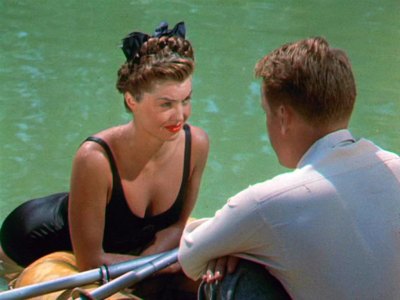
The main selling point of Easy to Wed for me was Esther Williams. There are none of her signature water ballet numbers, but she does spend a lot of time in the water. (Her first kiss with Johnson even takes place underwater.) She is beautiful and sexy, and emerges from the water many times in the picture, sleek and dripping, her makeup still perfect. But she’s beautiful on land, too, and looks great in Technicolor, whether she’s playing a board game by the fire or fully decked-out, singing and dancing in one of the film’s several passable musical numbers.
Besides Williams, the only thing I really liked about Easy to Wed was the crazily outfitted Ethel Smith, who performs a wild musical number at the organ. It’s a scene that borders on the surreal, and I loved it.
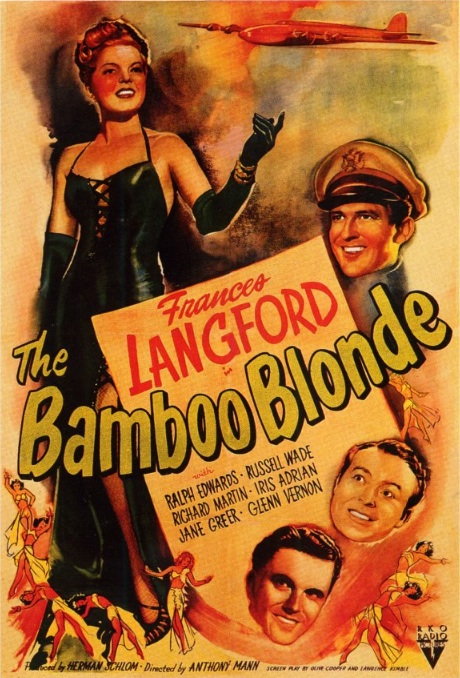
Anthony Mann’s The Bamboo Blonde is a cute little World War II-era programmer based on Wayne Whittaker’s story “Chicago Lulu.” It’s a romantic comedy, but there are nearly enough songs to qualify it as a musical. There are also nearly enough bombing raids over Japan to qualify it as a war movie, but the tone is so light that all the death and destruction on the ground is just there to provide a context for the saucy pinup girl painted on the nose of the bomber. It’s a fun romp — hell and gone from the westerns and noirs on which Mann’s reputation currently rests, but a thoroughly enjoyable way to kill 67 minutes during the dog days of summer.
The film begins with a magazine reporter named Montgomery (Walter Reed) interviewing Eddie Clark (“Truth or Consequences” host/creator Ralph Edwards), the mile-a-minute talker who runs Bamboo Blonde enterprises, an enormous conglomerate that operates a recording studio, furniture manufacturer, hosiery company, cosmetics line, and more. The reporter wants to know how the company got started, and when Eddie finally tires of trying to push Bamboo Blonde brand candy bars on the poor guy, he settles in to tell the story. It all started, Eddie explains, “Around the time Japan was finding out the B-29 wasn’t another American vitamin.”
The picture then begins in earnest, and we see the Ransoms, a wealthy family from Bucks County, Pennsylvania, tearfully send their son, Patrick Ransom, Jr. (Russell Wade), off to war. I say “tearfully,” but I can’t remember if there were any actual tears. The send-off was so wrought with emotion, however, that the presence of waterworks is beside the point. The Ransoms are the type of blue bloods who think nothing of Junior kissing mom on the mouth to say goodbye.
After cutting — or at least loosening — the umbilical cord, young Ransom wanders into Eddie’s Club 50, heedless of the sign outside barring all servicemen from entering. A couple of MPs walk out of the back office, and a perky little blonde named Louise Anderson (Frances Langford) acts quickly, hiding Ransom behind some curtains and then walking onstage to perform the song “I’m Good for Nothing But Love.”
Ransom is the new skipper of a bomber crew, and as the new guy, his boys had sent him to the club as a practical joke, or, as Ransom explains it to Louise over dinner, “Sending me here was a tactical maneuver to ditch me.” The two hit it off right away, and go on the kind of date that was really “on the beam” for the greatest generation, and is still pretty fun today. It starts with dinner at a restaurant with red and white checked tableclothes and candles stuck in bottles that’s run by a woman named “Mom” (Dorothy Vaughan) and it ends in a photo booth. The only thing that seems weird by today’s standards is that Louise sits in the photo booth alone, and Ransom ends up with a little framed photo of her.
That little framed photo will lead to big things. After a disastrous series of runs in the Pacific, Ransom’s B-29 has the worst record in the Air Force, without a single Zero downed. To turn their luck around, one of the guys borrows Ransom’s photo of Louise and paints an Alberto Vargas-style pinup of her with a stacked body “painted from memory.” After a long argument about what exact color hair their sexy new mascot has, they settle on “bamboo blonde,” and they’re well on their way to becoming “that nightmare to the Nips,” as Eddie Clark will later describe them.
The only problem is that Ransom’s crew thinks that Louise is his girlfriend, and he hasn’t disabused them of the notion, even though he has a dark-haired fiancée back home named Eileen Sawyer (Jane Greer, who shows a little bit more of that Out of the Past malevolence than she did in Sunset Pass, which was released a week before this picture). Eileen is a real harpy, and her interest in Ransom is only rekindled because of his growing fame. Meanwhile, Louise first learns that she’s been painted on the side of a bomber while reading a copy of Look magazine that has a picture of Ingrid Bergman on the cover wearing a nun’s habit (presumably from the 1945 film The Bells of St. Mary’s). You don’t have to be a genius to foresee the romantic complications that will arise once Ransom and his boys are called back home for a USO tour with Louise to help sell war bonds.
This is all frothy nonsense, of course, but Mann keeps things moving at a nice clip. Even when working with material that was clearly beneath him, such as this picture and Strange Impersonation (1946), he was able to craft something that was darned watchable. Langford was a classically trained singer, and has a really beautiful voice, which helps. (She was a radio star, and spent a lot of time as a USO performer.) For the most part, the musical numbers are staged in a straightforward fashion, but Mann takes a left turn into the realms of the surreal when Louise sings “Right Along About Evening.” Not only is everything in the idyllic farmland backdrop labeled (e.g., “mailbox,” “dog”), but it end with her rolling up a suddenly two-dimensional Ransom and stuffing him under her pillow before she goes to sleep. Truly odd.
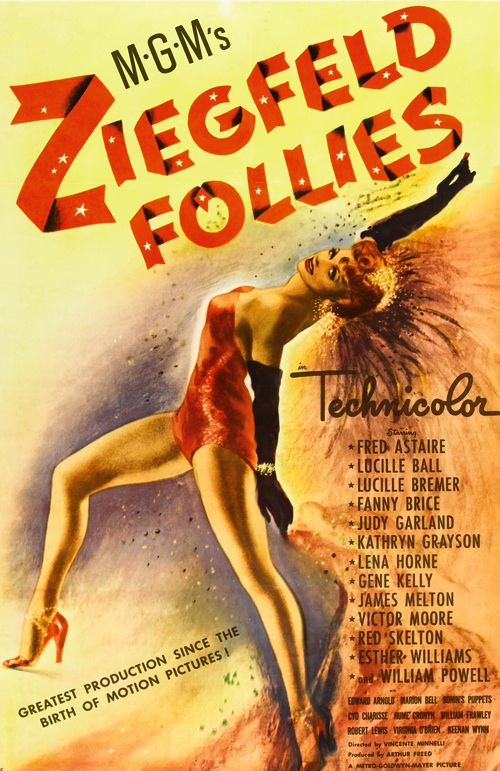
Ziegfeld Follies premiered in Boston on August 13, 1945. It was first shown in New York on March 22, 1946, and went into wide release on Monday, April 8, 1946. On some theatrical release posters, the film’s title was Ziegfeld Follies of 1946. The film is a lavish, old-fashioned musical pieced together from a big bag of spare parts. It was a pet project of producer Arthur Freed, and was originally intended to mark Metro-Goldwyn-Mayer’s 20th anniversary in 1944, but it went through so many edits and revisions that it missed the mark by more than a year.
Despite the studio’s boast on the theatrical release poster that Ziegfeld Follies is the “greatest production since the birth of motion pictures,” I really didn’t enjoy it that much. The musical numbers are hit and miss, and the comedy bits all hit the ground like lead zeppelins. There are a lot of impressive set pieces, and the colors are really bright, but as far as plotless extravaganzas go, it just doesn’t have the latter-day stoner appeal of Fantasia (1940).
The film begins with little models of Shakespeare’s Globe Theatre, then P.T. Barnum’s big top, then Florenz Ziegfeld, Jr.’s theater. That’s it, folks. The only three shows in the history of the world that matter. Clearly humility is not on the program for the evening.
William Powell, who played “Flo” Ziegfeld in The Great Ziegfeld (1936), reprises his role for the first segment of the picture. He’s on a set that looks like the kind of pad Liberace and Louis XVI might have picked out for themselves if they were roommates, talking a lot of nonsense about magic and the theater (it took me a little while to catch on to the fact that he’s supposed to be in heaven). We’re then treated to an elaborate stop-motion recreation of Ziegfeld’s 1907 opening by the Bunin puppets. All of his great stars are recreated as puppets; Marilyn Miller, Fanny Brice, Will Rogers, and even Eddie Cantor in blackface.
Each segment that follows is introduced by a storybook page. Fred Astaire appears in the first, “Here’s to the Girls.” He acknowledges that “Ziggy,” as he calls him, never had much use for villains or plots, then sings an ode to the American girls who were Ziegfeld’s main attractions. Cyd Charisse dances a little solo and then Lucille Ball cracks a whip over eight chorus girls dressed as panthers. Finally, Virginia O’Brien hollers for some fellers, and then sings, “Bring on Those Wonderful Men.” It’s a punishing spectacle that sets the tone for what is to come.
In the next segment, Esther Williams appears in … surprise, surprise … a water ballet. It’s fine, and she spends a lot of time underwater, which is neat, but what is the sequence even doing in this picture?
Next, Keenan Wynn appears in the comedy short “Number, Please.” I found it completely unfunny, but maybe that’s because I can’t stand “frustrating” humor. Basically, all he wants to do is make a phone call, but he’s thwarted at every turn, until his face is red and steam is coming out of his ears. For me it dragged the movie to a halt like a sweaty punchline comic working the in-betweens at a burlesque strip show.
Next, James Melton and Marion Bell sing “La Traviata.” Yawn.
Ooh, goody, more comedy! Victor Moore and Edward Arnold appear in “Pay the Two Dollars,” in which a man spits on the subway and is trapped in a legal nightmare because his attorney won’t let him just pay the $2 fine. Again, what’s up with the horribly frustrating situational humor? Not only did this segment not make me laugh, it made me feel as if I was watching a stage adaptation of a Kafka story.
Next, Fred Astaire and Lucille Bremer appear in a “dance story” called “This Heart of Mine,” with music by Harry Warren and words by Arthur Freed. It’s pretty good. It took me back to the days when lighting a girl’s cigarette and then dancing while smoking was still classy. On the other hand, no one glides across a ballroom like old Fred, so the rotating circular centerpiece seemed wholly unnecessary. Who did the director think he was dealing with, Clark Gable?
The next comedy segment is called “A Sweepstakes Ticket,” and for some reason it’s filmed on a regular set, not the impressionistic “stage” sets used in all the previous comedy bits. Hume Cronyn gives away a winning Irish sweepstakes ticket to make up the few bucks he was short on the rent, and he and his wife Fanny Brice try to get it back from their landlord. Again, it’s not at all funny, just frustrating.
The next segment, “Love,” with Lena Horne (R.I.P.), was a nice opportunity to see black people in Technicolor, and in a steamy tropical setting no less. It should have been longer.
Next, Red Skelton shows us all what will happen “When Television Comes.” He does a promo for “Guzzler’s Gin.” He drinks a whole bunch each take and acts more and more stinko. If you’re amused by cross-eyed drunkenness and double-takes, this will still do the trick. Although it’s possible audiences in 1946 were amused by this segment, I can’t imagine they were left with a very clear idea of what the advent of television would mean for the country.
Up next is “Limehouse Blues,” in which Fred Astaire and Lucille Bremer return, only this time in yellowface. The Chinatown tropes are offensive, but the colors and imagery are quite beautiful and impressive, in a non-P.C. sort of way. Once we get to the actual dance number, however, the piece is hamstrung by its own ridiculous conceit. It doesn’t help that in all the medium shots, Astaire’s makeup makes him look a lot like Boris Karloff in The Mask of Fu Manchu (1932).
In “A Great Lady Has an Interview,” Judy Garland seems to be lampooning Katharine Hepburn or possibly Greer Garson. I got the feeling that there were a lot of industry in-jokes that I wasn’t getting. For me, Garland is always a treat, however, so I didn’t mind it that much.
And then, like a terrible party that suddenly becomes fun 20 minutes before the police arrive to break it up, Fred Astaire and Gene Kelly appear in “The Babbitt and the Bromide,” by George and Ira Gershwin. Their dialogue is funnier than any of the “comedy” bits in the movie, and their side-by-side dance number is transcendent. Ziegfeld Follies is worth seeing for this sequence alone.
Finally, Kathryn Grayson sings “Beauty,” by Warren and Freed. It’s standard stuff, but there are enormous piles of bubbles that I thought were pretty cool.
In other news, the last living Ziegfeld Follies “girl,” Doris Eaton Travis, died yesterday at the age of 106. I hope it doesn’t seem as if I’m beating up on the Follies themselves. I’d love to go back in time and see a Ziegfeld revue on Broadway. This film just doesn’t really capture the magic.
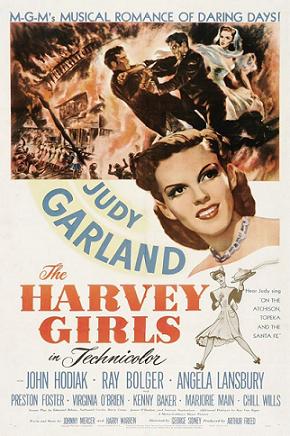
In 1876, a 41-year-old entrepreneur named Fred Harvey opened a string of restaurants along the Atchison, Topeka, and Santa Fe Railway line. The eateries catered to middle-class and wealthy travelers alike, and at the height of the franchise’s success, there were more than 80 Harvey House restaurants. Harvey died in 1901, but the Fred Harvey Company continued to build restaurants into the 1960s.
A restaurant chain might seem an unlikely subject for a big-budget, Technicolor, Hollywood musical, but clearly the young, attractive waitresses in their crisp black and white uniforms were enough of a hook. The film opens with the following portentous prologue:
“When Fred Harvey pushed his chain of restaurants farther and farther west along the lengthening tracks of the Santa Fe, he brought with him one of the first civilizing forces this land had known … the Harvey Girls. These winsome waitresses conquered the west as surely as the Davy Crocketts and the Kit Carsons — not with powder horn and rifle, but with a beefsteak and a cup of coffee. To these unsung pioneers, whose successors today still carry on in the same tradition, we sincerely dedicate this motion picture.”
If all this is to be taken seriously, then who wouldn’t want to lionize these distaff settlers? I haven’t read Samuel Hopkins Adams’s 1942 novel that this film is based on, but it must have been a good story for Hollywood to want to pick it up. Or maybe it was just that Johnny Mercer and Harry Warren realized what a catchy rhythm the phrase “on the Atchison, Topeka, and the Santa Fe” had.
After the prologue and credits, the film opens on a shot of a moving train. Susan Bradley (Garland) is standing on the deck of the caboose, singing a forgettable song about love. She is heading out west to marry a man whom she only knows from the florid love letters he has written her. When her suitor, H.H. Hartsey (Chill Wills), turns out to be a functionally illiterate cowpoke who had a friend play Cyrano for him by penning the letters himself, Susan parts with him (mostly amicably), and becomes a Harvey girl.
The dramatic conflict, such as it is, comes from the local saloon and gambling house, which also features dancing girls. The owner of the palace of sin, Ned Trent (John Hodiak), and his star attraction, Em (played by a young and foxy Angela Lansbury), fear that the opening of the Harvey House will usher in a new era of respectability and crush their business. In real life of course, Trent’s girls would have been prostitutes and Em would have been their madam, but in the world of 1940s M-G-M musicals, dancing the cancan for hooting and hollering cowboys was about as scandalous as they could get.
Garland and Lansbury both give good performances, and are backed up by a large and talented cast. Virginia O’Brien (as the Harvey girl “Alma from Ohio”) is tough and sassy, and Ray Bolger, most famous for playing the Scarecrow in The Wizard of Oz (1939), here gets to play the Cowardly Homosexual, a popular character type in Hollywood pictures for decades. While his sexual preference is never identified outright, Bolger’s character’s effeminacy and fear of any butch labor (such as shoeing horses), as well as his spirited prancing, leaping, and tap dancing make it clear that he doesn’t have any designs on the ladies.
The Harvey Girls is an entertaining mix of musical and western. But if director George Sidney aspired for it to be anything more than breezy entertainment, it doesn’t show. Judy Garland is always a delight, but Vincente Minnelli’s ability to coax a nuanced performance from her and to tell an engaging story from beginning to end in a musical is sorely missed here. The Harvey Girls is enjoyable, but it’s no Meet Me in St. Louis (1944). Also, aside from the standout song, “On the Atchison, Topeka, and the Santa Fe” (which won an Academy Award for best song), no musical number in the picture really stands out.



 OCD Viewer