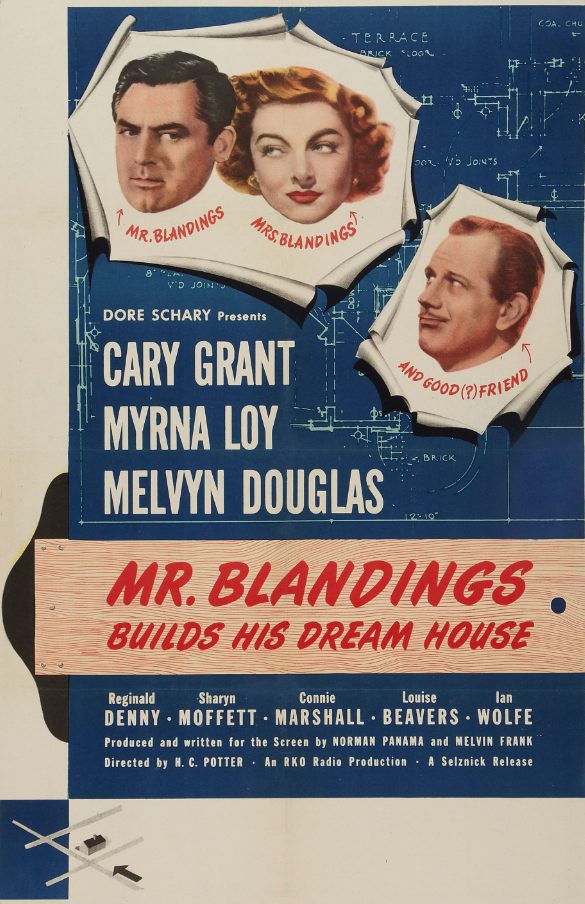
I don’t know about you, but comedies like H.C. Potter’s Mr. Blandings Builds His Dream House really stress me out.
When the subject of “things I could never laugh at” comes up, most people think of things like the death of a beloved family pet or ethnic cleansing, but while I don’t find either of those subjects fertile ground for comedy, one subject stands above all others as something I can never laugh at — chasing good money after bad.
I don’t know if Mr. Blandings Builds His Dream House is the first comedy in which most of the “comedy” involves someone making terrible decision after terrible decision and throwing vast sums of money into a disastrous project, but it’s one of the best-known and most well-loved.
The first movie like this I saw was the 1986 Tom Hanks “comedy” The Money Pit, which even as a kid I found stressful and unfunny.
The second was the Joe McDoakes “comedy” short So You Want to Move (1950), in which every bad decision the main character makes and every accident he has is flashed on screen in dollar amounts. As the one-reeler continues, and he drops things and crashes into things, his financial responsibility grows and grows. As an argument for using professional movers, So You Want to Move is a persuasive infomercial, but as a comedy it’s totally devoid of laughs. At least for me.
At least Mr. Blandings Builds His Dream House is enjoyable in the early going, and stars Cary Grant and Myrna Loy, who previously starred together in Wings in the Dark (1935) and The Bachelor and the Bobby-Soxer (1947), and who are both attractive, charming, and a lot of fun to watch.
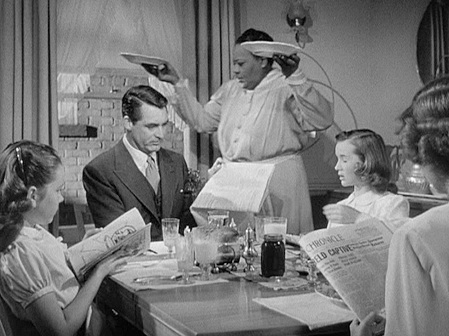
Grant plays Jim Blandings, a college graduate who lives in Manhattan, works in advertising, and makes about $15,000 a year. We learn all this from the film’s omniscient narrator, who also calls Mr. Blandings a “modern-day cliff dweller,” since he lives in a high-rise apartment building with his beautiful wife Muriel (Myrna Loy), their two daughters, and their housekeeper Gussie (Louise Beavers).
Here’s a case where inflation doesn’t tell you everything, since $15,000 is roughly $145,000 in 2012 dollars, but I don’t think even that salary today would be nearly enough to support a wife who doesn’t work, two kids in private school, and a Manhattan apartment big enough to fit a family and a live-in servant.
Granted, the Blandings live in cramped quarters. Everything in their apartment is full to bursting and ready to explode like Fibber McGee’s hall closet, and as the narrator tells us, “just getting shaved in the morning entitles a man to the Purple Heart.” But that’s just Manhattan living, folks. Even for the relatively well-to-do.
One day Mr. Blandings is enticed by a brochure from a Connecticut real estate firm that encourages him to “trade city soot for sylvan charm.”
I can’t even talk about what happens next. It’s just too painful.
I will say this, however. Mr. Blandings Builds His Dream House was funny enough to entertain even someone like me, and Mr. Blandings is presented as just enough of a screwball idiot to make his terrible decisions a little easier to laugh at. For instance, when his lawyer Bill Cole (Melvyn Douglas) asks what his engineer said about the foundation of the house he just purchased, Mr. Blandings responds, “Who needs engineers? This isn’t a train, you know.”
Jacques Tourneur’s crisp thriller Berlin Express presents occupied Germany in miniature. Every nation associated with Allied-occupied Germany is represented by the film’s characters — the United States, France, Germany, England, and Russia.
It’s filmed in the semi-documentary style that was popular in the late ’40s. Europeans speak to each other in their own languages, with no subtitles (there is a voiceover narrator to explain to the viewer what’s transpiring), and much of Berlin Express was filmed on location in Paris, Frankfurt, and Berlin. (According to IMDb.com, it was the first Hollywood production in Europe after World War II.)
Berlin Express has stylistic elements of the German “Trümmerfilm” (“rubble film”), like Die Mörder sind unter uns (The Murderers Are Among Us) (1946). The German rubble films used the war-ravaged backdrops that were plentiful in German cities heavily bombed during the war. Berlin Express doesn’t have the same gravitas or overwhelming sense of tragedy as the rubble films, but the location footage gives it a sense of authenticity not found in most run-of-the-mill thrillers.
Compared with Jacques Tourneur’s previous film, the film noir masterpiece Out of the Past (1947), Berlin Express is a lesser effort, but Tourneur is a pro, and every one of his films that I’ve seen has been a work of solid craftsmanship.
The MacGuffin in Berlin Express is a note that falls into the hands of the Deuxième Bureau that reads: “21:45 / D / 9850 / Sulzbach.” The first part seems to refer to a time of day (9:45 PM), but there are Sulzbachs in every occupied zone of Germany. What’s happening? And where will it happen?
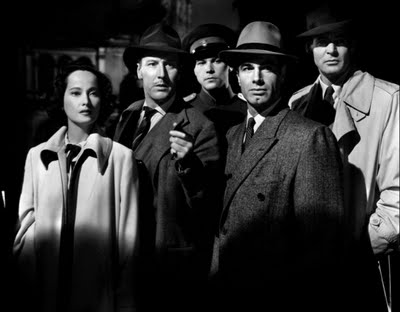
Enter a multinational motley crew of characters traveling aboard the Berlin Express. In compartment A is Robert J. Lindley (Robert Ryan), a United States Government Agricultural Expert. In compartment B is Lucienne Mirbeau (Merle Oberon), a secretary from France. In compartment C is Herr Otto Franzen (Fritz Kortner), once a German industrialist, now a dealer in scrap iron. Compartment D is unoccupied, but is being held for a “person of importance.” Compartment E is shared by two men, a former British soldier named James Sterling (Robert Coote), and a military aide for the Russian Occupation Authority, Lt. Maxim Kiroshilov (Roman Toporow). In compartment F is Henri Perrot (Charles Korvin), once a member of the French Underground, now a man of commerce. And finally, in compartment G, is Hans Schmidt (Peter von Zerneck), whose occupation is a mystery to the viewer (the whistle of the train covers what the narrator is saying, which is a cute touch).
Of course, this is an espionage thriller, so it should go without saying that not everyone is what they appear to be, and there will be at least one big reveal or switcheroo before the credits roll.
Berlin Express was made during that curious little space in time when World War II was over but the Cold War had not yet kicked into high gear. Its villains may not seem very plausible or consequential to modern viewers, but for my money, a good thriller is a good thriller. The voiceover narration is a little heavy-handed, but for the most part Berlin Express keeps things tight, fast-paced, and properly thrilling.
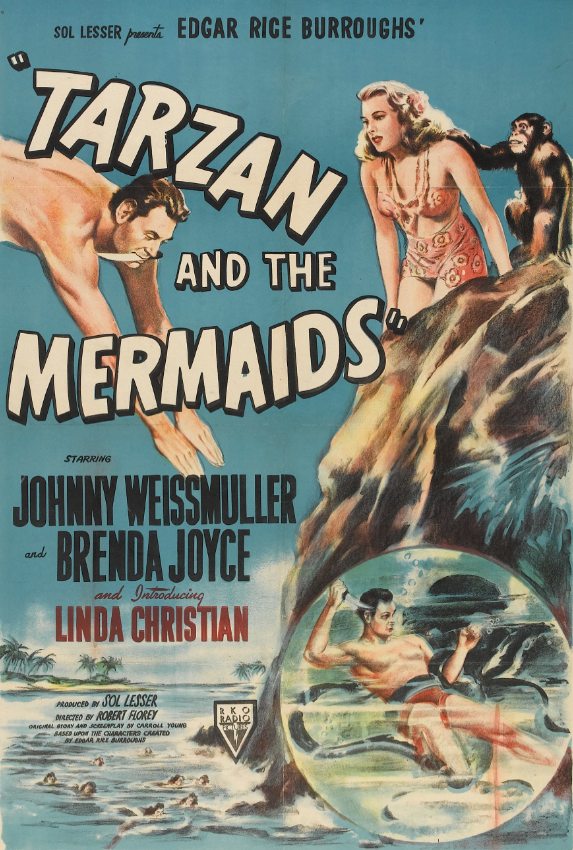
Tarzan and the Mermaids (1948)
Directed by Robert Florey
Sol Lesser Productions / RKO Radio Pictures
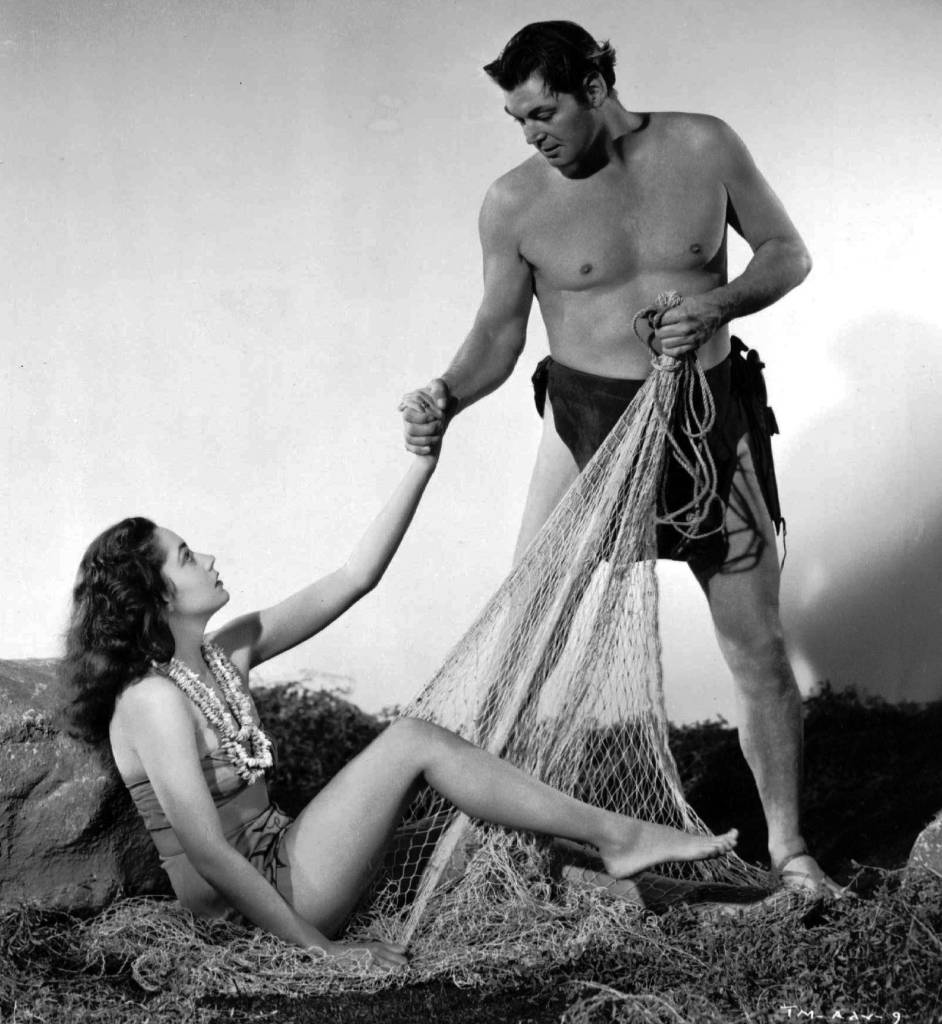
Tarzan and the Mermaids was Johnny Weissmuller’s last go-round as the Lord of the Jungle. It was directed by Robert Florey, produced by Sol Lesser, and released by RKO Radio Pictures. It was Weissmuller’s twelfth time starring in a Tarzan film. (His first six Tarzan films were released by M-G-M and the last six were all released by RKO.)
The M-G-M Tarzan films are generally superior — the production values are higher and Weissmuller was younger, so he better looked the part — but the RKO Tarzan films are a lot of fun, too. They’re B pictures, no doubt about it, but they’re well made for what they are, and it’s always fun to see Weissmuller swing, yell, swim, grunt, and get the bad guys.
Tarzan and the Mermaids was filmed entirely on location in Mexico, at Studios Churubusco and locations in Acapulco and Mexico City. The film doesn’t actually take place in Mexico, but rather in and around “the forbidden island of Aquatania,” which lies at the end of the river that runs past Tarzan and Jane’s home.
If you’ve ever seen a Tarzan movie you know that Tarzan and his mate Jane (played by Brenda Joyce) live somewhere on the continent of Africa, so Aquatania is probably meant to exist somewhere in the Indian Ocean, but there’s no mistaking it for anything but Mexico, even if the people of Aquatania are dressed to look vaguely Polynesian.
Then again, no one watches a Tarzan film for geographic or anthropological accuracy. For that matter, no one should watch a Tarzan movie and expect its story to accurately reflect its title.
To wit, the closest thing to a mermaid in Tarzan and the Mermaids is the beautiful Mexican-born actress Linda Christian, a.k.a. “The Anatomic Bomb” (and soon to be Mrs. Tyrone Power). Christian plays “Mara,” a young woman Tarzan drags out of the river.
Mara is on the run from her tribe’s high priest, Palanth (George Zucco), who has demanded she marry the “god” Balu, a slow-moving, bejeweled monstrosity that stands atop the cliffs and causes his worshipers to quake in fear.
Balu is just a guy wearing a costume, of course. He’s a villainous pearl trader named Varga (Fernando Wagner), and he and Palanth have a lucrative scam going. I wasn’t clear on how Balu planned to consummate his forced marriage to Mara (costume on or costume off?) but since she falls under Tarzan’s wing before that can happen, her reunion with her true love, Tiko (Gustavo Rojo), is pretty much a foregone conclusion.
I enjoyed Tarzan and the Mermaids despite its flaws. John Laurenz’s character “Benji” is similar to the Chito Rafferty character he played in numerous RKO westerns, and he seems mind-bogglingly out of place in the film, but other than that I didn’t have any major complaints. Dimitri Tiomkin’s musical score is rousing, there are some spectacular cliff diving stunts, and Weissmuller is always a treat to watch as Tarzan, even when he’s middle-aged and puffy.
Understand me, gentleman. I am not a martinet, but I do want to take pride in my command. We here have little chance for glory or advancement. While some of our brother officers are leading their well-publicized campaigns against the great Indian nations — the Sioux and the Cheyenne — we are asked to ward off the gnat stings and flea bites of a few cowardly digger Indians.
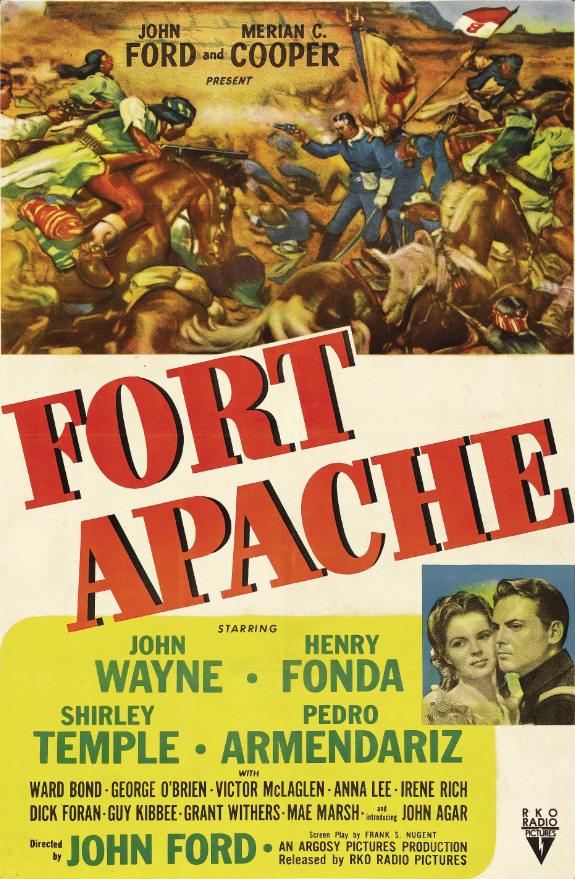
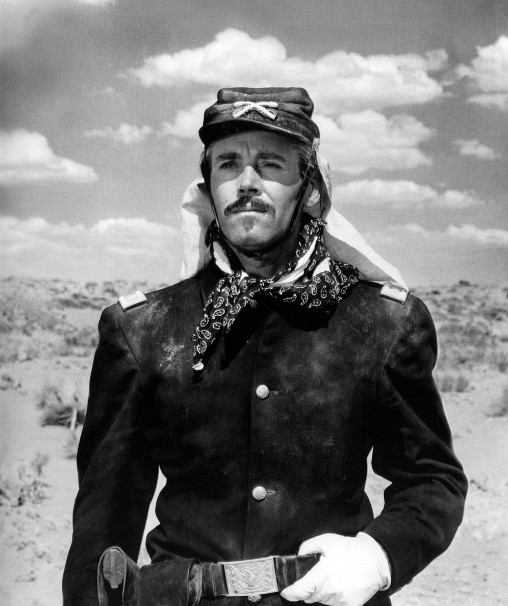
This irony-laden speech by Lieutenant Colonel Owen Thursday (Henry Fonda) occurs early in the second reel of John Ford’s Fort Apache. It foreshadows the tragic and violent finale of the film, and firmly establishes what kind of man Thursday is. Not only is he the dictionary definition of a martinet, but his underestimation of the Apache will be fatal.
When Captain Kirby York (John Wayne) protests that Cochise and his Apache warriors are far from “digger Indians,” Thursday refuses to listen, and the conflict between Capt. York and Lt. Col. Thursday only intensifies as the film goes on. When York, who is familiar with the customs of the Apaches, arranges a meeting with Cochise (played by Miguel Inclán), Thursday refuses to honor the agreement Kirby makes with Cochise. “There is no question of honor, sir, between an American officer and Cochise,” Thursday says. Kirby simply responds, “There is to me, sir.”
In a lesser film, Thursday’s rigid adherence to discipline would mask cowardice, but Thursday isn’t a coward. He isn’t vainglorious either. When York, who remembers Thursday as a general from Civil War, addresses him as “general,” Thursday curtly corrects him. “I’m not a general, Captain,” he says. “A man is what he’s paid for. I’m paid in the rank of Lieutenant Colonel.”
Fonda’s performance in Fort Apache is remarkable. His character is so clearly in the wrong so much of the time that it would be easy for him to be a stock villain, but he never is.
Fort Apache is a study in heroism and myth-making, and a story of how the messiness of real life will always end up either forgotten or completely remade.
Of course, since it’s a film directed by John Ford, it’s also a film full of broad comedy, mawkish Irish sentimentalism, and lionizations of the common man.
And no matter how much Ford ever deconstructed the idea of heroism and myth-making in any of his films, he couldn’t resist engaging in his own larger-than-life artistry. Just like My Darling Clementine (1946), Ford shot Fort Apache in Monument Valley because it looked good, not because it was where the real events of his story took place.
Fort Apache isn’t a perfect film, but it’s damned close. It’s an excellent western, and a great film about the U.S. Cavalry that doesn’t paint the Apache as mindless savages. There are references to men tied to wagon wheels, roasted alive (off screen, of course), but Cochise and his warriors are never two-dimensional villains.
Fonda and Wayne are the stars of the film, but they have excellent support from the rest of the cast, especially Ward Bond, who plays Sergeant Major Michael O’Rourke, and Pedro Armendáriz, who plays Sergeant Beaufort.
If there’s a weak link for me in the film, it’s John Agar, who plays Second Lieutenant Michael Shannon O’Rourke. When Agar appeared in Fort Apache he was the real-life husband of Shirley Temple, who plays Lt. Col. Thursday’s daughter, Philadelphia Thursday. (Agar and Temple married on September 19, 1945, and were divorced on December 5, 1949. They had one child together.)
In terms of action, Fort Apache is stately and fetishistic. There are no real skirmishes that lead up to the final battle — as there would be in any picture made today — there is only the aftermath of Apache raiding parties.
And in the charge that begins the final battle, the bugler is the first to be killed by Cochise and his men, putting an end to the stirring patriotic music, which is perfectly fitting. The final battle is accompanied only by Apache war whoops, gunshots, and the thunder of hoof beats.
During World War II, director George Stevens served as a Lieutenant Colonel in charge of combat photography. He filmed D-Day, the Battle of the Bulge, the liberation of Paris, and the horrors of the concentration camps.
When he returned home to America he started a production company, Liberty Films, with William Wyler and Frank Capra. For his first film, Stevens chose to look back to the time and place of his own boyhood — early 20th-century California — rather than the uncertain post-war future.
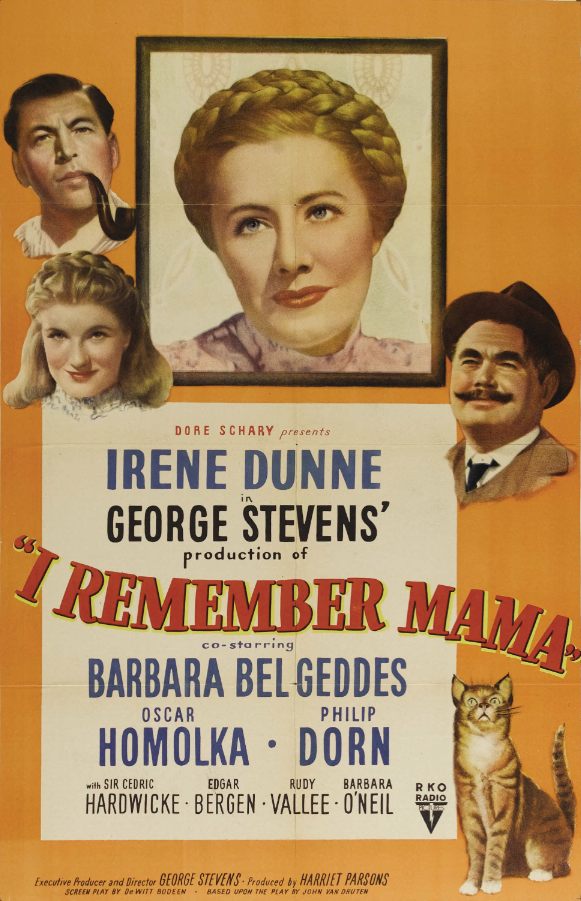
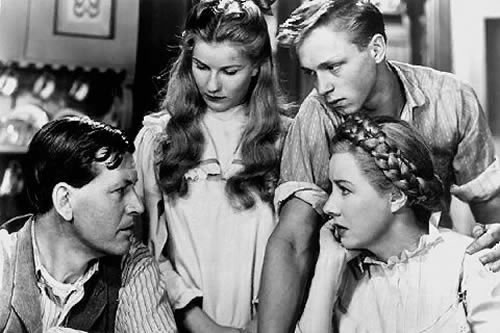
I Remember Mama is the story of a Norwegian immigrant family living in San Francisco. It’s based on the 1944 play by John Van Druten, which was adapted from Kathryn Forbes’s book Mama’s Bank Account, which was published in 1943.
The film opened in limited release on March 9, 1948. At 11:55 AM on that day, director Michael Curtiz sent Stevens a telegram that read:
Dear George: Without exception I think “I Remember Mama” is the most perfect picture that Ive [sic] seen in years. Direction was magnificent and I think all of us can learn [a] great lesson from it. My deepest admiration goes to you and everyone who had any part in this production. Warmest regards. Mike Curtiz.
While I wouldn’t go so far as to say that I Remember Mama is the most perfect film I’ve seen in years, it’s a wonderful movie that’s heart-warming without being saccharine and that’s beautifully acted and filmed, much of it on location in San Francisco.
Of course, Stevens had the benefit of wonderful source material. I’ve never seen the play by John Van Druten that the film is based on, but I read Kathryn Forbes’s Mama’s Bank Account in sixth grade, and so much about it has stayed with me. It’s warm, humorous, and there’s pure magic in its evocation of ordinary life.
Mama’s Bank Account is a fictionalized memoir written from the point of view of a young woman who aspires to be a writer. (Much of the book was inspired not by Forbes’s mother but by her Norwegian immigrant grandmother.)
Barbara Bel Geddes plays Katrin, the young writer who finds her subject when she decides to write about her mother, and she sometimes addresses the camera directly. Irene Dunne plays “Mama” (we never learn her real name, which is as it should be).
Like the book, the film is a series of vignettes. There is the tale of the family’s roomer, Mr. Hyde (Cedric Hardwicke), whom Mama’s sisters warn her might be putting something over on her when he’s always late with the rent, but Mama doesn’t mind so much, because Mr. Hyde reads to the family every night from the classics — A Tale of Two Cities, The Hound of the Baskervilles, and Hamlet. Like most of the stories that comprise I Remember Mama, the tale of Mr. Hyde has a bittersweet end, but it’s more sweet than bitter, since his enthralling nightly storytelling sessions kept Katrin’s brother Nels (Steve Brown) off the street the night his friends were arrested for breaking into a shop, and were Katrin’s inspiration to become a writer.
My favorite vignette from both the book and the movie is about Katrin’s Uncle Chris (Oskar Homolka), with his loud voice and his fierce black mustache, who would come down from his ranch in the north and descend upon San Francisco in his automobile, charging up Market Street with ferocious speed, compensating, perhaps, for the limp he still carries from a childhood accident. When Katrin writes a story about her uncle Chris, her teacher scolds her and tells her it’s not nice to write that kind of story about a family member.
I Remember Mama occasionally gets a little schmaltzy, like when Mama impersonates a scrubwoman to get into the children’s ward of a hospital to see her youngest child, Dagmar (June Hedin), and then sings a lullaby that puts all the little girls in the ward to sleep. But for the most part Stevens avoids easy sentiment. Dunne’s performance as Mama is really wonderful, and her line delivery is great. When Katrin asks her mother, “Wouldn’t you like to be rich?,” Mama responds, “I would like to be rich the way I would like to be ten feet high. Is good for some things, is bad for others.”
I Remember Mama was nominated for a bunch of Academy Awards, but it didn’t win any — Best Actress (Irene Dunne), Best Supporting Actor (Oskar Homolka), Best Supporting Actress (Barbara Bel Geddes), Best Supporting Actress (Ellen Corby), and Best Cinematography, Black and White (Nicholas Musuraca).
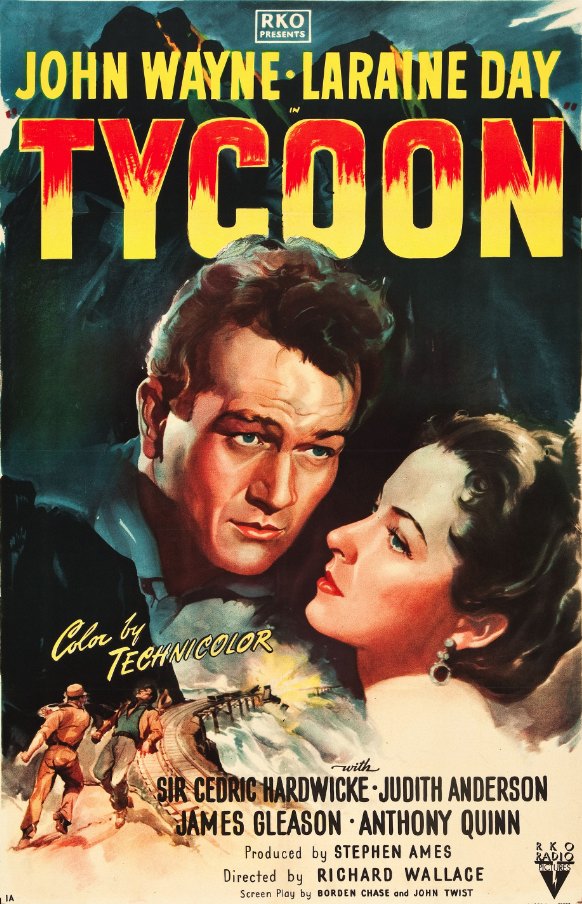
Richard Wallace’s Tycoon is a bloated, overlong Technicolor epic that takes place in the Andes. It stars John Wayne as a big, tough, fearless railway engineer named Johnny Munroe.
Munroe and his crew of wisecracking roughnecks are hired by a fussy British aristocrat named Frederic Alexander (played by Sir Cedric Hardwicke) — who for some reason has a sprawling estate in South America — to build a railroad tunnel through miles of solid rock.
Munroe thinks it would be smarter to just build a bridge over the mountain, but Alexander’s personal engineer Ricky (Anthony Quinn) wants a tunnel — and the stockholders agree with him — so that’s what the stockholders will get.
Munroe’s difficult job becomes even harder when he meets Alexander’s pretty daughter Maura (Laraine Day). Alexander is an overprotective single father who plans for his daughter to marry a suitable man and take her place in society, so when she falls for Munroe’s thuggish charms he’s horrified. He tells her that he understands that in pagan Rome young women of breeding amused themselves with gladiators, but he never thought she’d fall victim to such venal desires.
The romantic and domestic scenes in Tycoon are campy and poorly handled. The masculine realm is better handled, but not by much, and at more than two hours long, I found Tycoon a chore to get through.
John Wayne is one of the most famous movie stars of all time, but there’s a reason his most popular movies are westerns and war movies. He just wasn’t that good at playing romantic leads.
Tycoon was the most expensive movie to date from RKO Radio Pictures, but I doubt it caused Darryl F. Zanuck or any of the other big studio heads to look over their shoulders too much. The film’s $3.2 million budget didn’t touch spectacles like Cecil B. DeMille’s $5 million Unconquered (1947) or Zanuck’s $6 million Forever Amber (1947), but even taking into account the difference in budget, Tycoon can’t hold a candle to other big-budget flicks. The filmmakers originally planned to shoot at RKO’s Estudios Churubusco in Mexico, but shifted production to Hollywood at the last minute. Consequently, Tycoon just doesn’t look that good. All the backgrounds are matte paintings and the Incan ruins are obviously sets. There are a bunch of explosions and a big finale involving a race against time to stabilize a bridge against the onslaught of an overflowing river that involves some pretty hot miniatures and a stunt double who looks nothing like Wayne, but that’s about it in terms of excitement.
Some people will tell you that movies made by committee are what’s wrong with Hollywood.
They’re wrong. Movies made by committee have always been around, and like everything else made by committee, they occasionally turn out just fine.
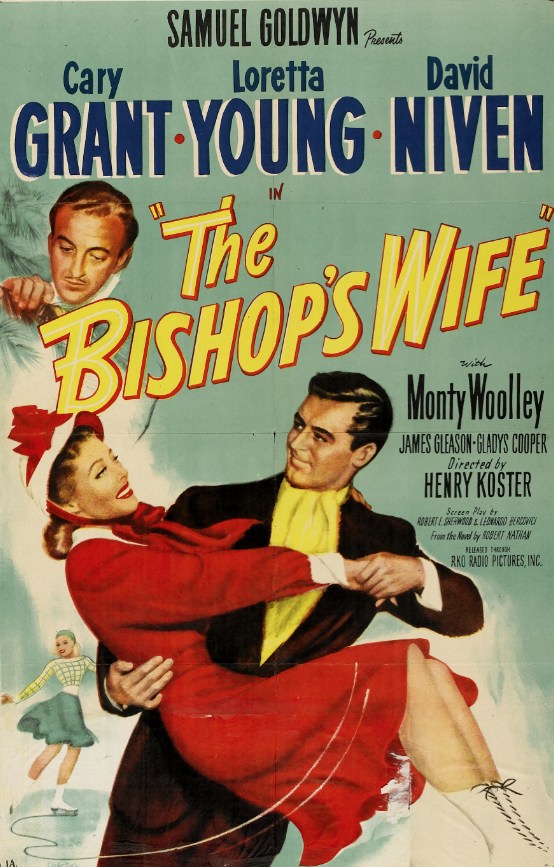
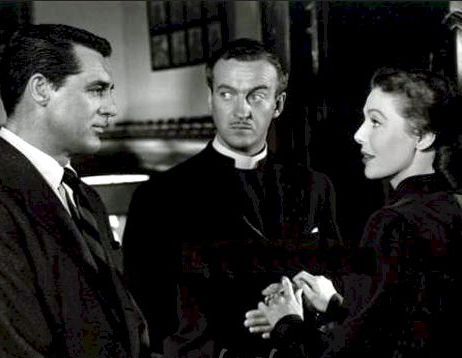
Henry Koster’s The Bishop’s Wife, for instance, is a sweet little Christmas confection. It won’t fill you up, and it will possibly leave you wanting more, but for what it is, it’s delicious.
The original director was William A. Seiter, but producer Samuel Goldwyn didn’t care for what he came up with, so he replaced him with Henry Koster. (Koster’s version had its own problems, so Billy Wilder and Charles Brackett made some uncredited revisions to the script.)
The biggest change from Seiter’s version was that David Niven and Cary Grant switched roles, but there were several other changes. For one, Teresa Wright — who originally played the bishop’s wife — was replaced by Loretta Young.
But Niven and Grant’s role-switching is the big change that everyone talks about, and with good reason.
The priggish but always likable Niven is perfect as Henry Brougham, the Episcopal bishop whose cathedral-building project is destroying his personal life, and Grant is perfect as Dudley, the angel who’s sent to put Henry back on the right track.
It’s as difficult for me to imagine anyone but the ageless and effortlessly charming Grant as Dudley as it is for me to imagine anyone but Edmund Gwenn as Kris Kringle in Miracle on 34th Street.
Dudley shows up on earth in answer to Henry’s prayer for guidance, but he’s not an unearthly angel who waves a magic wand that sets everything right. While he can move objects with his mind, stop busy traffic on Madison Avenue while helping a blind man cross the street, and presumably do pretty much anything he wants, he mostly just puts ideas in people’s minds … good ideas that they end up thinking are their own.
Dudley is also not an ethereal, androgynous angel whose feet never touch the ground. He’s Cary Freakin’ Grant, and his good lucks and charm have quite an effect on Henry’s neglected wife Julia (Loretta Young). One afternoon — after Henry’s forced to cancel yet another date with his wife due to his work on the cathedral — Dudley takes her to lunch at Michel’s, the French restaurant where Henry proposed to her.
After Dudley orders, Julia tells him, “You speak French beautifully.”
“I’ve had quite a bit of work to do in Paris,” Dudley responds.
And when Dudley takes Julia’s hand to read her palm, oh how the old bluenose biddies tut-tut.
The Bishop’s Wife takes place around Christmas, and it’s a wonderful holiday film. It’s also an excellent comedy, even though its broadly humorous moments are rare. Mostly its just a heartwarming, romantic, and delightful film.
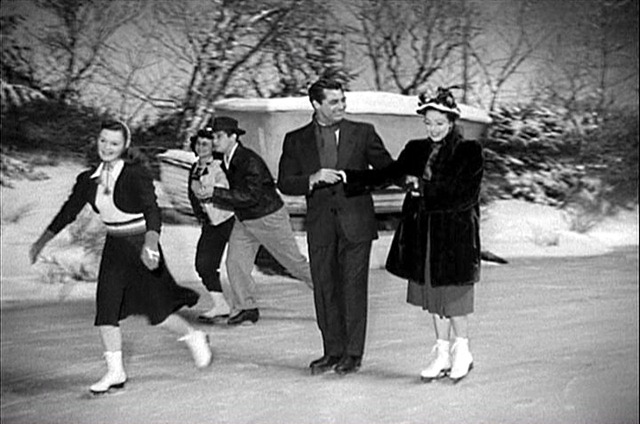
And the scene in which Dudley takes Julia ice-skating and uses his magical powers to make them both glide around the ice like Olympic champions is one of the most enjoyable bits I’ve seen in a long, long time.
Dudley Nichols’s Mourning Becomes Electra has its staunch defenders, but so does every other awful movie.
Mourning Becomes Electra is unquestionably the worst movie I have seen so far this year, and it’s unlikely that I will see another one that’s as bad in the short time remaining. If I did “worst of the year” lists, it would almost certainly be at the very top.
Rosalind Russell was nominated for the Academy Award for best actress for her role in Mourning Becomes Electra and famously lost out to Loretta Young, who played a young Swedish-American woman in the lightweight comedy The Farmer’s Daughter, despite the fact that Russell lobbied hard for herself. (Russell did win the Golden Globe for best actress for Mourning Becomes Electra.)
I’ve got nothing personal against Rosalind Russell, but if I’d been a member of the Academy 64 years ago, she could have given me a brand new Lincoln Continental, a sable coat for my wife, and one hundred thousand dollars in cash, and I still wouldn’t have voted for her.
It’s not just that her performance is so one-note and hysterically pitched, but also that the entire film is so ineptly directed that each actor in the film seems to be directing him- or herself.
Mourning Becomes Electra is a film version of Eugene O’Neill’s play cycle of the same name, which was a reimagining of the Oresteia trilogy by Aeschylus.
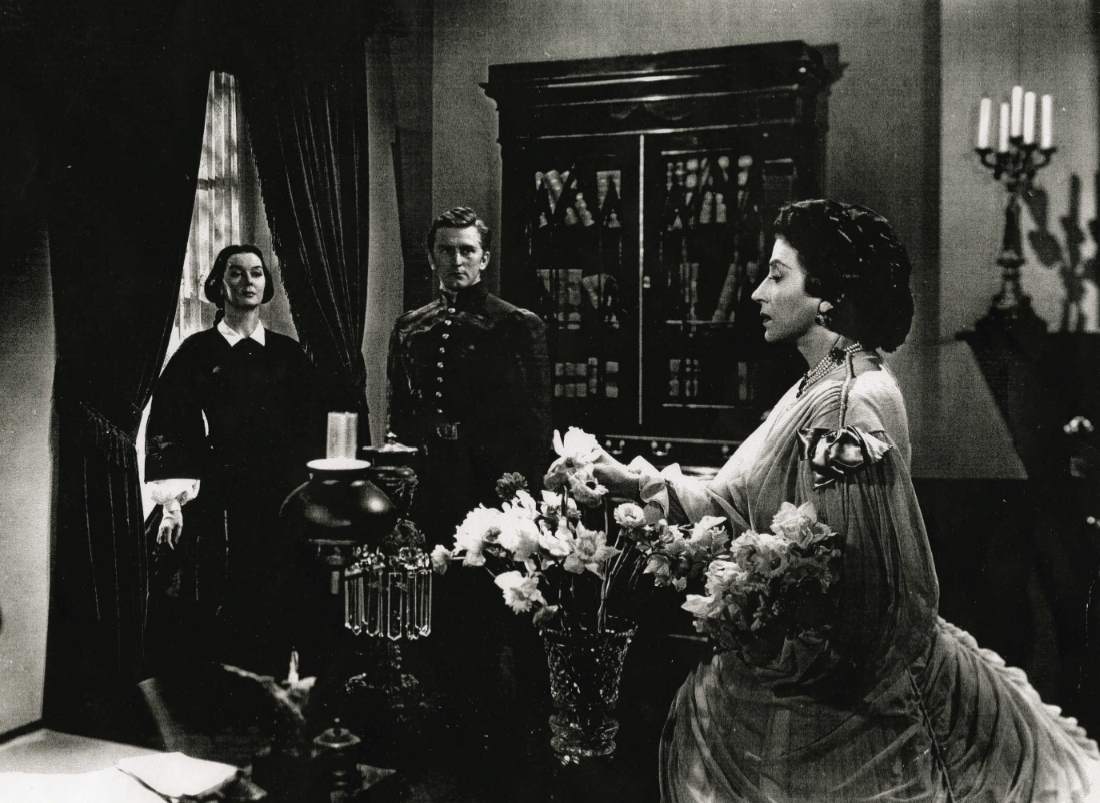
Instead of Agamemnon returning from the Trojan War to his wife Clytemnestra, his son Orestes, and his daughter Electra, a Union general named Ezra Mannon returns to Massachusetts from the Civil War to his wife Christine, his son Orin, and his daughter Lavinia.
Just as in the Greek myth of Orestes, Ezra Mannon is murdered by his wife, and her children plot to avenge their father’s death.
Just like O’Neill’s original play cycle, the film is divided into three parts, Homecoming, The Hunted, and The Haunted.
Of course, the play is more than just a retread of classical Greek tragedy. O’Neill was also strongly influenced by the Freudian psychosexual theories that were in vogue in the ’30s.
However, for a movie with kissin’ cousins and freaky Oedipus complexes, Mourning Becomes Electra sure is boring.
The problems begin at the beginning. The first scene of Homecoming involves Seth Beckwith (Henry Hull), the Mannons’ groundskeeper, leading a small group of townspeople around the Mannon estate and explaining all the characthers’ names and relationships. It’s obvious that Seth and the townspeople are meant to function as a Greek chorus, but it’s too much information too soon, and without any context, it’s mind-numbingly boring.
In Homecoming, Christine Mannon (Katina Paxinou) and her daughter Lavinia (Russell) howl at each other for awhile over the affections of officer Adam Brant (Leo Genn), who it turns out is the product of an illicit coupling between a Mannon male and a lowly housekeeper, both of whom were expelled from the house. Brigadier General Ezra Mannon (Raymond Massey) returns home, and his wife conspires with her lover, Adam, to poison him. Ezra accuses her with his dying breath.
In The Hunted, Orin Mannon (Michael Redgrave) returns home and spends a lot of misty-eyed time with his head in his mother’s lap. Eventually his sister Lavinia convinces him that Adam Brant and their mother were responsible for their father’s death, so they sneak aboard the ship The Flying Trades and kill Adam after they observe Christine’s rendezvous with him. Following Adam’s murder, Christine shoots herself out of grief.
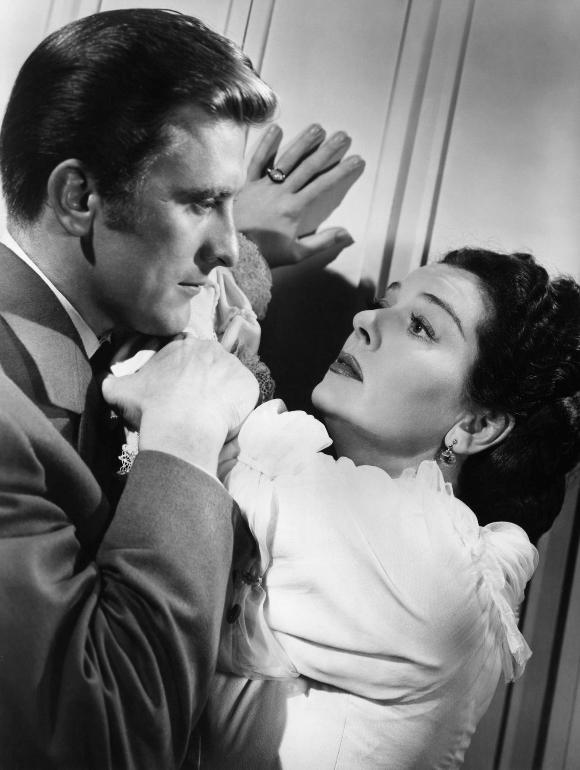
In The Haunted, Orin and Lavinia return home after a romantic year-long getaway to the South Seas. When they return to Massachusetts, their friends — a slightly less dysfunctional pair of siblings, Peter Niles (Kirk Douglas) and Hazel Niles (Nancy Coleman) — are disturbed by the changes Orin and Lavinia have gone through. Lavinia plans to marry Peter, but Orin threatens to reveal all of their crimes to Peter if she goes through with her plan. Orin tries to molest his sister, and kills himself when she rejects him. Then, instead of marrying Peter, Lavinia shuts herself up in the house forever. The end.
Mourning Becomes Electra flopped terribly at the box office, and was hastily recut from its original 173-minute version down to a 105-minute version (which I believe was achieved by chopping off the entire final third section, The Haunted). It has since been restored, mostly, and exists on DVD in a 159-minute version. (The full 173-minute version has been shown on TCM.)
The main problem with Mourning Becomes Electra is how uninteresting and stagy the direction is. (Dudley Nichols did much more work as a writer than as a director, and Mourning Becomes Electra was the last film he ever directed.) This does not mean, however, that it is a faithful adaption. The demands of cinema are very different from the demands of the stage. Simply running through the lines of a stage play in front of a camera is a very different proposition than performing a play night after night in front of an audience. As a film, Mourning Becomes Electra is a “faithful” adaptation of O’Neill’s play in the same way a film of an elderly British man reading Great Expectations aloud for 19 hours could be called a “faithful” adaptation of Charles Dickens’s novel.
It also doesn’t help that nearly everyone in the cast has a wildly different accent from everyone else, and that nearly everyone is the wrong age for the character they’re playing. The “young and handsome” Adam Brant is played by Leo Genn, a square-headed, fat-lipped 41-year-old British actor. Lavinia is supposed to be a young woman, but Rosalind Russell was 40 (or nearly 40) when she appeared in Mourning Becomes Electra, while Katina Paxinou, who plays her mother Christine, was only 46. This closeness in age could perhaps be overlooked if the two actresses were on the stage together, but on film, it’s distracting. Also, Paxinou’s thick Greek accent could perhaps be explained by her marrying into the Mannon family, but how to explain Michael Redgrave’s British accent?
The psychosexual and incestuous drama of Mourning Becomes Electra is obvious and ham-fisted. This is a film that is likely to be praised as “Freudian” only by people who have never read Freud. It’s also a film that is likely to be praised only by pretentious dilettantes who think that merely by forcing themselves to sit through something long and crushingly boring they are engaging in a high-minded activity.
Out of the Past (1947)
Directed by Jacques Tourneur
RKO Radio Pictures
Jacques Tourneur’s Out of the Past is the greatest film noir ever made, but no one knew it at the time.
Robert Mitchum even said as much when he told writer Arthur Lyons, “Hell, we didn’t know what film noir was in those days. Cary Grant and all the big stars at RKO got all the lights. We lit our sets with cigarette butts.”
In 1947, French film critics and cinéastes were just beginning to use the term “film noir” (it was first used in 1946 by French film critic Nino Frank) and it would be decades before the term caught on in the United States, long after the end of the “noir cycle.”
All of this is a good thing, of course, since self-consciousness can kill art.
If filmmakers in the ’40s and ’50s had deliberately tried to make films with all the elements that the French were praising, they probably would have produced ham-fisted junk that was as unwatchable as most of the “neo-noir” that littered multiplexes in the ’90s.
On the other hand, this means that a brilliant noir like Out of the Past got lost in the shuffle at the time of its release, and was viewed as just one more “private eye” picture, or just one more “violent melodrama.” The review in the December 15, 1947, issue of Time, for instance, called it “a medium-grade thriller.” (Although they did praise Nicholas Musuraca’s beautiful cinematography.)
In his November 26, 1947, review of Out of the Past, curmudgeonly NY Times critic Bosley Crowther had a lot of good things to say about the film, and praised the dialogue and acting, but admitted that he couldn’t make heads or tails of the plot.
This is a fair criticism, since the plot of Out of the Past still confounds first-time viewers, and most second- and third-time viewers as well. Note, for instance, the number of reviews of the film that claim the story is told mostly in flashback, when the flashback portion of the story actually occupies less than a half hour of running time, and from the 40-minute mark onward, the film takes place entirely in the present.
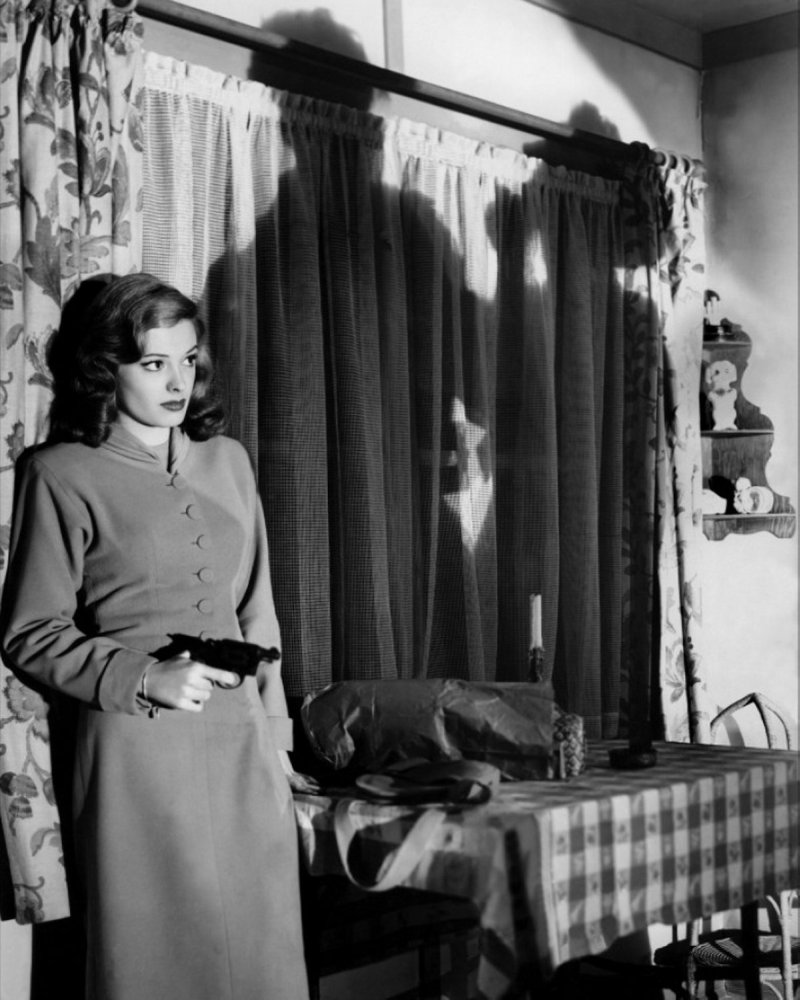
But time has been kind to Out of the Past, and a perfect understanding of its plot isn’t a prerequisite for enjoying every gorgeously filmed minute of it, since it’s packed with everything that makes a noir a noir. Its male protagonist, Jeff Markham (Robert Mitchum), is smart and tough, but ultimately helpless when faced with the seductive charms of the film’s femme fatale, Kathie Moffat (Jane Greer). The film contains murders, swindles, frame-ups, crosses, double-crosses, triple-crosses, gambling, a large chunk of stolen money, a tragic ending, and some of the most seductive chiaroscuro cinematography of all time.
The plot can’t really be summarized in a nutshell, but I’ll try anyway.
While driving through a one-stoplight California town called Bridgeport, which is 79 miles south of Lake Tahoe, Joe Stephanos (Paul Valentine) pulls into a service station owned by Jeff Markham, who’s living in Bridgeport under the name “Jeff Bailey” and trying to forget his tawdry old life by going fishing every day with a nice girl named Ann (Virginia Huston), which her boyfriend Jim (Richard Webb) isn’t too happy about.
Joe tells Jeff that Whit Sterling (Kirk Douglas), his old employer, wants to see him in Lake Tahoe.
So Jeff spills to Ann. His real name is Markham, not Bailey. Three years ago he lived in New York and worked with an oily gentleman named Jack Fisher (Steve Brodie). They were detectives. They got a call to see a big operator, a gambler named Whit. His girl had shot him with his own .38 and taken off with $40,000 of his money, and he wanted her back. The money, too, but mostly her.
Jeff took off on his own, leaving Fisher behind, and followed Kathie’s trail to Acapulco, Mexico. As soon as he saw her, he was hooked like a fish.
In voiceover, Jeff recalls his romance with Kathie in Acapulco.
I never saw her in the daytime. We seemed to live by night. What was left of the day went away, like a pack of cigarettes you smoked. I didn’t know where she lived, I never followed her. All I ever had to go on was a place and time to see her again. I don’t know what we were waiting for. Maybe we thought the world would end. Maybe we thought it was a dream and we’d wake up with a hangover in Niagara Falls. I wired Whit but I didn’t tell him.
“I’m in Acapulco,” I said. “I wish you were here.” And every night I went to meet her. How did I know she’d ever show up? I didn’t. What stopped her from taking a boat to Chile or Guatemala? Nothing. How big a chump can you get to be? I was finding out.
Kathie swore to Jeff that she didn’t take Whit’s money, to which he responded, “Baby, I don’t care,” and kissed her.
Jeff and Kathie ran off together and headed for San Francisco. Things went swimmingly until he was spotted at the racetrack by his old partner Jack Fisher, who would turn him and Kathie over to Whit in a heartbeat for the payoff.
Despite Jeff’s best efforts to lose the tail, Fisher eventually tracked him and Kathie down. When Jeff and Fisher started trading blows, Kathie coldly shot Fisher, then took off.
Jeff never saw her again. He was left to bury Fisher’s body in the woods. He also found a deposit slip for $40,000 in Kathie’s purse, confirming that she’d lied to him about the money.
The rest of the film takes place in the present. Jeff meets with Whit at his palatial getaway in Lake Tahoe. Kathie has returned to Whit, and he now knows everything about Jeff’s betrayal of him.
Exacting a kind of payback, Whit forces Jeff to go to San Francisco to steal income tax records from the crooked accountant — Leonard Eels (Ken Niles) — who helped him hide his money from Uncle Sam and who’s now demanding $200,000 hush money. Jeff is supposed to get to Eels through his beautiful secretary, Meta Carson (Rhonda Fleming).
But it quickly becomes clear to Jeff that he’s being set up as a patsy, and that Whit’s people are going to kill Eels and make it look as if Jeff did it.
Ann, the good girl in Jeff’s life, can’t believe that Kathie is as awful as he makes her out to be. “She can’t be all bad, no one is,” Ann says. “Well, she comes the closest,” Jeff responds.
And he’s right. Kathie is a murderer, a thief, and a liar. She’s completely and utterly faithless, but Jeff keeps falling for her. Every time she calls, he comes running. He can’t help it. He hates himself for it, but he can’t stop.
I first saw Out of the Past when I was 17, and I’ve seen it many times since then. It took me several viewings before I got a handle on exactly what was going on in the film, but I always felt that its byzantine plot was part of its appeal.
Even if you can’t figure out exactly what’s going on or who’s doing what to whom (or why), Out of the Past is still a seductive and brilliant film. It’s the Platonic ideal of a film noir.
Faith and religiosity are notoriously difficult things to depict on film. It’s easy to go too far in one direction — witness for instance, the brutal, mind-numbing literalism of Mel Gibson’s The Passion of the Christ (2004). Belief and faith are abstract things, and while cinema can suggest the abstract, it is still a visual medium.
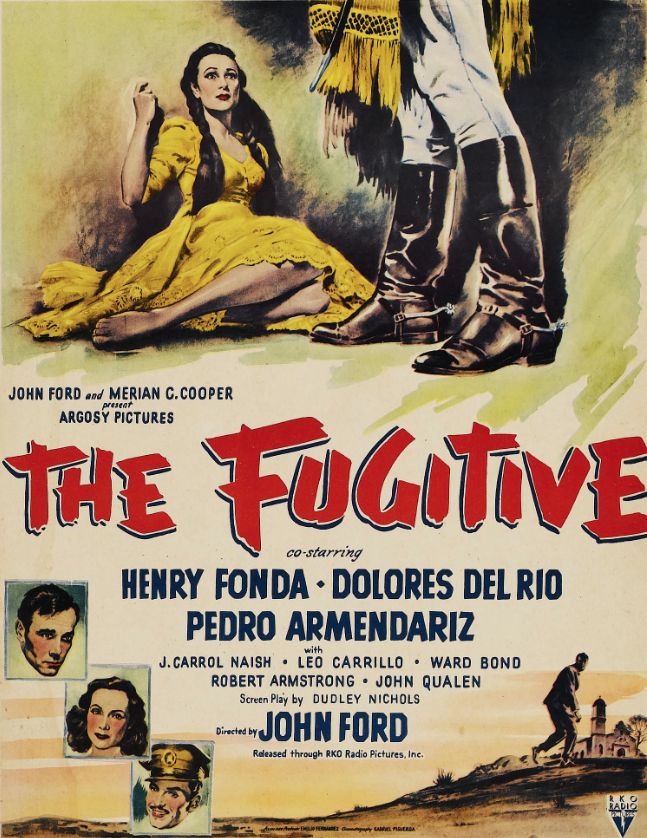
John Ford’s The Fugitive is rarely numbered among the director’s greatest achievements, but it was reportedly one of his personal favorites. It was filmed entirely in Mexico, and much of the crew was assembled from the Mexican film industry.
In it, Henry Fonda plays a fugitive priest, on the run from the authorities after the church and its emissaries have been made illegal following a civil war. He’s a man whose faith appears to be broken — or at least in the process of being tested — but it’s difficult to really know, because Fonda’s performance is so blank-eyed and tentative that it’s hard to know what’s going on in his mind for most of the picture. Ironically, The Fugitive is a movie that is strongest when it is at its most heavy-handed.
It’s clear from the outset that the movie is meant to be seen as an allegory — the opening narration tells us as much. Also, in the opening credits, we see that none of the characters have names. Fonda plays “A Fugitive,” Dolores del Rio plays “An Indian Woman,” Pedro Armendáriz plays “A Lieutenant of Police,” J. Carrol Naish plays “A Police Informer,” Leo Carrillo plays “A Chief of Police,” and Ward Bond plays “El Gringo.” It’s also not meant to take place in Mexico, but rather, as the narrator informs us, “merely a small state, a thousand miles north or south of the Panama Canal. Who knows?”
Graham Greene’s 1940 novel The Power and the Glory (also published as The Labyrinthine Ways) did actually take place in Mexico, but the filmmakers likely didn’t want to offend their host country with a story that was critical of the Mexican Revolution or any of its ramifications.
Greene wrote The Power and the Glory when he was himself a kind of fugitive. Twentieth Century-Fox and Shirley Temple’s lawyers had sued Greene and the magazine Night and Day for criminal libel over his review of the film Wee Willie Winkie (1937), which — ironically — was directed by John Ford. In his review of the film, Greene wrote of Temple that “she measures a man with agile studio eyes, with dimpled depravity. Her admirers — middle-aged men and clergymen — respond to her dubious coquetry, to the sight of her well-shaped and desirable little body, packed with enormous vitality, only because the safety curtain of story and dialogue drops between their intelligence and their desire.”
Greene’s trip to Mexico in 1938 was ostensibly at the behest of the Vatican, who wanted him to document anti-Catholic violence and persecution. According to Greene’s friend, director Alberto Cavalcanti, whose lost autobiography was recently unearthed, Greene’s real reason for going to Mexico was to escape Temple’s lawyers.
In any case, whatever narrative subtlety and moral complexity the novel had is not present in the film, which has little to offer in the way of ideas. I hesitate to call Henry Fonda “miscast,” because he’s usually such a wonderful performer, but he really is awful in The Fugitive. His facial expressions range from beatific to panicked, and that’s about it.
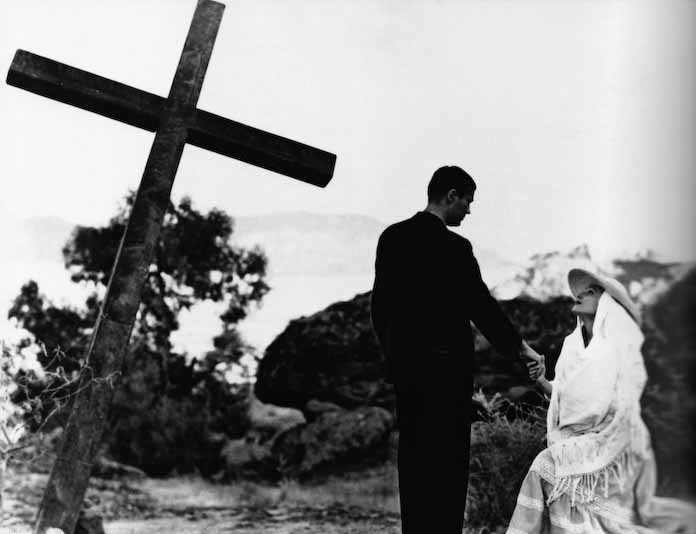
The power of the film — and it is a powerful film, especially toward the end — comes from its visuals. Ford and his cinematographer, Gabriel Figueroa, crafted a beautiful-looking movie, full of nighttime shadows, murky light, and sun-drenched wide open spaces. The final sequence, which is an allegory for the crucifixion and resurrection, is achieved with very little dialogue, and is well-done, if a little obvious.
 I don’t know about you, but comedies like H.C. Potter’s Mr. Blandings Builds His Dream House really stress me out.
 Grant plays Jim Blandings, a college graduate who lives in Manhattan, works in advertising, and makes about $15,000 a year. We learn all this from the film’s omniscient narrator, who also calls Mr. Blandings a “modern-day cliff dweller,” since he lives in a high-rise apartment building with his beautiful wife Muriel (Myrna Loy), their two daughters, and their housekeeper Gussie (Louise Beavers).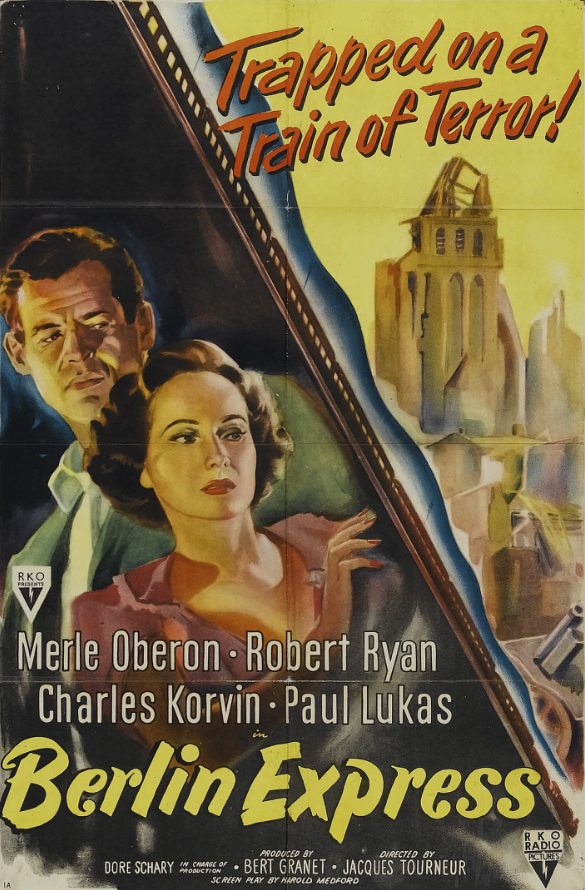



 OCD Viewer