Tag Archives: Warner Bros.

Cheyenne (June 6, 1947)

Cheyenne
Cheyenne (1947)
Directed by Raoul Walsh
Warner Bros.

Most of the time, when people say “adult western,” they’re talking about the more psychologically realistic western dramas that stood apart from the fray of Saturday matinee singing cowboys. They’re talking about the films of John Ford and Anthony Mann, and TV series like Gunsmoke (1955-1975). Raoul Walsh’s Cheyenne is a different kind of adult western.

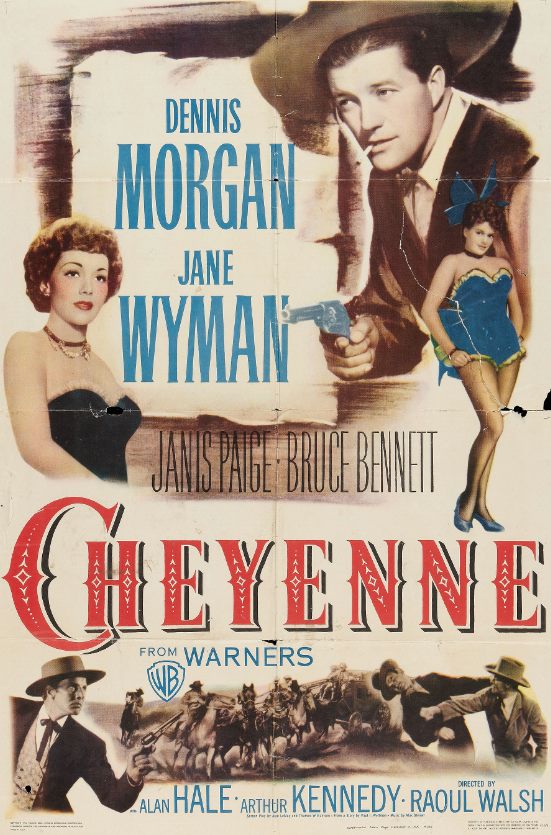
While tame by the standards of today’s R-rated movies and cable TV, Cheyenne is a feast of double entendres and sexually suggestive scenes and dialogue. The film stars Dennis Morgan — doing his best impression of George Sanders — as James Wylie, a gentleman gambler who’s impressed into the service of the law by private detective Webb Yancey (Barton MacLane).

Yancey offers to cut Wylie in on the $20,000 reward being offered for “The Poet,” who’s responsible for a series of stagecoach robberies along the Wells Fargo line. Wherever the Poet strikes, he leaves a piece of paper with a few lines of verse, such as “I’m happy the frontier is settling down / With a thriving bank in every town / Let the riders and nesters deposit their pay / So I and my gun can take it away.”

Cheyenne co-stars Jane Wyman (back when she was still Mrs. Ronald Reagan) as a woman named Ann Kincaid. Ann is married to a Wells Fargo banker named Ed Landers (Bruce Bennett), but their marriage is on the rocks, and she’s clearly attracted to the dashing and roguish Wylie. Of course, for the sake of propriety (and the Hays Code), she acts as though she can’t stand Wylie.

There’s plenty of lighthearted, sexy banter, and great lines like, “How did I know she was the sheriff’s daughter? I couldn’t find a badge.” Or my personal favorite, “You know how women are. Like bears. They never get enough honey.”

Ann and Wylie’s situation is complicated when they fall in with a gang led by the Sundance Kid (Arthur Kennedy). Kennedy plays his role with brio. Sundance is a snarling badass who shoots first and thinks later. When a young punk in his gang stands up to him, and says that the Sundance Kid may have all the other members of his gang buffaloed but he doesn’t fool him, Sundance kicks him to the ground and shoots him dead.

Wylie tells Sundance that he is in fact the Poet, and offers to cut him in on the take from his robberies. He also claims that Ann is his wife, which leads to some sexy playacting. Maybe too sexy. As one of Sundance’s gang says, “He kissed the gal like he liked it. That ain’t like no husband.”

When they go to bed in the same room because some of Sundance’s gang are outside watching, Wylie says, “I’ll sleep with one eye open.” Ann responds, “What do you think I’m gonna do?”

The sexual suggestions aren’t limited to the dialogue. The old spinster housekeeper’s look of regret when Ann says “You know how men are” is priceless. And even I couldn’t believe the scene in which Ann complains about back pain after the night she spends with Wylie.

Janis Paige

The sexiness doesn’t stop with Jane Wyman. Janis Paige gives a good performance as a voluptuous saloon singer named Emily Carson. The two songs she performs in a black bustier, dark stockings, and high heels — M.K. Jerome & Ted Koehler’s “I’m So in Love” and Max Steiner & Ted Koehler’s “Going Back to Old Cheyenne” — were a high point of the picture for me.

I enjoyed Cheyenne quite a bit, but it’s not as interesting as Raoul Walsh’s previous western, Pursued (1947), and it suffers from wild shifts in tone. Most of the film is sexy and playful, but the action scenes are surprisingly dark and violent.

Cheyenne is definitely worth seeing for fans of westerns and aficionados of its prolific and talented director. The actors are all fun to watch, especially Arthur Kennedy, and Max Steiner’s bombastic score does a nice job of propelling the action during the film’s shootouts and chase scenes.
The Unfaithful (June 5, 1947)

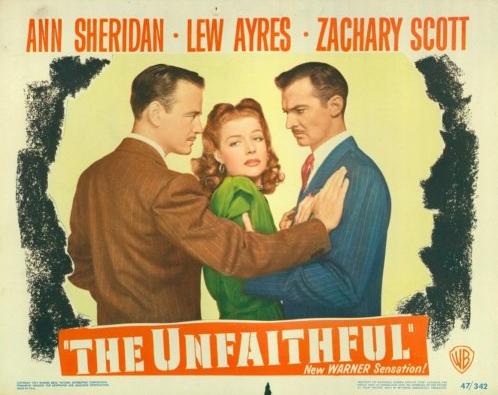
The opening narration of The Unfaithful informs us that while the film takes place in Southern California, it deals not with a problem of a particular place, but with a problem of our times. At first, this problem seems to be rampant divorce, but it ends up being more about wartime infidelity (or possibly the widespread problem of married women committing murder in self-defense and then having to lie about it to cover up an affair).

It’s hard not to compare The Unfaithful with Nora Prentiss, which was released earlier the same year. Both were directed by Vincent Sherman, both star the beautiful Ann Sheridan, and both have infidelity as their subject. But while Nora Prentiss indulged in some truly outré and baroque excesses by the time the credits rolled, The Unfaithful goes in the opposite direction, and slowly peters out to an anticlimax. It’s a good film — well-acted and directed with assurance — but when it was over, I couldn’t help feeling as if the filmmakers wanted to make a melodrama about an “issue of the day,” but weren’t sure how to fold it into the murder investigation and blackmail story that dominate the film.

The picture opens with a party being thrown by a character named Paula (played by Eve Arden) to celebrate her divorce. (Interestingly, Arden herself divorced her husband — Ned Bergen — in 1947 after eight years of marriage. Her next marriage would be more successful. She married actor Brooks West in 1952, and they stayed married until his death in 1984 from a heart ailment. She and West had four children together.)

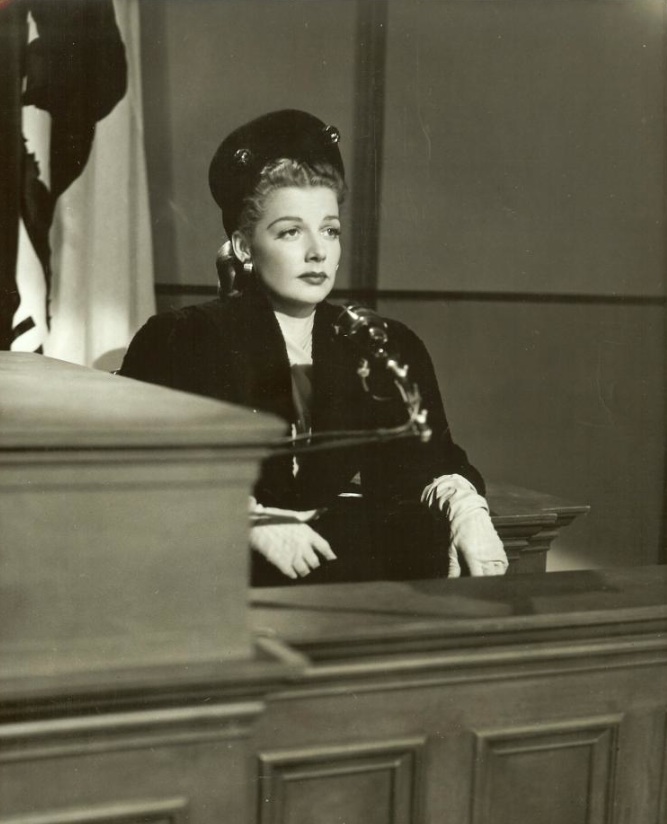
In attendance at the party is Paula’s friend Christine “Chris” Hunter (played by Ann Sheridan, who was also no stranger to divorce. She and her second husband, George Brent, divorced in 1943 on their one-year anniversary.) After the party, a mysterious figure attacks Chris as she unlocks the front door of her home. He pushes her inside and a struggle ensues, which we see play out through the living room windows of the Hunters’ suburban home as two silhouettes locked in a life-or-death struggle.

Chris’s husband, Robert “Bob” Hunter (Zachary Scott), a big-time house builder and real-estate developer, arrives home and comforts his wife, who’s understandably shaken up after killing the intruder in self-defense. The couple’s friend and lawyer Larry Hannaford (Lew Ayres) is also on hand to comfort Chris.

Det. Lt. Reynolds (John Hoyt) questions Chris, and doesn’t seem to really believe her story of a stranger attacking her in her home and demanding jewels, but he doesn’t accuse her of anything … yet. The detective also questions Hannaford about the couple, and Hannaford tells him he’d be hard pressed to find a couple as happy as the Hunters.

To summarize the plot any further would be to give away too much. It should suffice to say that there’s more to the story than Chris originally reveals to the police, and the film ends with a sensational trial and plenty of wagging tongues.

The Unfaithful takes place mostly indoors, but there are a lot of great Los Angeles exteriors, too. If you’re a fan of vintage street cars, this movie is worth checking out just for them.

Ernest Haller’s cinematography is especially memorable. I really liked the dark, low-angle shot of Zachary Scott parking his car in his driveway and striding along the front walk of his home after receiving some terrible news. And during the trial, there’s a wonderful shot of a bloody knife being held over the murder photograph, then quickly moved to the left as an exhibit — but for just a moment it seems as if we are seeing a gruesome murder scene with a bloody knife poised over a corpse.

The screenplay of The Unfaithful, by James Gunn and crime novelist David Goodis, is excellently written, with realistic dialogue and characterizations, especially in Ann Sheridan’s scenes with Zachary Scott. As I said, it’s a bit anticlimactic, but the journey is worth it, and The Unfaithful is worth seeing despite a weak final reel. Incidentally, it’s an uncredited remake of William Wyler’s The Letter (1940), which was based on the 1927 play of the same name by W. Somerset Maugham.

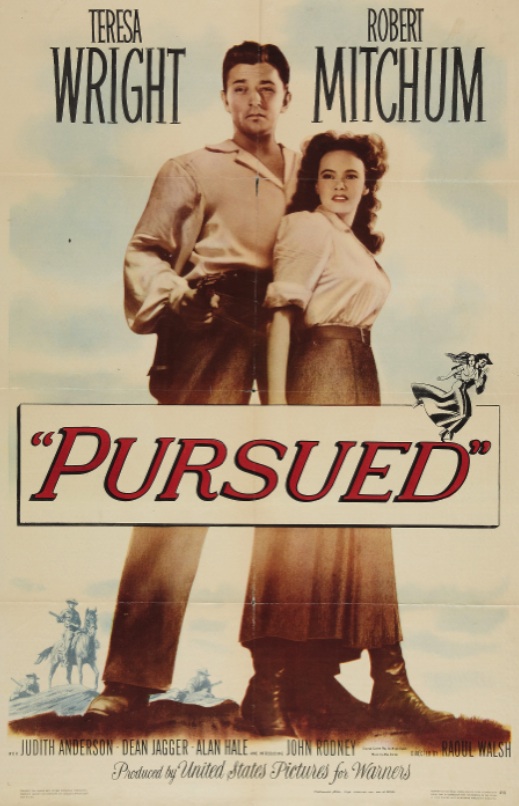
Pursued (March 2, 1947)

Pursued
Pursued (1947)
Directed by Raoul Walsh
United States Pictures / Warner Bros.

In the territory of New Mexico at the turn of the century, a handsome, sloe-eyed man named Jeb Rand (Robert Mitchum) is hunted across a desolate landscape by gunmen. He returns to the cabin where he was found as a boy and prepares for a showdown. The mountains that surround the cabin are drenched in shadows, and they tower above the tiny human figures below them like skyscrapers. As Jeb waits, he is plagued by nightmares of boots on wooden floors — boots with jangling spurs — but he can’t make sense of his strange visions.

Welcome to the world of Raoul Walsh’s Pursued. It’s an oneiric film about a man who is haunted by the past. Mitchum narrates the film, sounding like someone who knows he is doomed. (“I always have a feeling something’s after me,” he says.)

Pursued is a western, not a film noir, but it has all the hallmarks of noir, including stunning black and white cinematography by the great James Wong Howe, Freudian relationships up the wazoo, the sins of the past coming back to haunt the present, a man on the run, plenty of sinister characters packing heat, and a story mostly told in flashback.

Young Jeb Rand (played by Ernest Severn) survived the massacre that killed his family and was taken in by Mrs. Callum (Judith Anderson), who has two children about Jeb’s age — Thor (short for “Thorley”) and Adam. They’re played by Peggy Miller and Charles Bates as kids, and by Teresa Wright and John Rodney as adults.

Jeb often complains that his head hurts. Nothing about his past makes sense, and his present is equally confusing. Thor and Adam don’t treat him as a brother. (His separation from them is represented visually as well as thematically. In one scene in which the family gathers, Mrs. Callum stands in the center, with Thor and Adam on one side of her and Jeb on the other.) Adam hates his adopted brother Jeb. Thor loves Jeb, but her love seems more romantic than sisterly.

One day, someone shoots young Jeb’s horse out from under him. Mrs. Callum tells him it was probably just careless deer hunters, but Jeb is convinced that it was Adam.

We eventually learn that Mrs. Callum’s brother-in-law, Grant Callum (Dean Jagger), led the attack on Jeb’s family. Grant’s brother (Mrs. Callum’s husband) was killed in the attack, and Grant was wounded and had to have his arm amputated. Grant vowed not to rest until every last Rand on earth was dead. Mrs. Callum, on the other hand, considers the events of that night Providence — the Lord may have taken her husband, but He delivered unto her a second son.

Jeb, Thor, and Adam grow to adulthood. When the draft board demands that at least one young man from every family in the territory enlist to fight in the Spanish-American War, Jeb and Adam flip a coin. Jeb loses.

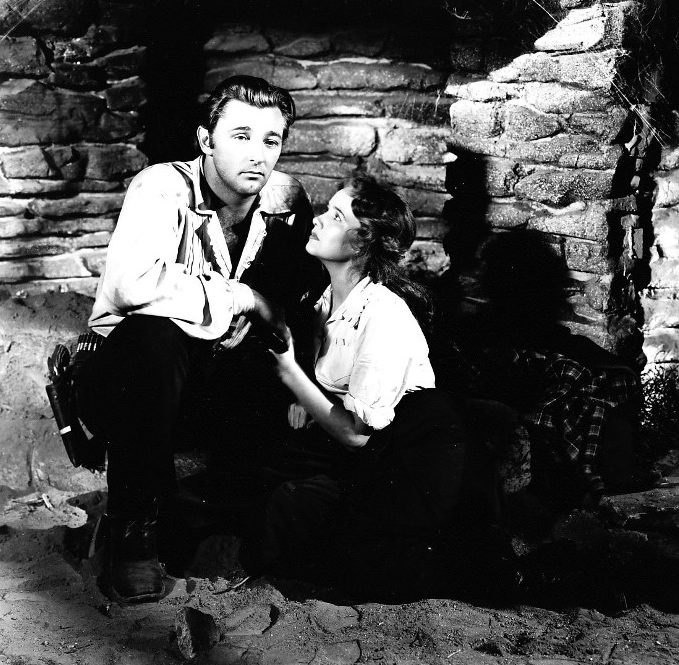
Robert Mitchum and Teresa Wright

He returns home from the war to find that little has changed. Adam still hates him, and Thor still has romantic feelings for him. “I want you to come courtin’ me,” she says. “I know that seems silly when we grew up together, but I want to pretend we didn’t.”

Mrs. Callum doesn’t have a problem with Jeb and Thor marrying, but she refuses to ever talk with Jeb about the night his family was killed, no matter how much he pushes her. “I’m giving you my daughter for your wife,” she says. “Isn’t that enough for you? Doesn’t that show you that you’re loved?”

Grant Callum dogs Jeb’s every move, sending shooters after him even though he clearly just wants to be left alone. After he’s forced to kill two men in self-defense, Mrs. Callum and Thor shun Jeb, and tell him that he’s dead to them.

“Right then I knew I had to have you,” Jeb says in voiceover as he watches Thor at a funeral. “I’d have to climb across two graves to get to you, but nothing in the world would hold me back.”

Pursued has a happy ending, but that doesn’t stop Jeb and Thor’s semi-incestuous love from having a doomed quality. “There was a black dog riding my back and yours,” Jeb tells Thor as they reminisce about their past while waiting in the burned-out cabin together for Grant Callum and his gunmen to arrive.

This noirish sense of doom pervades the film. So many scenes take place at night or indoors — in smoky saloons and casinos — that the film has a powerful sense of claustrophobia. And the fact that Jeb is a returning combat veteran plagued by nightmares gives him more in common with many of the protagonists of post-war film noirs than it does with the cowboy heroes of most post-war oaters.

Nora Prentiss (Feb. 21, 1947)

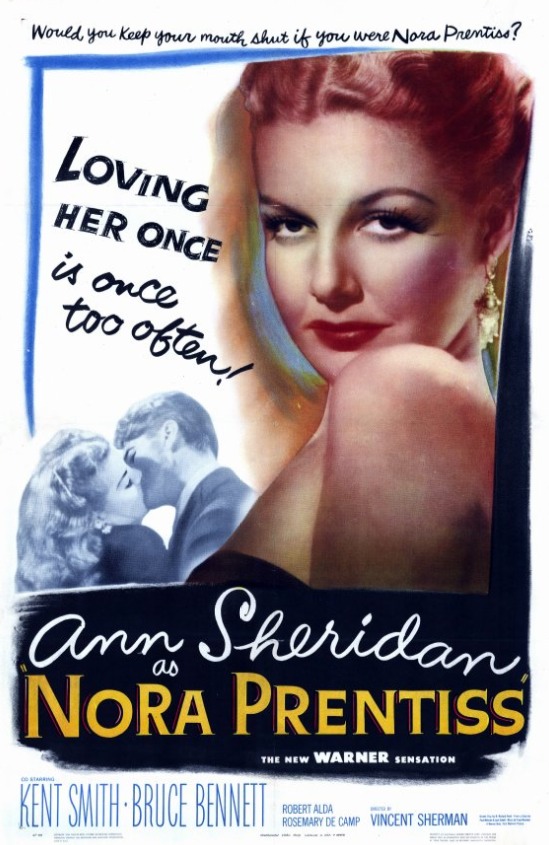
In 1947, March was “make jokes about Nora Prentiss” month on the Jack Benny show. A week didn’t go by with at least one line like, “She makes Nora Prentiss look talkative.”

I suppose the promotional tagline for the film — “Would you keep your mouth shut if you were Nora Prentiss?” — was irresistible for comedians, especially since it’s selling the picture based on its final 10 minutes, which strain credulity a bit.

If you can swallow a few plot contrivances, however, Nora Prentiss is a fantastic film. The performances are great, Vincent Sherman’s direction is assured, Franz Waxman’s score is rich and expressive, and James Wong Howe’s black and white cinematography is crisp and beautiful, as it always was.

The title, poster, and advertising campaign for Nora Prentiss all seem to be modeled on the earlier Warner Bros. “women’s noir” Mildred Pierce (1945), but they’re very different films. Nora Prentiss, which is based on Paul Webster’s short story, “The Man Who Died Twice,” is more about its male protagonist, Dr. Richard Talbot (Kent Smith), than it is about Nora.

The film begins, as so many noirs do, at the end. A man sits in the shadows of a prison cell and refuses to say how he knew Dr. Talbot, or why he was blackmailing him.

Dr. Talbot is a 43-year-old physician with a wife (Rosemary DeCamp) and two teenaged children (Robert Arthur and Wanda Hendrix). He lives in a beautiful house in San Francisco and shares a thriving practice with his partner, Dr. Joel Merriam (Bruce Bennett).

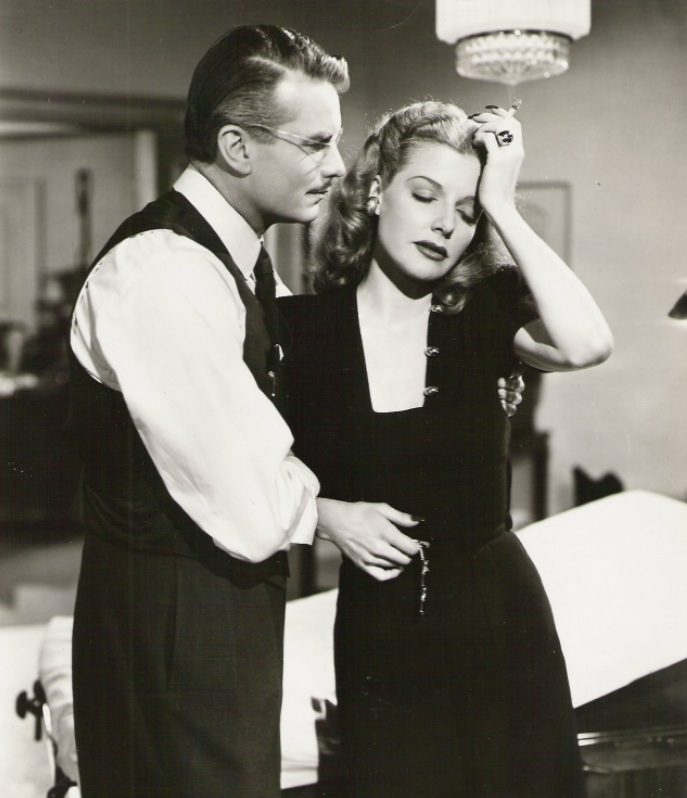
One night, Talbot comes to the aid of a beautiful nightclub singer after she’s knocked down by a car and suffers minor leg injuries. The singer, Nora Prentiss (Ann Sheridan), flirts with him a little as he tends to her, her nylon rolled down on one leg.

The strait-laced Talbot is completely smitten with Nora, but when she finds out he’s married, she resists his clumsy advances. Talbot says he doesn’t see a reason why they can’t be friends, but an afternoon at his cabin in the mountains never seems platonic, no matter what either of them says.

Nora is drawn to Talbot, but she never seems less than clear-headed about the affair. After a short, dreamy period of time with Talbot, she realizes that she doesn’t want to be “the other woman,” and attempts to break it off. He is less clear-headed, and will do anything to be with her, including — but not limited to — promising her he will divorce his wife, using a cadaver to fake his own death, and following her to New York, traveling under an assumed name.

If the logic police tend to kick down your doors of perception anytime the party in your head gets too weird, you’ll probably find yourself picking apart the plot of Nora Prentiss starting around the halfway mark.

But if you can relax, sit bank, and enjoy the ride, Nora Prentiss is an absorbing film about a man who loses everything for the love of a woman, eventually devolving into a paranoid, hard-drinking wreck who never leaves his hotel room for fear he will be recognized.

Kent Smith is very good as Talbot, but the film works as well as it does because of Ann Sheridan’s performance as Nora. Unlike noirs in which a wicked femme fatale with no discernible inner life seduces and ensnares a sad sack Everyman, Sheridan’s Nora is a three-dimensional character. She’s beautiful, intelligent, and sensible enough to pull away from Talbot when things start to go south. This has the effect of making Talbot’s obsession sadder and more believable than it would be if she were just a harpy with a beautiful face.

The Man I Love (Jan. 11, 1947)

The Man I Love
The Man I Love (1947)
Directed by Raoul Walsh
Warner Bros.

Loving the popular music of the ’30s and ’40s isn’t a prerequisite for enjoying Raoul Walsh’s The Man I Love, but it sure helps.

If you don’t like old pop standards (I do, and found myself humming “The Man I Love” constantly for about a day after I watched this movie), then you’d better like “women’s pictures,” because that’s what this is. (I’ve seen The Man I Love called a film noir, but it’s not. Half the movie takes place in nightclubs, and there’s a hint of criminal malice every now and then, but that alone does not a noir make.)

The most prominent tune is the one that gives the film its title, George and Ira Gershwin’s sublime “The Man I Love” — both as a smoky nightclub number and as a constant refrain in Max Steiner’s lissome score — but there are plenty of other great songs, like Jerome Kern and Oscar Hammerstein’s “Why Was I Born?” and James P. Johnson and Henry Creamer’s “If I Could Be With You.” There are also tunes just tinkled out on the piano, like George Gershwin’s “Liza (All the Clouds’ll Roll Away)” and Johnny Green’s “Body and Soul,” suffusing the film with a nostalgic languor that’s a nice counterpoint to all the melodrama.

When New York nightclub singer Petey Brown (Ida Lupino) packs her bags for Los Angeles to visit her siblings, she’ll find love, lose love, flirt with danger, and leave things a little better off than she found them. The poster for The Man I Love features the following tagline: “There should be a law against knowing the things I found out about men!” This is a bit of an overstatement, since most of what Petey finds out about men in this picture is what most clear-eyed women already know; most of them are rotten, some are crazy, some are sweet but naive and dim-witted, and the few you fall for are probably in love with another dame who they’ll never get over.

Petey’s sister Sally Otis (Andrea King) has a young son and a husband, Roy Otis (John Ridgely), who’s languishing in a ward for shell-shocked soldiers. Sally lives with the youngest Brown sister, Ginny (Martha Vickers), who’s 18 and should be enjoying life, but instead spends most of her time caring for the infant twins of their across-the-hall neighbors, Johnny and Gloria O’Connor (Don McGuire and Dolores Moran). Joe Brown (Warren Douglas) — the girls’ brother — is hip-deep in trouble. He’s working for a slimy nightclub owner named Nicky Toresca (Robert Alda) and seems destined for a one-way trip to the big house.

There are a few potentially interesting stories that never really go anywhere, such as Ginny’s attraction to Johnny, whose wife is two-timing him, and Sally’s relationship with her mentally ill husband. For better and for worse, Lupino is the star of The Man I Love, and her dangerous dealings with Nicky Toresca and her doomed romance with a pianist named San Thomas (Bruce Bennett) who’s given up on life dominate the running time of the picture.

The actors are all fine, and the stories are involving, but it’s the music that elevates this picture. Ida Lupino expertly lip synchs her numbers, which were sung by Peg La Centra (who can be seen in the flesh in the 1946 film Humoresque, singing and playing the piano in two scenes in a dive bar).

There’s also at least one allusion to a popular song in the dialogue. When Petey sees the twins and asks “Who hit the daily double?” Gloria responds gloomily, “Everything happens to me,” which is the title of a Matt Dennis and Tom Adair song first made popular by Frank Sinatra when he was singing for Tommy Dorsey’s band. There are probably other little in-jokes like that sprinkled throughout, but that was the only one I caught.

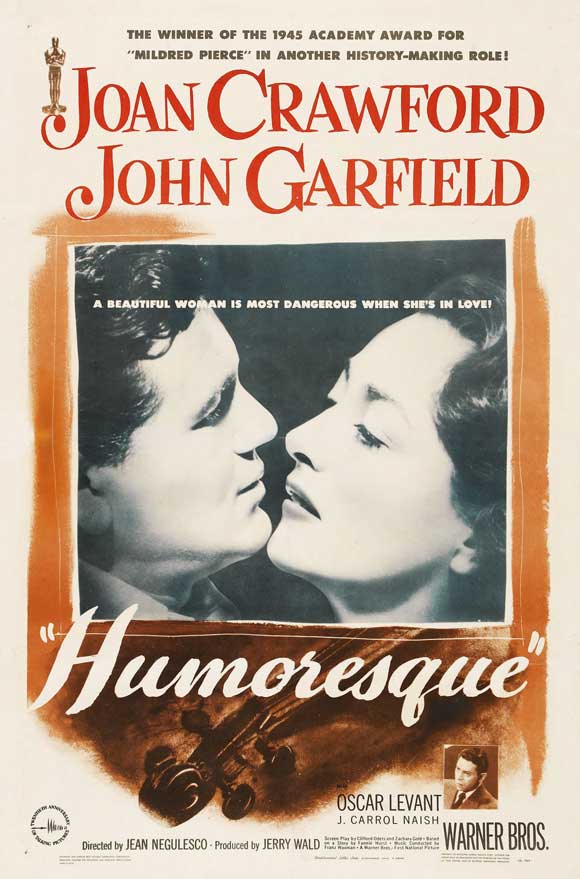
Humoresque (Dec. 25, 1946)

In a recent NY Times interview with David O. Russell, the director of the Oscar-nominated biopic The Fighter (2010), he compared his star, Mark Wahlberg, to John Garfield. Russell said that — like Garfield — Wahlberg is “always kind of in character, because it’s always him in some way.”

Garfield might seem as unlikely a choice as Wahlberg to play a concert violinist, but Humoresque never tries to pass Garfield off as something he wasn’t. His character, Paul Boray, spends his boyhood in what appears to be New York’s Lower East Side, in an immigrant family that has neither the time nor the money for classical music. (Garfield was born Jacob Julius Garfinkle, the son of Russian Jewish immigrants, and grew up in Brooklyn and the Bronx, where he was enrolled in a school for difficult children.) At a high society party, a tipsy young woman refuses to believe Boray when he tells her he’s a violinist. She pegs him as a prizefighter, and refuses to believe he even knows what end of a violin the music comes out of. “It comes out of the middle,” he responds. (Garfield would, however, play a boxer in his next film, Body and Soul.)

There are plenty of hoary cliches in the early sections of the film. Bobby Blake plays Boray as a child. His immigrant father (J. Carrol Naish) works hard and always has his eye on the bottom line, while his mother (Ruth Nelson) is more sensitive, and grows to believe in Paul’s desire to play music. All of these scenes are pretty laborious.

Perhaps director Jean Negulesco wanted to be explicit about how a rough young man from the slums could become a dedicated concert musician, but all of the scenes of Boray’s childhood are less effective than a short sequence later in the picture in which the adult Boray storms out of a recording studio after being forced to cut a major chunk from a piece for radio time. He returns to his apartment to play alone, and the wildness of his music is reflected in a herky-jerky montage of chaotic city streets and teeming masses of people.

Long stretches of Humoresque are told through music, which is beautifully played by violinist Isaac Stern, but there’s plenty of snappy dialogue, too. When Boray gets in an argument with his friend, accompanist, and mentor Sid Jeffers (played by pianist and wit Oscar Levant), Jeffers tells him, “You’ll do all right. You have all the characteristics of a successful virtuoso. You’re self-indulgent, self-dedicated, and the hero of all your dreams.” Boray responds, “You oughta try a few dreams yourself, it might make you less cynical. When I look at you, I know what I want to avoid.” (And to give you an idea of the rapidity of the dialogue in the film, that exchange takes place in less than 12 seconds.)

The plot, such as it is, kick in around the 30-minute mark, when Joan Crawford shows up as Mrs. Helen Wright, a myopic, dipsomaniac socialite with a sharp tongue. Her husband is a cultured, sensitive man, but — by his own admission — very weak, and as soon as Helen takes an interest in Paul and his career, tongues begin to wag.

Garfield and Crawford have great chemistry, and both are good enough actors to give their relationship depth. It’s unclear for a time exactly what each wants from the other, but her alcoholism and his deep-seated anger make for plenty of stormy scenes. At one point, Paul blows up and yells at her, “Well, you didn’t do any of this for me, really. You did it for yourself, the way you buy a racehorse, or build a yacht, or collect paintings. You just added a violin player to your possessions, that’s all.”

In Bosley Crowther’s review of Humoresque in the December 26, 1946, issue of the NY Times, he wrote, “The music, we must say, is splendid — and, if you will only shut your eyes so that you don’t have to watch Mr. Garfield leaning his soulful face against that violin or Miss Crawford violently emoting (‘She’s as complex as a Bach fugue,’ Oscar says), and if you will only shut your ears when folks are talking other such fatuous dialogue, provided by Zachary Gold and Clifford Odets, you may enjoy it very much.”

I love Crowther’s reviews. Maybe if I’d been around when he was writing them I would have resented the stranglehold he had on public perception, but in retrospect they’re fantastically entertaining. I liked Humoresque more than he did, but I don’t disagree with his assessment. One has to take into account his longstanding hatred of Joan Crawford, of course, but by the time the credits rolled I was more moved by the music than by any of the vacuous melodrama.

The Beast With Five Fingers (Dec. 25, 1946)

Robert Florey’s horror flick The Beast With Five Fingers begins with the following words: “This is the story of what happened — or seemed to happen — in the small Italian village of San Stefano — nearly fifty years ago.”

Normally in my reviews I try to avoid spoilers. I’ll summarize the plot, but only up to a point, and I try to talk around any big twists. But since The Beast With Five Fingers is pretty up-front about its unreal elements right from the start, I’m just going to give everything away about this movie willy-nilly. So if you don’t like spoilers, stop right now and go read my review of Tarzan and the Leopard Woman. I totally don’t give away how hot Brenda Joyce looks in it.

Anyway, The Beast With Five Fingers is based on a short story written in 1919 by W.F. Harvey (1885-1937), an English author who is also famous for penning the story “August Heat,” which was memorably adapted for the radio show Suspense in 1945, in a show starring Ronald Colman.

The script for the film was written by Curt Siodmak, who intended it to be a vehicle for Paul Henreid. Henreid turned it down, however, reportedly saying, “I’m not wild to play against a dead hand.”

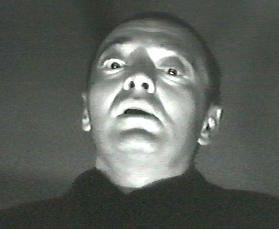
Peter Lorre, in his last film role for Warner Bros., was cast instead. Siodmak felt this casting was less effective, since the audience immediately assumes that Lorre is a psychopath, which they wouldn’t when presented with a handsome, self-contained actor like Henreid. I tend to agree, especially since Lorre does nothing to disabuse the viewer of the notion that he’s a raving maniac. From his very first scene, Lorre does what he did best; act completely creepy and insane.

Lorre plays Hilary Cummins, an astrologer who takes his work very seriously. He’s employed as secretary to partially paralyzed concert pianist Francis Ingram (Victor Francen), but if Hilary does any actual work for Ingram, we don’t see it. He’s unashamed to admit that he wants Ingram’s nurse, Julie Holden (Andrea King), to constantly dote on him so he can be left alone to discover a “key to the future,” which Hilary claims was known only to the ancient astrologers, but has been lost since the burning of the great library at Alexandria.

There are other hangers-on in Ingram’s Italian villa, such as Ingram’s attorney, Duprex (David Hoffman), and Bruce Conrad (Robert Alda), a small-time con man and composer who seems stymied by his association with Ingram. Conrad transcribed some Bach pieces, modifying them to be played by a one-handed pianist, and ever since, has been unable to write anything.

Ingram is a petty tyrant and thoroughly unpleasant man. His right side might be paralyzed, but his left hand is incredibly strong, as he demonstrates in a memorable scene in which he strangles Lorre — who is more than capable of the histrionic puffing and wheezing required of him when Ingram finally lets go.

One dark and stormy night, Ingram rolls around the villa in his wheelchair, pitifully crying for Julie. He pitches down the stairs, and the fall kills him.

His death brings a few greedy relatives (played by Charles Dingle and John Alvin) out of the woodwork, eager to hear the reading of the will. They’re not happy when Duprex informs them that Ingram recently changed his will to leave everything to Julie.

For most of its running time, The Beast With Five Fingers is a fairly standard haunted-house mystery, but it has a strange premise that’s always bubbling beneath the surface, namely that you’re going to see some kind of five-fingered beastie scuttle around for at least some of the picture.

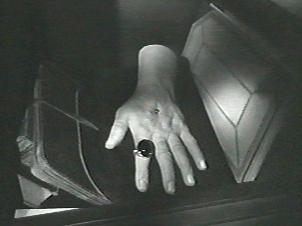
This odd premise is delivered on eventually. After Duprex is murdered, the other occupants of the villa open the sarcophagus holding Ingram and find him clutching a push dagger in his right hand, his left hand missing … cut off.

Enter J. Carrol Naish as commissario of police Ovidio Castanio. It’s one of many “ethnic” roles Naish sunk his teeth into (see also Humoresque and the radio show Life With Luigi), and like everything else in the film, it’s more silly than scary, but Naish is a good actor, and he gets one of the film’s best moments, during the last minute of the picture.

The eponymous crawling thing doesn’t show up until almost an hour has passed. The final 20 minutes of The Beast With Five Fingers, however, deliver what the audience paid to see … a phantasmagoria that only exists in Lorre’s mind. He watches Ingram’s disembodied hand float over the keyboard, playing Bach’s Chaconne in D minor as arranged for the left hand by Brahms (who was friendly with composer Max Steiner’s family back in Vienna). He then rips apart the library to find the crawling hand and attempts to stop it by nailing it down. It’s classic Lorre … all bug eyes and feverish gasping. And although it probably played pretty gruesomely at the time of the film’s release, it’s all campy good fun now.

Florey directed the silly proceedings in a solid, professional fashion, with plenty of fluid camerawork and smooth dolly shots. Time magazine said in their review of the film that Florey was “plainly untroubled by considerations of taste,” but the worst thing in this picture is a disembodied hand that crawls around on its fingers, strangling a few people here and there. It’s an effective special effect, but too ridiculous to ever be taken seriously. This is one you can watch with the kids during prime time.

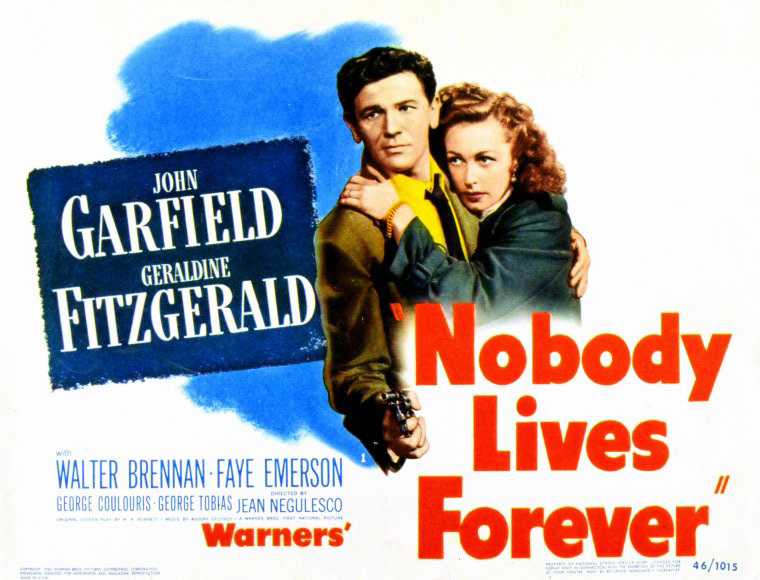
Nobody Lives Forever (Nov. 1, 1946)

Jean Negulesco’s Nobody Lives Forever is far from a great film, but it’s crackerjack entertainment. Warner Bros. had been making crime pictures for 16 profitable years at this point. While the heyday of the Warner gangster film may have been in the ’30s, this is a fine example of the quality product the studio was still churning out in the post-war era.

The screenplay is by W.R. Burnett, whose 1929 novel Little Caesar was made into a film in 1931 starring Edward G. Robinson — the first of Warner’s great cycle of gangster movies. Nobody Lives Forever is based on Burnett’s novel I Wasn’t Born Yesterday, and while it may not be as significant as Little Caesar, it’s still a tight thriller with plenty of snappy tough-guy dialogue.

Besides the good script and excellent direction, the picture works as well as it does because of impeccable casting. When you’re looking for a hard-bitten but essentially decent con man, you can’t ask for a better protagonist than John Garfield. A kindly, doddering old mentor of cons named “Pop”? Who better than Walter Brennan? A sweaty, bug-eyed, paranoid louse named “Doc” who desperately needs one decent score to get back on top? Is George Coulouris available?

Garfield plays Nick Blake, a World War II veteran honorably discharged after being wounded in action. One of his hands doesn’t close quite right, but other than that he’s none the worse for wear. After his sidekick Al Doyle (George Tobias) picks him up from the hospital in Governor’s Island, they take the ferry back to Manhattan, where he reunites with his girl, Toni Blackburn (Faye Emerson). As she sings “You Again” in a swanky nightclub, Nick follows the mustachioed club owner Chet King (Robert Shayne) into his office to settle a beef over money. Rudi Fehr’s editing in this sequence is superb, cutting between Toni on stage, Al standing guard outside the office, and Nick bracing Chet inside.

After Toni finishes her number, Nick confronts her, then kisses her passionately, then smacks her in the face for double crossing him.

The action soon switches to California, where Al has gotten a line on a widow with a $2 million fortune, which — as Pop points out — is a lot of money, even after taxes. Nick, a handsome “diamond in the rough,” is the perfect candidate to pose as a shipping magnate and charm her out of her cash.

Unlike most long cons, Nick, Pop, Doc, Al, and the other members of their crew meet in smoky back rooms as if they’re planning a bank heist. The only problem with the job is that Nick actually starts to fall for the widow, Gladys Halvorsen (Geraldine Fitzgerald), who turns out to be younger than most widows, and a dish to boot.

When Doc pushes Nick to close the deal, he shoots back, “I’m not used to operating with a bunch of cheap, hungry chiselers who should be in the strong-arm racket. Big deals take time.”

Garfield has great chemistry with his co-stars, particularly the ladies, but the relationships take a back seat to the action, especially during the final climactic 20 minutes.

Sure, there are some holes in the plot, and there’s nothing deep about Nobody Lives Forever, but it’s a hell of a way to kill an hour and 40 minutes.

Deception (Oct. 18, 1946)

In my recent review of Decoy (1946), I mentioned that most of the movies that are now classified as film noirs were originally called “thrillers” or “melodramas.”

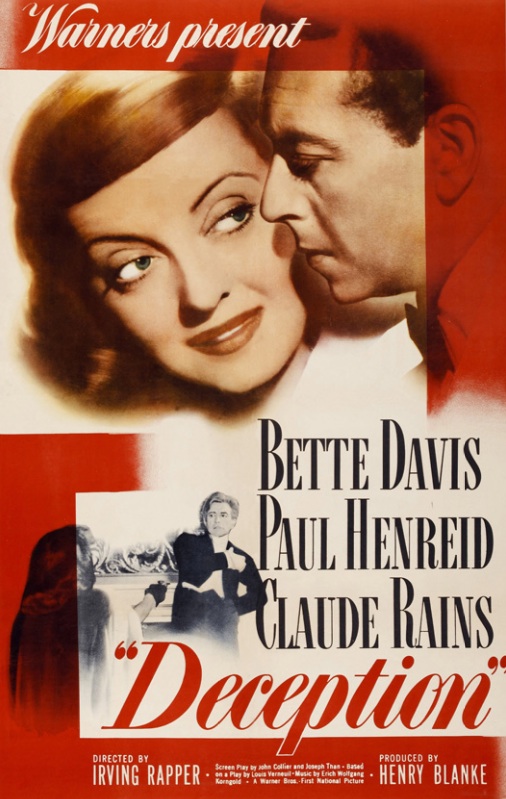
Irving Rapper’s Deception, about a love triangle in the world of classical music, sometimes gets thrown on the film noir pile, but it’s a melodrama through and through. The film reunited the director and all three stars of the popular, classy flick Now, Voyager (1942), which featured one of Bette Davis’s most iconic performances.

Lightning didn’t strike twice. While Deception, which reunited Davis with her fellow Now, Voyager alumni Paul Henreid and Claude Rains, received generally positive reviews, it was the first picture Bette Davis made for Warner Bros. that lost money. It’s a good film, but as melodramas go, it’s not terribly thrilling, and the criminal activity is kept to a minimum.

In the first scene of the film, piano teacher and musician Christine Radcliffe (Bette Davis) rushes through the driving rain to a concert in a small, second-floor performance area. She sees cellist Karel Novak (Paul Henreid), and she begins to cry. Quite by chance, she saw an announcement for the performance and couldn’t believe it, since she believed that Novak, her old flame, had died during World War II.

Their reunion is so emotional that it quickly leads to marriage. Even before the nuptials, however, Novak senses that Christine might be hiding something from him. She lives in an enormous apartment with a spectacular view of Manhattan, and her closets are full of fur coats, all improbabilities in the tight housing market of 1946, especially on a piano teacher’s salary.

Things quickly reach a head at their wedding celebration, with the appearance of Christine’s teacher, the famous composer Alexander Hollenius (Claude Rains). He has witticisms and icy remarks to spare, but he doesn’t really tip his hand until Christine sits down to play Beethoven’s Piano Sonata No. 23 in F minor, Op. 57, the “Appassionata.” Hollenius listens, enthralled, and crushes his champagne glass in his hand. When Christine rushes to tend to him, he says, “Like all women, white as a sheet at the sight of a couple of scratches. Calm and smiling like a hospital nurse in the presence of a mortal wound.”

That’s the first hint he drops about his feelings, but it won’t be the last. When Christine goes to visit him the next day, she walks into Hollenius’s conservatory and calls the piece he is playing “wonderful,” to which he responds, “Extraordinary, isn’t it, that music can exist in the same world as the basest treachery and ingratitude?”

From the beginning, Christine kept Novak in the dark about her relationship with Hollenius. Hollenius goes along with this deception, but never misses an opportunity to drop a hint or needle Novak about something. Compounding the mess is the fact that Hollenius is one of Novak’s favorite composers, and when he offers Novak the chance to be the soloist for the world premiere of his new cello concerto, Novak is ecstatic. Christine, on the other hand, senses that the mercurial Hollenius may be setting a trap for the emotionally fragile Novak.

And it certainly seems that way to the viewer, especially when Hollenius brings in Bertram Gribble (John Abbott), a journeyman cellist, to act as understudy in case Novak’s strained nerves get the better of him. Besides all the barbs and insinuations in social settings, Hollenius the conductor even seems hell-bent on tormenting Novak during the serious work of preparing for their concert, when he forces him to replay the same measure over and over during a dress rehearsal.

I’ve rarely seen a character in a film wield his art as a weapon quite so effectively as Hollenius does. It’s a perfect role for Rains, who as an actor projected a unique mix of effeteness and virility. By the time the climactic world premiere scene rolls around, the audience’s nerves are so thoroughly jangled that merely watching Henreid bow and pluck at his cello’s strings is as suspenseful as watching someone defuse a ticking time bomb. (It helps that Henreid’s pantomiming is nearly perfect. His cello parts were actually played by cellist Eleanor Aller, the wife of Felix Slatkin, when she was pregnant with their son, Frederic Zlotkin. Henreid was coached on how to properly mimic playing the instrument by Aller’s father, Gregory Aller.)

The score of Deception and all of Hollenius’s compositions were written by Erich Wolfgang Korngold (1897-1957), an Austro-Hungarian composer whose stirring, neo-Romantic scores for films like The Adventures of Robin Hood (1938) and The Sea Hawk (1940) presaged the work of John Williams. His style was too old-fashioned and his medium was too populist to attract anything but disdain and indifference from critics and scholars during his lifetime, but he was incredibly talented, even though his music was neither groundbreaking nor avant-garde. In Deception, he seems to be straining against the bonds imposed on him by the conventions of the cinema, and Novak’s cello part in the concerto is especially moving and powerful. At least I thought so.

Cloak and Dagger (Sept. 28, 1946)

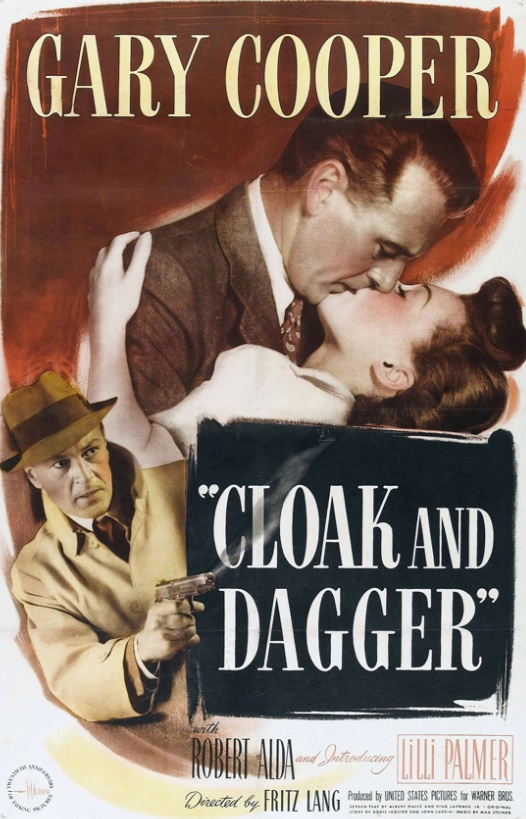
Fritz Lang’s Cloak and Dagger is the best espionage thriller I’ve seen since Alfred Hitchcock’s Foreign Correspondent (1940). Like that film, it doesn’t have the over-the-top stunts or pyrotechnics of a modern action movie, but its pacing, plot, and music create a spectacle that is every bit as suspenseful and exciting.

Gary Cooper, who is best known for playing stoic men of action, gives a credible performance as bookish physicist Alvah Jesper, a man who finds himself in over his head, but is smart enough and tough enough to find a way out of one tight situation after another.

Professor Jesper is recruited by the O.S.S. (the Office of Strategic Services, the U.S. intelligence agency formed during World War II that would eventually become the C.I.A.) and sent to Switzerland to bring his former colleague Dr. Katerin Lodor (Helen Thimig) back to the United States. Dr. Lodor, an elderly woman, escaped through the Alps from Germany, where she was being forced to work on an atomic bomb project for the Nazis. Switzerland is a neutral country, but it’s lousy with agents of the Gestapo, and Dr. Lodor’s life is in peril.

Immediately, there are two implausible aspects of the plot that you have to get over to suspend your disbelief and enjoy the picture. One is that the O.S.S. would recruit a college professor with no experience in the intelligence field to act as an undercover agent merely because he has a personal connection to their target and speaks conversational German. The other is that, by this point in 1946, it was common knowledge that any nuclear research being conducted by the Nazis was mostly smoke and mirrors, and the Third Reich was never close to developing an atomic bomb.

Neither of these issues proved a stumbling block for me. Every spy thriller needs a plot hook, and plenty of these hooks prove either factually inaccurate or completely ridiculous after five or ten years have passed. Also, the O.S.S. was a young organization, and they did some pretty wild stuff during the war. Recruiting a college professor in his mid-40s for dangerous undercover work doesn’t seem completely outside the realm of possibility. (Cooper’s role is loosely inspired by the exploits of Michael Burke, president of the N.Y. Yankees from 1966 to 1973, who briefly played with the Philadelphia Eagles in 1941 before leaving to serve with the O.S.S., where he worked behind the lines in Italy and later in France, where he helped the Resistance prepare for D-Day.)

There are some great touches, too. When Jesper disembarks in Switzerland, he thinks he’s being smart by casually covering his face with his hand when he walks by a photographer, but it is precisely this action that alerts the Gestapo to the fact that he might be a man worth watching.

After Jesper makes contact with Dr. Lodor, she leads him to Dr. Giovanni Polda (Vladimir Sokoloff), another physicist who is being forced by the Nazis to work on their atomic bomb program. Jesper travels to Italy, where he is aided by Italian partisans led by Pinkie (Robert Alda) and the beautiful Gina (Lilli Palmer).

Luckily, Jesper is able to pose as a German doctor because the Italian fascist thugs keeping Dr. Polda prisoner in a beautiful villa clearly don’t recognize American-accented German when they hear it. Viewers with an ear for languages probably will.

The Italian baddies are led by a man named Luigi, who is played by veteran character actor Marc Lawrence, who had a very long career playing gangsters in Hollywood. His first film role was an uncredited part as a henchman in If I Had a Million (1932), and one of his last was playing Carlo Gambino in the 1996 TV movie Gotti.

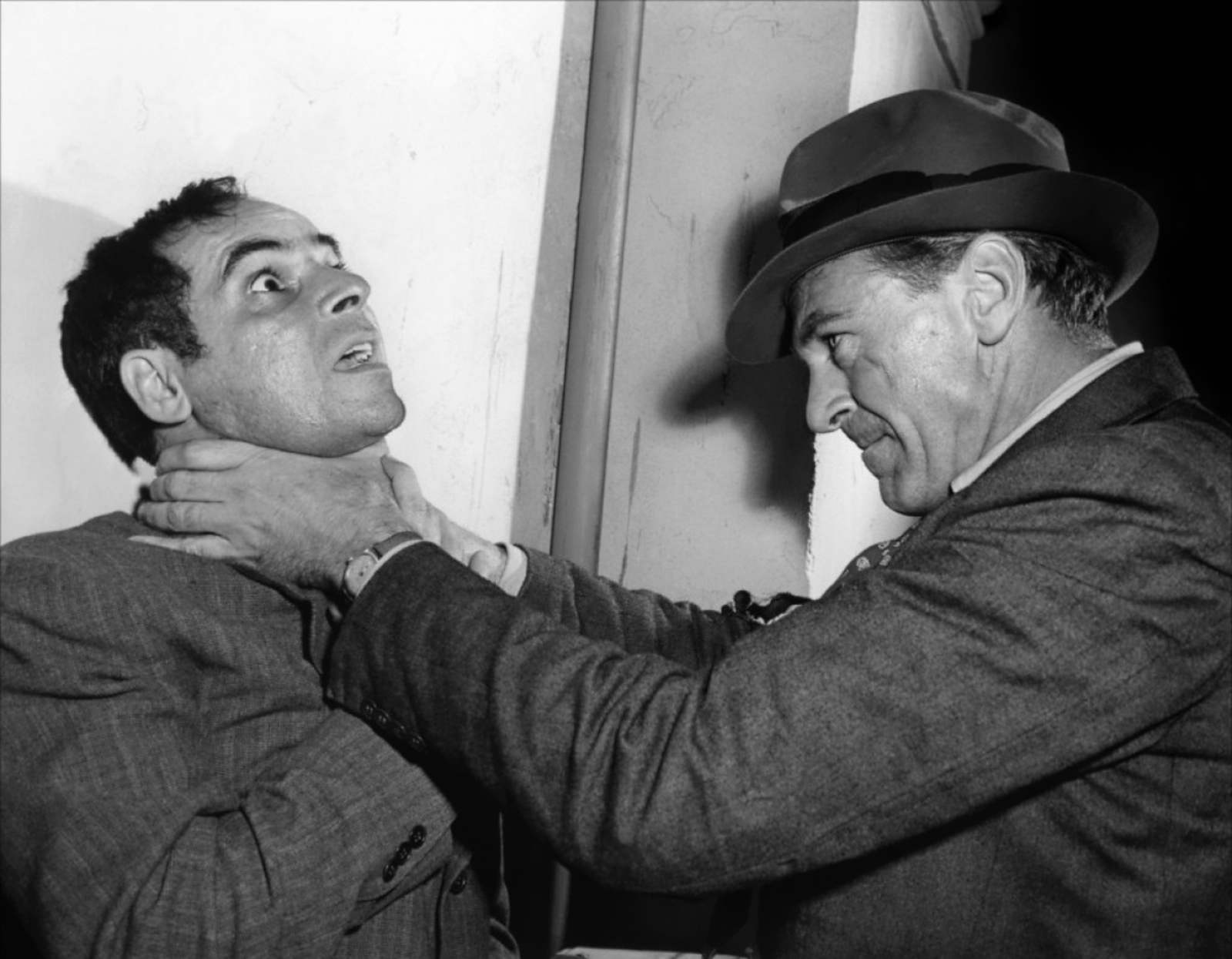
Toward the end of the movie, Cooper and Lawrence square off in the most brutal and realistic fight I’ve seen in a movie from the 1940s. The James Cagney thriller Blood on the Sun (1945) features a great judo fight that was way ahead of its time, but the combat between Jesper and Luigi is a desperate fight to the death, pure and simple. There’s nothing flashy about it, and it’s not overly choreographed. The two men hold each other close, clawing at each other’s faces, choking each other, kicking at weak points, and twisting back fingers and arms. It’s over in less than 90 seconds, but its impact lasts for the rest of the movie.

The screenplay for Cloak and Dagger was written by Albert Maltz and Ring Lardner, Jr., based on a story by Boris Ingster and John Larkin, and “suggested” by the 1946 nonfiction book Cloak and Dagger: The Secret Story of O.S.S., by Corey Ford and Alastair MacBain.

Director Lang is best known for the films he made when he still lived in Germany, such as the silent science fiction opus Metropolis (1927), the chilling portrait of a child killer M (1931), and the crime thriller The Testament of Dr. Mabuse (1933), but Lang was a master craftsman at every stage of his career, even when doing for-hire work like this.