Tag Archives: Film Noir

The Lady From Shanghai (Dec. 24, 1947)

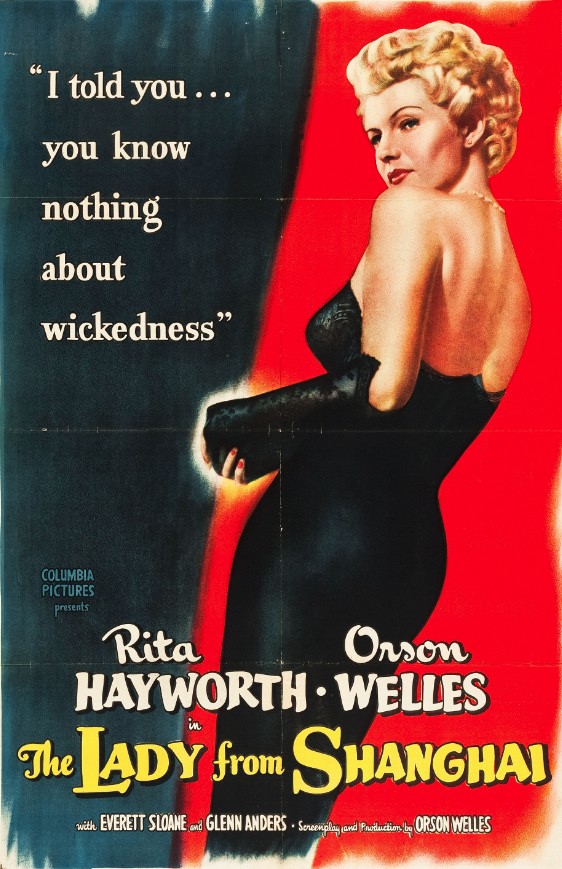
Orson Welles’s The Lady From Shanghai premiered in France on Christmas Eve, 1947, and in the United States nearly half a year later, on June 9, 1948.

The film is something of a minor classic now, but at the time of its release it was generally a disappointment; a disappointment to critics, to the studio, to audiences, and to Welles himself, who had little control over the final product released into theaters.

The Lady From Shanghai was filmed in 1946, and the original cut ran more than two and a half hours. Executives at Columbia Pictures made numerous cuts, and the final musical score was not to Welles’s liking. The litany of complaints from all sides were legion, and are outside the scope of this review.

But before I get into a discussion of the film itself, I need to mention the complaint that I find most mystifying. Welles chose to radically alter the looks of his leading lady, Rita Hayworth (to whom he was married from 1943 to 1948), by chopping her long tresses and dying her hair platinum blond. This decision caused a whirlwind of controversy, and was blamed by some in Hollywood for the dismal box office performance of The Lady From Shanghai.

Was the movie-going public in 1948 composed entirely of people whose tonsorial proclivities were identical to the Son of Sam’s? I think that Rita Hayworth is stunningly beautiful and alluring no matter what her hairstyle, and The Lady From Shanghai is all the proof I need.

The Lady From Shanghai stars Welles as a “black Irish” rascal and drifter named Michael O’Hara who saves a beautiful young woman named Elsa Bannister (Hayworth) from a group of muggers in Central Park, and then becomes embroiled in a byzantine scheme that involves a faked death.

The plan is hatched by her husband’s law partner, George Grisby (Glenn Anders), who wants O’Hara to confess to murdering him after Grisby leaves the country, never to return. The rub is that without a body, the authorities won’t be able to convict O’Hara, and he’ll pocket a lump sum of cash for his trouble while Grisby pockets the insurance money. But Elsa’s husband, Arthur Bannister (Everett Sloane), has noticed the way Elsa and O’Hara make eyes at each other, and he’s got his own wild scheme.

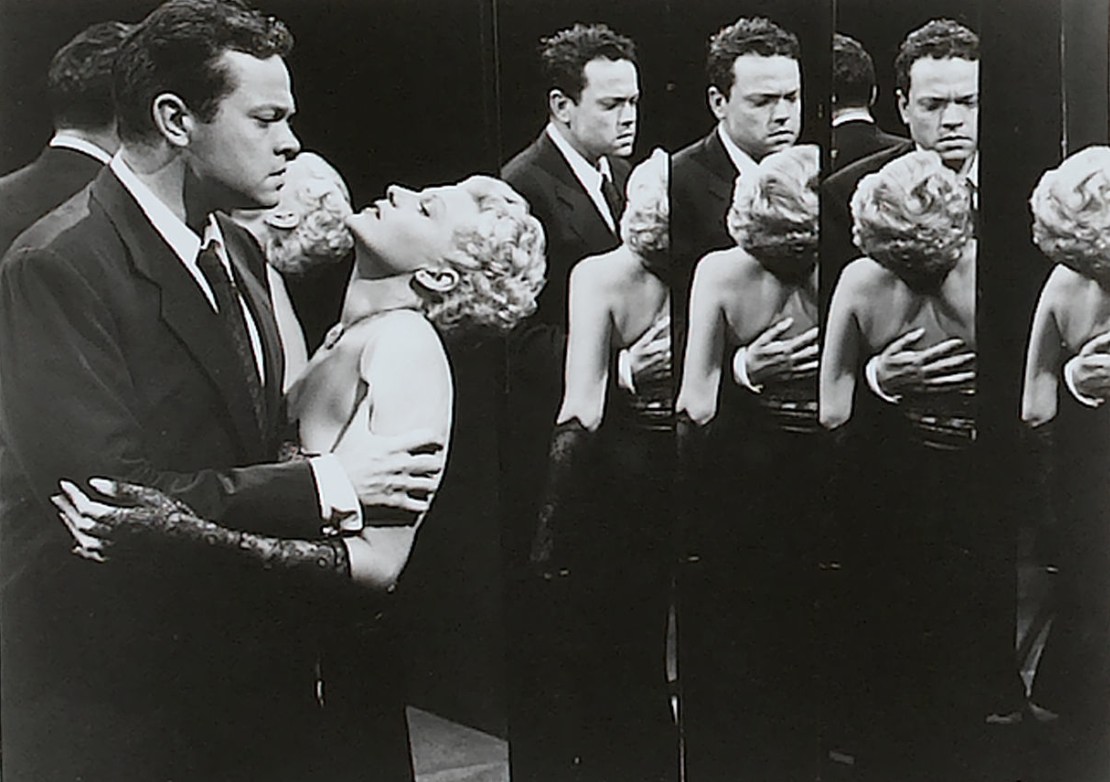
Even for a movie that was hacked down from 155 minutes to just 87, The Lady From Shanghai covers a lot of ground, and much of it is crazy. O’Hara accompanies the Bannisters and their entourage on a yacht tour of Mexico on their way from New York to San Francisco before the plot really gets rolling. Then, after the triple-cross scheme plays out, there’s a farcical courtroom scene that is genuinely funny and truly bizarre. Finally, there is a wild and phantasmagoric journey through San Francisco’s Chinatown that culminates in a chase through an abandoned fairground, and the film’s famous climax in the hall of mirrors of The Crazy House.

Given the studio-imposed cuts in the film’s running time, it’s probably not Welles’s fault that the plot is full of holes. But it’s hard to imagine any additional footage or story elements that would make the wild shifts in tone and byzantine plot any more digestible.

Ultimately, though, it really doesn’t matter. If you can get over Welles’s bad Irish accent and the general confusion of ideas in The Lady From Shanghai, it’s a brilliant, engrossing film that’s a joy to watch. Besides the gorgeous black and white cinematography and wonderful performances from Sloane, Hayworth, and Anders (and Welles, more or less), Welles is a director who was decades ahead of his time in terms of action and pacing. The slightly sped-up camerawork during fight scenes and the rapid editing isn’t like anything else you’ll see from the mid- to late-’40s.

There are a lot of things about The Lady From Shanghai that are totally unlike anything else in cinema at the time of its release. Welles’s reach usually exceeded his grasp, but as a director I think he was without parallel. The Lady From Shanghai may not be a perfectly formed work of art like Citizen Kane (1941), but it’s a fascinating and incredibly entertaining film.
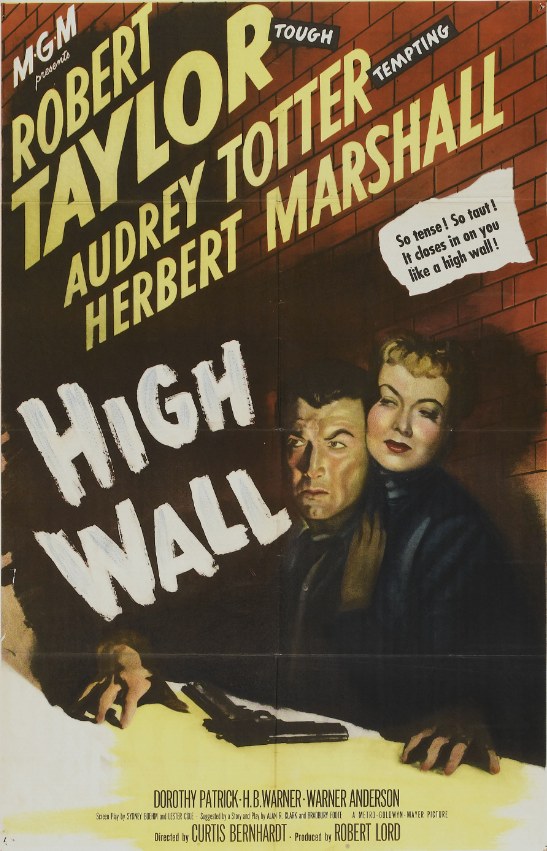
High Wall (Dec. 17, 1947)

High Wall
High Wall (1947)
Directed by Curtis Bernhardt
Metro-Goldwyn-Mayer

Curtis Bernhardt’s High Wall stars Robert Taylor as that most venerable of film noir archetypes — the amnesiac combat veteran who may or may not have committed murder.

Bernhardt was one of many German filmmakers who fled the Third Reich to work in Hollywood, and whose dark artistic sensibilities helped create what we now know as “film noir.” So far I’ve seen two other films he made, the excellent melodrama My Reputation (1946), which starred Barbara Stanwyck and George Brent, and the equally excellent psychodrama Possessed (1947), which starred Joan Crawford and Van Heflin.

High Wall lets Bernhardt flex his suspense-thriller muscles a little, and he’s more than up to the task.

At first glance, High Wall looks and feels like any number of similar dramas from RKO Radio Pictures — tight, well-made, black and white flicks designed for the bottom of a double bill — but it was actually produced by Metro-Goldwyn-Mayer, a powerhouse of a studio that wasn’t usually in the “noir” business.

High Wall is a pretty lean thriller, but MGM production values are evident in a few scenes, particularly when the protagonist, Steven Kenet (Robert Taylor), is sent to Hamelin County Psychiatric Hospital. The sanitarium features a big cast of extras; there are legions of brusque, businesslike cops and hospital attendants, and dozens of hapless patients lolling around on beds in the open ward. If High Wall had been an on-the-cheap production for Monogram pictures, there probably would have been one night attendant, two other patients, and sets that looked like they were on loan from a theatrical production.

Most of High Wall is shot on sets, so the exteriors are pretty fake-looking, but not distractingly so. Shooting on a soundstage also allows Bernhardt and his cinematographer, Paul Vogel, to create a dramatic rain-swept finale full of rich textures that probably wouldn’t have been possible if they’d been shooting on location.

Robert Taylor and Audrey Totter

Also, with such a big cast of loonies, it’s more believable that Kenet has so much difficulty seeing his psychiatrist, Dr. Ann Lorrison (Audrey Totter).

Kenet, you see, looks like the most likely suspect for his wife’s murder. Her strangled corpse was sitting right next to him when he drove his car off a bridge in a daze, after all.

But after Kenet finally gets a few appointments with Dr. Lorrison, she starts to believe that he might be innocent. Lorrison is a no-nonsense salt-of-the-earth gal. (This is evident early in the film when she turns down a male doctor’s offer of a date at the opera because she has Red Sox tickets.)

It’s not just Kenet’s good looks, tragic aura, six-year-old son, and Distinguished Service Cross and Silver Star from World War II that attract Lorrison, it’s nagging evidence of his innocence, so she starts helping him escape from the asylum for periods of time so he can investigate upstanding citizen Willard Whitcombe (Herbert Marshall), a middle-aged man who works for Brattle Press Religious Educational Text Books.

Marshall is the perfect villain for this type of melodrama. His bearing is patrician — and his voice is one of the smoothest and most charming you’ll ever hear — but there’s clearly something very wrong with him.

For a good portion of High Wall, it’s possible to be in doubt of the outcome. Kenet looks guilty, even to the viewer, and he suffers from fainting spells. He has a subdural hematoma in the left lobe that’s causing forgetfulness, irritability, and a possible proclivity toward murder and suicide.

High Wall is a fun movie. When it comes to the question of Audrey Totter’s charm and sexiness, I was a little on the fence after Lady in the Lake (1947), but she’s utterly charming in High Wall, and much more natural in High Wall than in Lady in the Lake. (It’s possible that not requiring her to stare into the camera the whole time might have let her deliver a more natural performance.)

I also really like the preview for High Wall. Its claims are actually accurate, too. “So tense. So taut.” That’s true. High Wall is a well-crafted suspense thriller. Also, when the preview says “Robert Taylor — more exciting than in Undercurrent,” that’s an understatement. Undercurrent is really pretty bad, and High Wall is really pretty good:

T-Men (Dec. 15, 1947)


T-Men (1947)
Directed by Anthony Mann
Eagle-Lion Films

Anthony Mann’s T-Men sneaks up on you like a sap-wielding mug in a dark alley.

For the first 10 minutes or so, it seems like just another docudrama about the heroic exploits of undercover government agents — like Henry Hathaway’s films The House on 92nd Street (1945) and 13 Rue Madeleine (1947) — right down to the stentorian voice-over narration by Reed Hadley, the guy who always did the stentorian narration in patriotic docudramas.

The title and opening credits of the film appear superimposed over the Seal of the United States Department of the Treasury as triumphant music plays. Then a disclaimer appears explaining that all the U.S. currency in the film was reproduced with special permission of the Treasury Department, and that reproduction of said currency is strictly prohibited. (Don’t film yourself fanning out a bunch of sawbucks at home, kids!)

Then the former chief coordinator of the law enforcement agencies of the Treasury Department, Elmer Lincoln Irey, haltingly reads from a piece of paper and explains the six units of the Treasury Department: “The Intelligence Unit, which tracks down income tax violators, the Customs Agency Service, with the border patrol, which fights smuggling, the Narcotics Unit, the Secret Service, which guards the president and ferrets out counterfeiters, the Alcohol Tax unit, which uncovers bootleggers, and the Coast Guard. These are the six fingers of the Treasury Department fist. And that fist hits fair, but hard.” (Incidentally, the mild-looking, bespectacled Irey was one of the men who brought down Capone. He also worked on the Lindbergh kidnapping case.)

Irey goes on to say that what we’re about to see is called “The Shanghai Paper Case,” a composite of actual counterfeiting cases tackled by the Treasury Department.

Over the course of the first couple of reels, however, it becomes clear that T-Men is a very different film from The House on 92nd Street, and that its dry, fact-filled introduction is only the tip of the iceberg.

McGraw and Ford

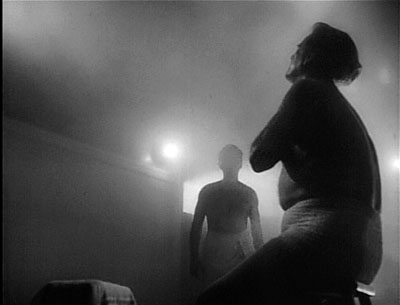
Although Reed Hadley’s hokey narration occasionally dominates the proceedings, the script is tight and the actors are all excellent. Dennis O’Keefe and Alfred Ryder, who play undercover treasury agents Dennis O’Brien and Tony Genaro, are solidly believable, and Wallace Ford — who plays “The Schemer” — is always fun to watch, but for my money, the most memorable character in the film is “Moxie,” played by the granite-jawed Charles McGraw. Moxie is a merciless thug who shoots men dead without blinking, breaks fingers as easily as he asks questions, and boils a man to death in a steam bath without changing his expression.

But it’s not just the sudden, brutal acts of violence or the sense of paranoia that suffuses T-Men that set it apart from other films of its ilk, it’s also the dimly lit, “you are there” cinematography by John Alton.

O'Keefe and McGraw

Director Mann and the studio had faith in Alton, and pretty much let him do whatever he wanted. Alton, quoted in the press book for T-Men,* said “…we shot scenes just as they came along. We shot under all conditions. Some of our night shots were made without any lights at all. I know some people thought the scenes wouldn’t match and it would turn out to be a horrible mess. Fortunately, it turned out as I was sure it would.”

T-Men was Mann’s first collaboration with Alton, but it wouldn’t be his last. Together they would go on to make Raw Deal (1948), He Walked by Night (1948) (which Alfred Werker directed and Mann co-directed), Reign of Terror (1949), Border Incident (1949), and Devil’s Doorway (1950).

Alton and Mann’s contribution to what we now call “film noir” is enormous. T-Men is a great picture. It’s tense, violent, and looks amazing. Despite its low budget, it was a big hit when it was released, and it’s still fresh today.

*And cribbed by yours truly from Alan K. Rode’s fantastic book Charles McGraw: Biography of a Film Noir Tough Guy.

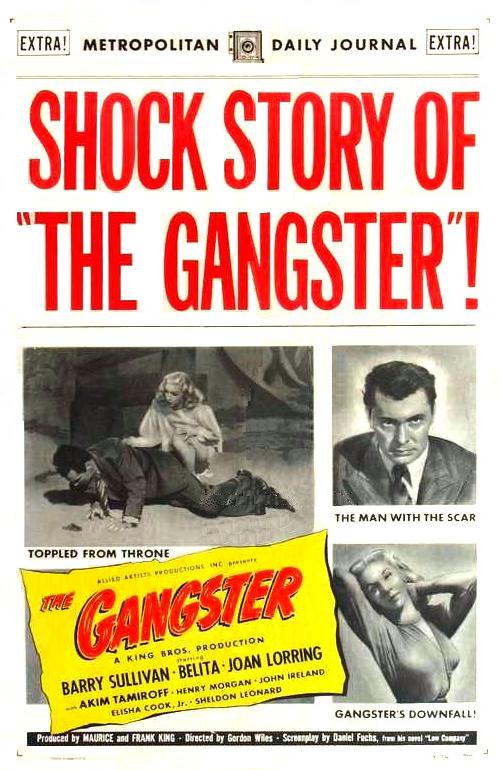
The Gangster (Nov. 25, 1947)

I’m no hypocrite. I knew everything I did was low and rotten. I knew what people thought of me. What difference did it make? What did I care?

In the dirty razzle-dazzle of Neptune Beach, one man runs the rackets, and he has the unlikely name of “Shubunka.” (You can sing his name along to the Perry Como hit “Chi-Baba, Chi-Baba.”) Neptune Beach is a thinly fictionalized version of Coney Island (there are references throughout the film to “uptown,” 5th Avenue, Central Park, and Queens).

Barry Sullivan plays Shubunka perfectly. His opening voiceover narration (quoted above) is just the tip of the iceberg. Like a lot of tough guys, Shubunka’s cynical patter doesn’t always match his actions.

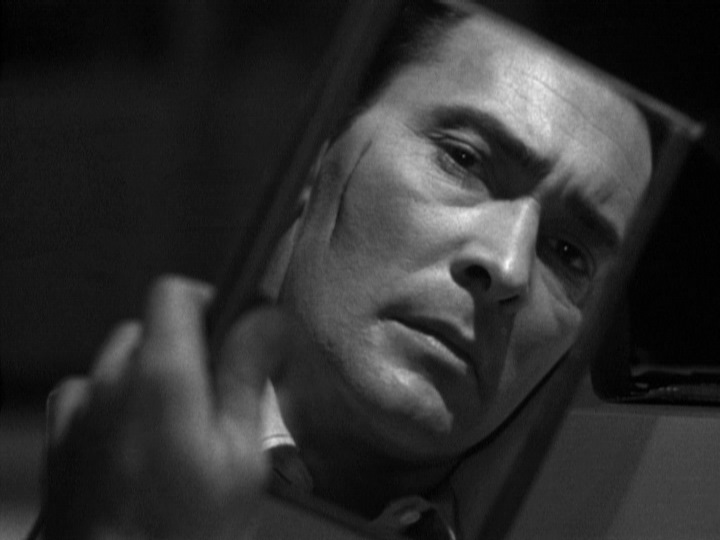
As we learn, he actually cares a lot about what people think of him. He’s sensitive, suspicious, and vain. The first time we see him, he’s inspecting his scarred face in a mirror. Later, he angrily asks Dorothy (Joan Lorring) — the girl who runs the cash register at the Neptune Beach ice cream store where he cools his heels — if there’s something wrong with the way he looks when she’s uncomfortable around him and doesn’t want to accept a gift from him.

If there were such a thing as “B-Movie Academy Awards,” Barry Sullivan would be at the top of my list for best actor of 1947.

Shubunka is a big fish in a small pond. The wisecracking soda-jerker Shorty (Harry Morgan) calls him “the King of Siam” behind his back and wonders why Shubunka hangs around Ann’s Soda Store if he’s so great. The Gangster takes place over a short period of time, and tells the story of how Shubunka loses his hold on the rackets in Neptune Beach — as well as his hold on everything else in his life.

Things are already falling apart when the film begins. The owner of Ann’s Soda Store — the sweaty, nervous Mr. Jammey (Akim Tamiroff) — sees right through him. “You go around putting up a tough front, but you don’t fool me. I see inside you. You are no man of iron. You are no terrible big shot. I’m telling you for your own good. If you don’t watch out they’re going to push you right out of business.”

When Mr. Jammey refers to “they,” he’s talking about the Syndicate, a group of sharply dressed criminals who are knocking out the independents one neighborhood at a time.

“Nobody’s pushing me out of business, forget that! I’m no soda jerker,” Shubunka tells Mr. Jammey. “I’m not one of these broken-backed dummies that come into your soda store. I’ll handle it, don’t worry. I worked six years building this thing up. I’m going to keep it. Nobody’s going to make a mug out of me.”

Shubunka is also paranoid about his beautiful blond girlfriend, Nancy Starr (played by Olympic and professional figure skater Belita). Everywhere he looks he sees evidence of her infidelity, even though she’s only making contacts and auditioning for roles in Broadway shows.

The Gangster is occasionally a little “arty,” but it’s never pretentious. And honestly, more B productions could stand to have this film’s self-consciousness and careful camera setups and lighting choices.

It doesn’t hurt that the actors are all really well cast. Harry Morgan, Barry Sullivan, and Akim Tamiroff are all really great, and even the lesser actors tend to be the cream of the crop of B movies — Sheldon Leonard, who plays the syndicate boss Cornell, was the best actor in Decoy (1946), and John Ireland, who plays the desperate, gambling-addicted accountant Karty, was the best actor in Railroaded (1947).

Out of the Past (Nov. 13, 1947)

Out of the Past
Out of the Past (1947)
Directed by Jacques Tourneur
RKO Radio Pictures

Jacques Tourneur’s Out of the Past is the greatest film noir ever made, but no one knew it at the time.

Robert Mitchum even said as much when he told writer Arthur Lyons, “Hell, we didn’t know what film noir was in those days. Cary Grant and all the big stars at RKO got all the lights. We lit our sets with cigarette butts.”

In 1947, French film critics and cinéastes were just beginning to use the term “film noir” (it was first used in 1946 by French film critic Nino Frank) and it would be decades before the term caught on in the United States, long after the end of the “noir cycle.”

All of this is a good thing, of course, since self-consciousness can kill art.

If filmmakers in the ’40s and ’50s had deliberately tried to make films with all the elements that the French were praising, they probably would have produced ham-fisted junk that was as unwatchable as most of the “neo-noir” that littered multiplexes in the ’90s.

On the other hand, this means that a brilliant noir like Out of the Past got lost in the shuffle at the time of its release, and was viewed as just one more “private eye” picture, or just one more “violent melodrama.” The review in the December 15, 1947, issue of Time, for instance, called it “a medium-grade thriller.” (Although they did praise Nicholas Musuraca’s beautiful cinematography.)

In his November 26, 1947, review of Out of the Past, curmudgeonly NY Times critic Bosley Crowther had a lot of good things to say about the film, and praised the dialogue and acting, but admitted that he couldn’t make heads or tails of the plot.

This is a fair criticism, since the plot of Out of the Past still confounds first-time viewers, and most second- and third-time viewers as well. Note, for instance, the number of reviews of the film that claim the story is told mostly in flashback, when the flashback portion of the story actually occupies less than a half hour of running time, and from the 40-minute mark onward, the film takes place entirely in the present.

But time has been kind to Out of the Past, and a perfect understanding of its plot isn’t a prerequisite for enjoying every gorgeously filmed minute of it, since it’s packed with everything that makes a noir a noir. Its male protagonist, Jeff Markham (Robert Mitchum), is smart and tough, but ultimately helpless when faced with the seductive charms of the film’s femme fatale, Kathie Moffat (Jane Greer). The film contains murders, swindles, frame-ups, crosses, double-crosses, triple-crosses, gambling, a large chunk of stolen money, a tragic ending, and some of the most seductive chiaroscuro cinematography of all time.

Greer and Mitchum

The plot can’t really be summarized in a nutshell, but I’ll try anyway.

While driving through a one-stoplight California town called Bridgeport, which is 79 miles south of Lake Tahoe, Joe Stephanos (Paul Valentine) pulls into a service station owned by Jeff Markham, who’s living in Bridgeport under the name “Jeff Bailey” and trying to forget his tawdry old life by going fishing every day with a nice girl named Ann (Virginia Huston), which her boyfriend Jim (Richard Webb) isn’t too happy about.

Joe tells Jeff that Whit Sterling (Kirk Douglas), his old employer, wants to see him in Lake Tahoe.

So Jeff spills to Ann. His real name is Markham, not Bailey. Three years ago he lived in New York and worked with an oily gentleman named Jack Fisher (Steve Brodie). They were detectives. They got a call to see a big operator, a gambler named Whit. His girl had shot him with his own .38 and taken off with $40,000 of his money, and he wanted her back. The money, too, but mostly her.

Jeff took off on his own, leaving Fisher behind, and followed Kathie’s trail to Acapulco, Mexico. As soon as he saw her, he was hooked like a fish.

In voiceover, Jeff recalls his romance with Kathie in Acapulco.

I never saw her in the daytime. We seemed to live by night. What was left of the day went away, like a pack of cigarettes you smoked. I didn’t know where she lived, I never followed her. All I ever had to go on was a place and time to see her again. I don’t know what we were waiting for. Maybe we thought the world would end. Maybe we thought it was a dream and we’d wake up with a hangover in Niagara Falls. I wired Whit but I didn’t tell him.

“I’m in Acapulco,” I said. “I wish you were here.” And every night I went to meet her. How did I know she’d ever show up? I didn’t. What stopped her from taking a boat to Chile or Guatemala? Nothing. How big a chump can you get to be? I was finding out.

Kathie swore to Jeff that she didn’t take Whit’s money, to which he responded, “Baby, I don’t care,” and kissed her.

Jane Greer

Jeff and Kathie ran off together and headed for San Francisco. Things went swimmingly until he was spotted at the racetrack by his old partner Jack Fisher, who would turn him and Kathie over to Whit in a heartbeat for the payoff.

Despite Jeff’s best efforts to lose the tail, Fisher eventually tracked him and Kathie down. When Jeff and Fisher started trading blows, Kathie coldly shot Fisher, then took off.

Jeff never saw her again. He was left to bury Fisher’s body in the woods. He also found a deposit slip for $40,000 in Kathie’s purse, confirming that she’d lied to him about the money.

The rest of the film takes place in the present. Jeff meets with Whit at his palatial getaway in Lake Tahoe. Kathie has returned to Whit, and he now knows everything about Jeff’s betrayal of him.

Exacting a kind of payback, Whit forces Jeff to go to San Francisco to steal income tax records from the crooked accountant — Leonard Eels (Ken Niles) — who helped him hide his money from Uncle Sam and who’s now demanding $200,000 hush money. Jeff is supposed to get to Eels through his beautiful secretary, Meta Carson (Rhonda Fleming).

But it quickly becomes clear to Jeff that he’s being set up as a patsy, and that Whit’s people are going to kill Eels and make it look as if Jeff did it.

Ann, the good girl in Jeff’s life, can’t believe that Kathie is as awful as he makes her out to be. “She can’t be all bad, no one is,” Ann says. “Well, she comes the closest,” Jeff responds.

And he’s right. Kathie is a murderer, a thief, and a liar. She’s completely and utterly faithless, but Jeff keeps falling for her. Every time she calls, he comes running. He can’t help it. He hates himself for it, but he can’t stop.

I first saw Out of the Past when I was 17, and I’ve seen it many times since then. It took me several viewings before I got a handle on exactly what was going on in the film, but I always felt that its byzantine plot was part of its appeal.

Even if you can’t figure out exactly what’s going on or who’s doing what to whom (or why), Out of the Past is still a seductive and brilliant film. It’s the Platonic ideal of a film noir.

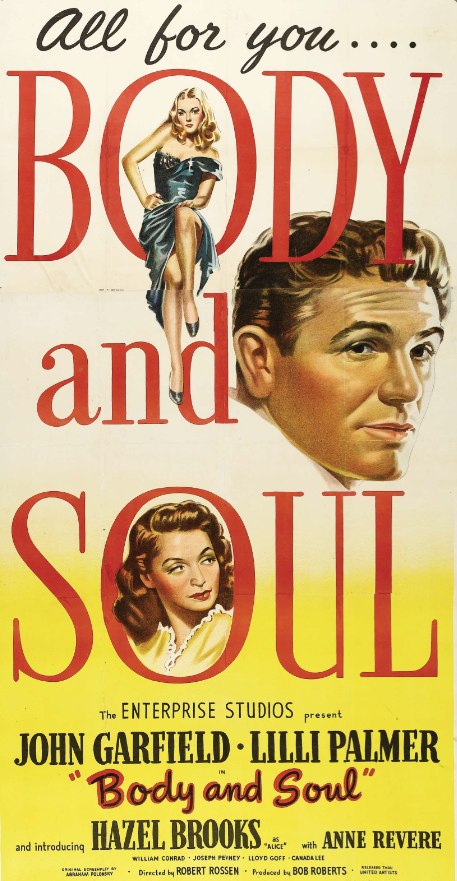
Body and Soul (Nov. 9, 1947)

Body and Soul
Body and Soul (1947)
Directed by Robert Rossen
Enterprise Productions / United Artists

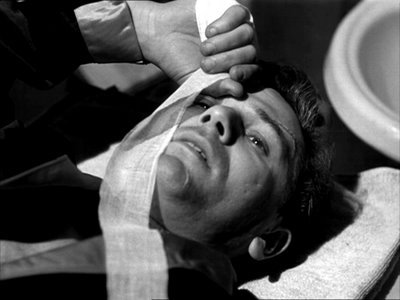
Charlie Davis’s face is a road map. Every scar tells a story, and every story is the same — a bruising boxing match, a big purse, wealth, success, and another step farther away from the people he loves.

This isn’t a spoiler, because we see exactly how far Charlie Davis (John Garfield) has fallen in the first scene of Robert Rossen’s Body and Soul. He wakes from a nightmare, sweat glistening on his scarred face, mournfully crying out a name … “Ben!”

He drives to his childhood home in New York’s Lower East Side and sees his mother (Anne Revere), but neither she nor his old girlfriend, Peg (Lilli Palmer), wants anything to do with him, so he drives to a smoky jazz club to see the beautiful singer Alice (Hazel Brooks). She tells him his manager has been looking for him everywhere. “How does it look, Charlie, the night before the fight, three a.m. and you loaded?” she asks him.

The next morning at the weigh-in, the challenger for the middleweight championship of the world, Jack Marlowe (Artie Dorrell), derides the tired and hungover champ. “All fat,” he sneers. “Nightclub fat … whiskey fat … thirty-five year-old fat.”

Back in his dressing room, Charlie’s gangster manager Roberts (Lloyd Gough) reminds him that he’s being paid $60,000 to throw the fight, and to make it look good.

John Garfield

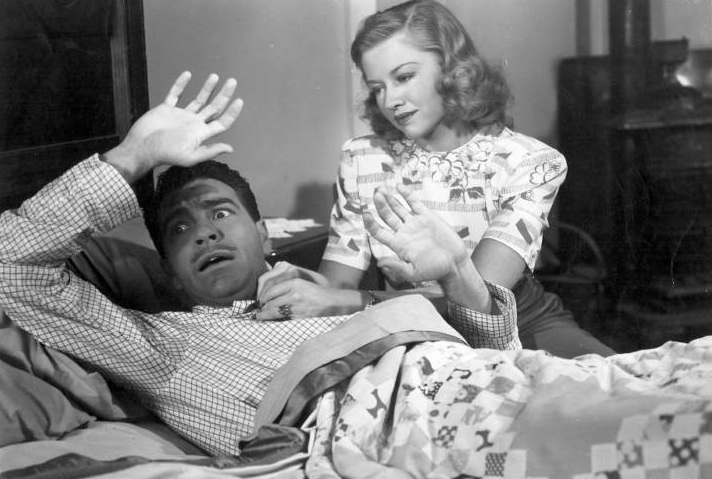
Most of the rest of the film is told in flashback. We see Charlie’s youth as a tough Jewish kid looking to break into the fight game. His best friend Shorty Polaski (Joseph Pevney) is his manager. Charlie’s father David (Art Smith) is supportive, but his mother wants him to choose a more respectable profession than the sweet science. All of this is strongly reminiscent of Garfield’s previous film, Humoresque (1946), although I have to say that Garfield is more believable as a pugilist than he was as a violinist.

Body and Soul is the first really great boxing film, and it still stands as one of the best. Garfield’s performance as Charlie Davis is pitch-perfect, and James Wong Howe’s black and white cinematography is gorgeous. As good as Raging Bull (1980) is, it still owes an enormous debt to this film. And so does nearly every boxing picture made after 1947.

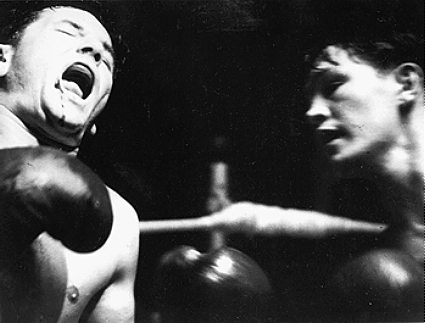
To be fair, the rise and fall structure of Body and Soul and most of its story elements were clichéd even at the time of the film’s release. But despite a sense of familiarity, Body and Soul still manages to feel fresh. A lot of this has to do with the final fight, which Howe famously shot with a handheld camera while standing on roller skates. It’s a brilliantly shot and edited sequence, and still thrilling to watch.

Garfield and Dorrell

Body and Soul was director Rossen’s second feature. His first, Johnny O’Clock (1947), was good, but overly complicated and occasionally contrived. Body and Soul, on the other hand, is a punch straight to the gut. It’s moving, brilliantly acted, and one of the best films I’ve seen in a long time.

Body and Soul was nominated for three Oscars; John Garfield for best actor, Abraham Polonsky for best original screenplay, and Francis Lyon and Robert Parrish for best film editing, the only category in which it won.

The Invisible Wall (Oct. 15, 1947)

Never gamble with the boss’s money.

I don’t know about you, but that seems to me like a pretty simple rule to follow.

Then again, more film noirs than I can count are based on doomed protagonists breaking simple life rules because of their uncontrollable urges.

In the case of Eugene Forde’s The Invisible Wall, the protagonist’s uncontrollable urge is the urge to gamble.

When World War II veteran Harry Lane (Don Castle) is sent to the Hotel Flamingo in Las Vegas by his once and future boss, big-time L.A. bookie and racketeer Marty Floyd (Edward Keane), he has $1,000 of his own money, and he plans to blow his roll fast. He’s holding $20,000 of Marty Floyd’s money that he needs to make a payoff with, though, so when he meets a man who claims to have a system for beating roulette, his goose is cooked.

The man who draws Lane into his gambling scheme in Las Vegas, Richard Elsworth (Richard Gaines), is accidentally killed, so Lane heads to Denver, where he impersonates Elsworth. The only snag is Elsworth’s wife, Mildred (Virginia Christine), who shows up and throws a monkey wrench into Lane’s plans.

The Invisible Wall follows a familiar film noir structure. It begins in St. Louis, where Harry Lane works at the Crown Jewelry Company under another name. He’s arrested for murder and gives a full confession, telling the story in flashback.

The Invisible Wall isn’t a great film by any stretch of the imagination, but it’s solid entertainment from Sol M. Wurtzel Productions, theatrically distributed by Twentieth Century-Fox. The actors are all stiff, but not laughably so, and as far as B noirs go, you could do a lot worse.

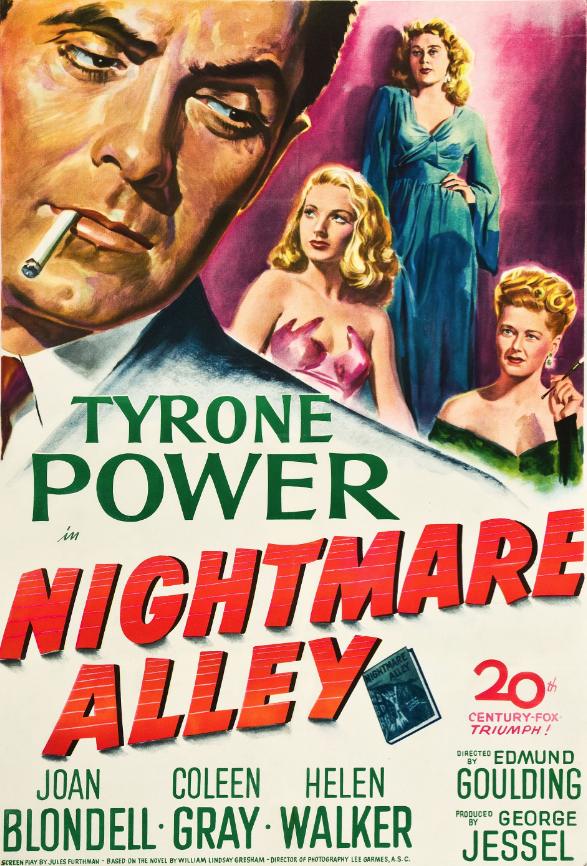
Nightmare Alley (Oct. 9, 1947)

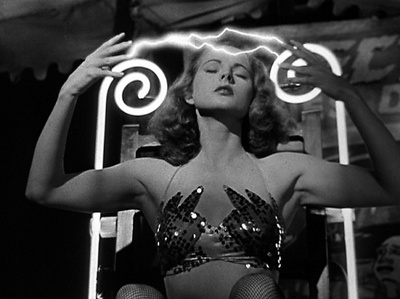
Nightmare Alley is a harrowing tale of manipulation and degradation. It’s a journey through a night-lit carnival world in which everyone is out for themselves and no one cares who they chew up and spit out if it means climbing one more rung on the ladder.

It was Tyrone Power’s second film directed by Edmund Goulding, and it’s miles ahead of their first collaboration, The Razor’s Edge (1946).

While The Razor’s Edge was more acclaimed at the time of its release — four Oscar nominations and one win — it’s aged poorly, and the Eastern mysticism at its center is supposed to be profound but is really just high-minded hokum.

Power made The Razor’s Edge with Goulding as a deliberate attempt to break out of the mold he’d been cast in as a handsome swashbuckler with a limited range. His performance wasn’t bad, but at times it seemed forced.

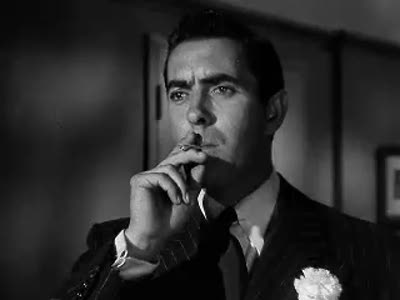
In Nightmare Alley, however, he completely loses himself in his character. His performance as Stanton “Stan” Carlisle — a grasping, duplicitous carny who graduates to tony nightclub performances and fleecing the wealthy — is so natural that I think someone who’d never heard of Tyrone Power before seeing Nightmare Alley would never guess that he wasn’t always seen as a serious actor.

Stan is one of the most memorable film characters I’ve seen in a long time. He’s a drifter who joins a carnival and attaches himself to an aging mentalist named Zeena (Joan Blondell) and her husband, broken-down alcoholic Pete (Ian Keith), then throws both of them aside when he’s learned all he can from them.

He takes up with Molly (played by the stunningly beautiful Coleen Gray), much to the dismay of her boyfriend, the brutish, simple-minded carnival strongman Bruno (Mike Mazurki). Using the techniques he learned from Pete and Zeena for cold reading a subject and conveying information through a spoken code, he and Molly take their mind-reading act to posh nightclubs, where they’re a sensation. Stan is more than just a quick study. He has an innate ability to see through people and glean their pasts, their innermost desires, and their secrets. The fact that he uses his talents to take people’s money doesn’t bother him, but it bothers Molly, who’s the only character in the film who’s essentially good and decent.

I love the scene in which Stan breaks down and finally uses the oldest trick in the book on Molly. He admits he’s a bad person and a hustler, but that he’s never lied to her. He may have used everyone else in his life, but he’s never used her.

This is, of course, also a lie, which becomes clear when he tosses Molly aside for Lilith Ritter (Helen Walker), consulting psychologist to Chicago’s upper crust, and uses Lilith’s knowledge of the intimate details of the lives of the wealthy to take them for all they’re worth.

While The Razor’s Edge was about Power’s character’s spiritual awakening, Nightmare Alley is about his character’s use of spiritual tropes to lie, cheat, and steal. Maybe it’s just the cynical age in which we live, but I thought that The Razor’s Edge came off as disingenuous, while Nightmare Alley was utterly convincing.

Nightmare Alley is based on the best-selling novel by William Lindsay Gresham. Certain aspects of the novel had to be sanitized for the film version, but it’s still a kick to the stomach. Its story of degradation is so powerfully told that there are many people who saw the film a long time ago and claim that there was a horrifying scene that was deleted for the DVD release. The scene they remember never existed (even in the novel), but it’s easy to see why they think they saw it. Like Psycho (1960) and Rosemary’s Baby (1968), Nightmare Alley uses the power of suggestion to make you remember horrifying things that you never actually see. It’s a great film, and one that will stay with you a long time after the credits have rolled.

Ride the Pink Horse (Oct. 8, 1947)

Ride the Pink Horse
Ride the Pink Horse (1947)
Directed by Robert Montgomery
Universal Pictures

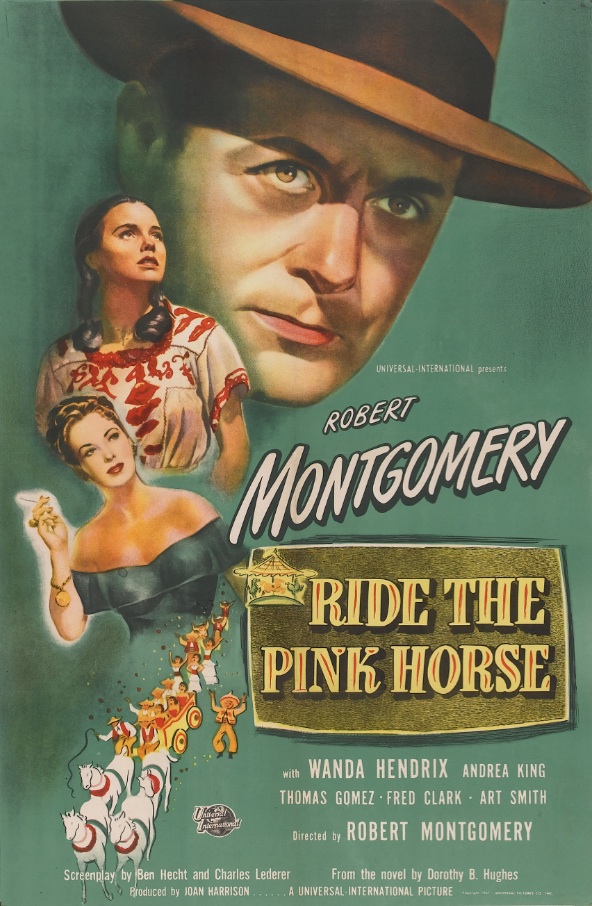
Robert Montgomery directed and starred in two movies released in 1947. The first, Lady in the Lake, was an interesting stylistic experiment — an adaptation of Raymond Chandler’s novel that was filmed entirely from private eye Philip Marlowe’s point of view. The second, Ride the Pink Horse, is more traditionally lensed. It’s based on a novel by Dorothy B. Hughes, with a screenplay by Charles Lederer and Ben Hecht. It’s also the better of the two films, so naturally it’s the one that isn’t available on DVD.

Besides being a more satisfying and involving film, Ride the Pink Horse also lets Montgomery flex his acting chops. In Lady in the Lake, since we only see what he’s seeing, all we hear is his voice, and his performance is somewhat listless.

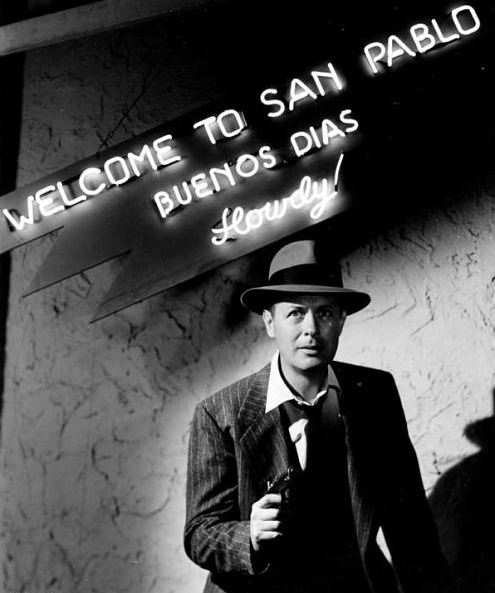
The character Montgomery plays in Ride the Pink Horse — Lucky Gagin — is a noir archetype; the returning veteran of World War II. But unlike baroque, oneiric noirs like Somewhere in the Night (1946), in which a veteran suffers amnesia, brainwashing, or any number of high-concept emotional injuries, Montgomery’s character in Ride the Pink Horse is believable as a returning combat veteran. Lucky Gagin is a bitter, tight-lipped man whom violence hangs over like a dark cloud. As soon as he steps off a Greyhound bus in the little town of San Pablo, New Mexico, we can read in his face miles of hard road, lost friends, and random death.

Lucky Gagin is obviously a less intelligent person than the man who plays him, and I wasn’t always convinced that Gagin was as dumb as some of his words and actions, but Montgomery’s performance is mostly believable. His pain-wracked sneer is especially easy to buy, which is good, since Gagin spends half the film clinging to life, bleeding out from a knife wound.

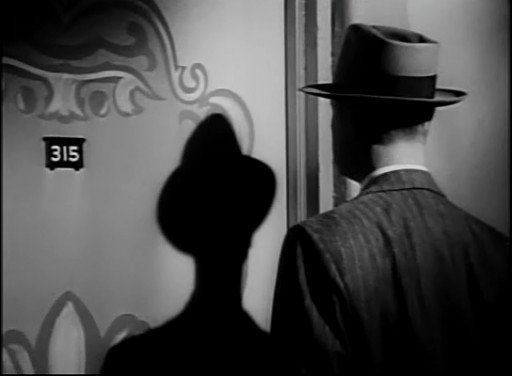
Room 315

Gagin is in New Mexico to blackmail racketeer and war profiteer Frank Hugo (Frank Clark) with a canceled check that proves Hugo’s involvement in criminal enterprise. Hugo ridicules Gagin for asking for a paltry amount. Nevertheless, there’s the sense hanging over the film that whether Gagin asks for one dollar or a million, he’ll never get it.

In one of those little touches that I love, Hugo wears a hearing aid, and he often has to move the receiver clipped to his shirt into a better position to hear what’s going on. It’s never played for laughs, but it humanizes him, which makes his power and malevolence all the more believable.

Like a lot of thrillers, Ride the Pink Horse is replete with characters whose motivations are vague and mysterious. The most mysterious of all is the Mexican-American Indian girl Pila (Wanda Hendrix), who develops an unnatural attachment to Gagin as soon as he steps off the bus. She foresees his death, and gives him a little doll to carry that she says will protect him. She also follows him around for the entire picture, despite the fact that he’s constantly mean to her. Long braids and brownface notwithstanding, Hendrix isn’t very believable as an American aboriginal, but she’s nice to look at, which makes up for a lot.

Montgomery

The other angels who come into Gagin’s life — and who might be able to help him if he could only get over his distrust of everyone — are an elderly G-man named Bill Retz (Art Smith), who wants Gagin to help him bring in Hugo using legal means, and a chubby, good-natured Mexican named Pancho (Thomas Gomez), who runs a carousel, and who gives Gagin a place to sleep.

It’s Pancho’s carousel that gives the picture its title, but if there’s a deeper meaning to the pink merry-go-round horse, I couldn’t suss it out. Does it symbolize death? Life? Everything? Nothing? Your guess is as good as mine.

Ride the Pink Horse is a crisp, well-made thriller. It’s not quite an all-time classic, but it’s worth a look, especially if you’re a noir aficionado, and it’s well deserving of a proper DVD release.

The Unsuspected (Oct. 3, 1947)

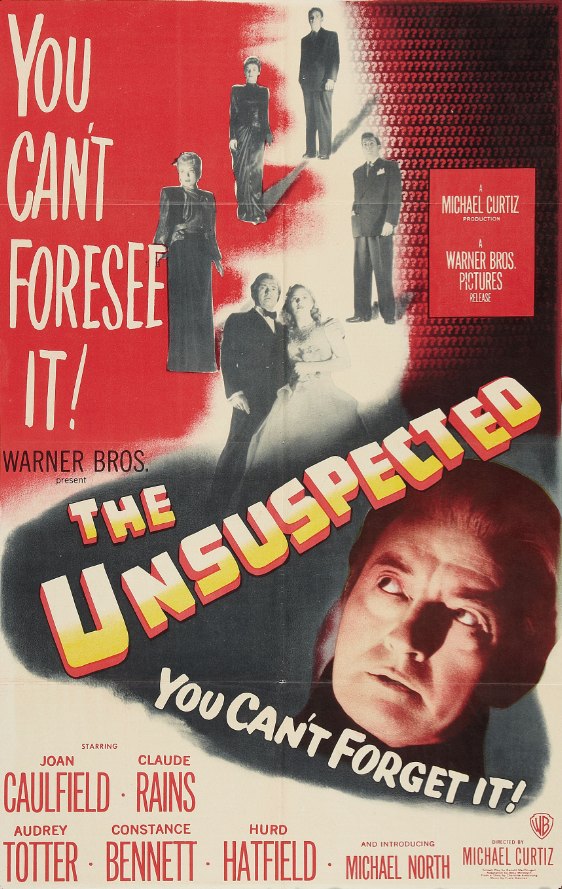
If you’re looking for proof that a mystery doesn’t have to be difficult to figure out to be thoroughly involving, look no further than Michael Curtiz’s The Unsuspected.

Claude Rains stars as Victor Grandison, the “genial host” of the radio program The Unsuspected on the fictional WMCB network. Grandison has turned his fascination with gruesome crimes into a lucrative career recounting tales of real-life murders to a nation of rapt listeners.

Roslyn Wright (Barbara Woodell), Grandison’s secretary, is the killer’s first victim. She’s working late in Grandison’s mansion in Croton, New York, when the door opens and a man’s shadow is thrown over the wall behind her. He strangles her, then hangs her from a chandelier to make it look like suicide.

Grandison lives with his niece, Althea (Audrey Totter), whom he maneuvered into seducing and then marrying Oliver Keane (Hurd Hatfield), who was set to marry Grandison’s other niece, Matilda Frazier (Joan Caulfield). Matilda is currently missing, presumed dead, after the ship she was traveling on was lost at sea. Althea is a grasping, scheming young woman who will do anything for money. Her husband Oliver really loved Matilda and has seemingly been on a bender since he married Althea.

The plot kicks into gear when Steven Francis Howard (Ted North) shows up, claiming he married Matilda shortly before she was lost at sea, and consequently is the heir to her fortune. This news is not taken well by Grandison, who has been moving the people in his life around like chess pieces in order to gain control of Matilda’s fortune.

Part of the fun of The Unsuspected is how the entire thing plays out as though it’s one of Grandison’s radio plays come to life. He’s the master of ceremonies, pushing and pulling, scheming and finagling.

He even uses 16″ transcription discs — which were used to record radio shows for later broadcast — as a part of his schemes, to divert and confuse people.

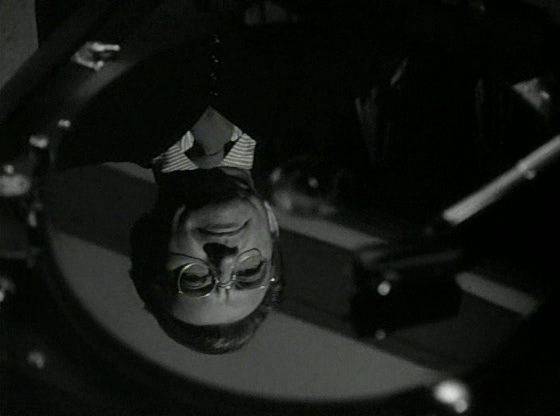
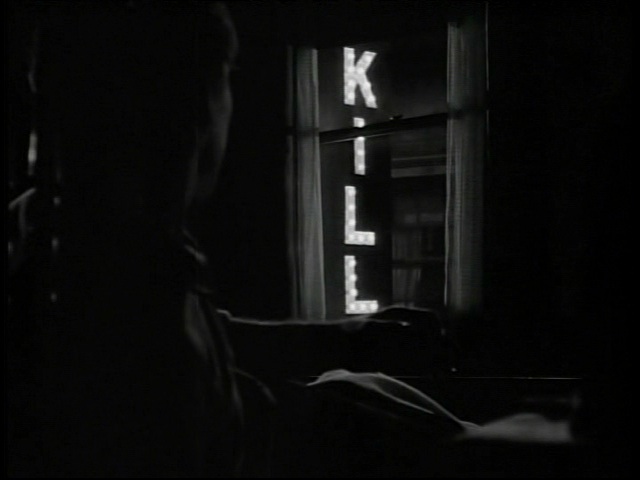
As I said, the identity of the killer isn’t difficult to suss out, and The Unsuspected is more of a thriller than a mystery, but it doesn’t matter. It’s a first-rate thriller, brilliantly directed by Curtiz and gorgeously shot by his cinematographer, Elwood “Woody” Bredell. Even though the story itself is standard stuff, the film is full of arresting visuals, recurring motifs like faces reflected upside down, and brilliant little moments like the one in which Mr. Press (Jack Lambert — recently seen as the villainous “Claw” in Dick Tracy’s Dilemma) sits in a dark hotel room. The neon sign outside says “Hotel Peekskill,” but when the shot cuts to inside the room, all we can see is “kill,” blinking on and off hypnotically.

The film isn’t perfect. Ted North isn’t a very good actor, and his scenes lack a certain something. (Interestingly, North is listed in the opening credits as “Introducing Michael North,” even though this was his last film. It was the first time he was credited as “Michael,” not “Ted,” but he’d had significant parts in plenty of films before, most recently The Devil Thumbs a Ride.)

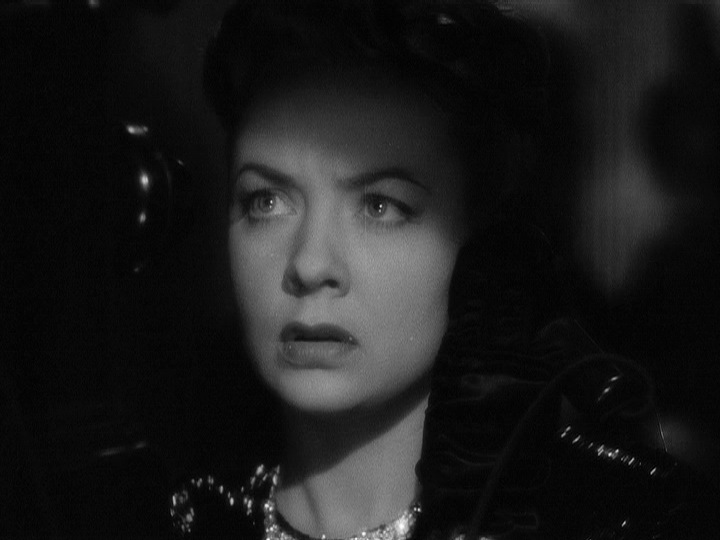
But Curtiz wisely doesn’t make North the focus of the film, and allows Rains to carry things, propelled by taut pacing and Franz Waxman’s compelling score. Aside from North, the actors are all good, especially Totter, whose role is enjoyably juicy. I also really liked Constance Bennett as Grandison’s witty, smart-mouthed assistant, Jane Moynihan. She delivers my favorite line of the picture: “After slaving all day over a hot typewriter, there’s nothing I like better than a swan dive into a bottle of bourbon.”

If you enjoy classy, well-made thrillers, The Unsuspected is well worth seeking out.