Act of Violence (Dec. 21, 1948)

Act of Violence
Act of Violence (1948)
Directed by Fred Zinnemann
Metro-Goldwyn-Mayer

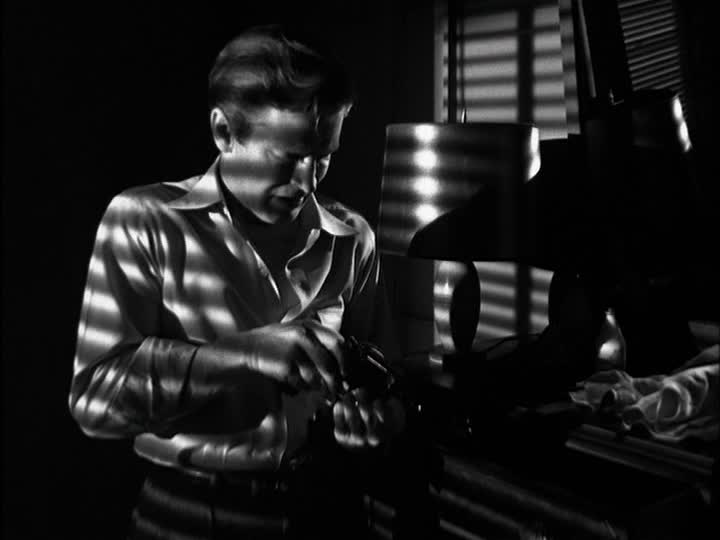
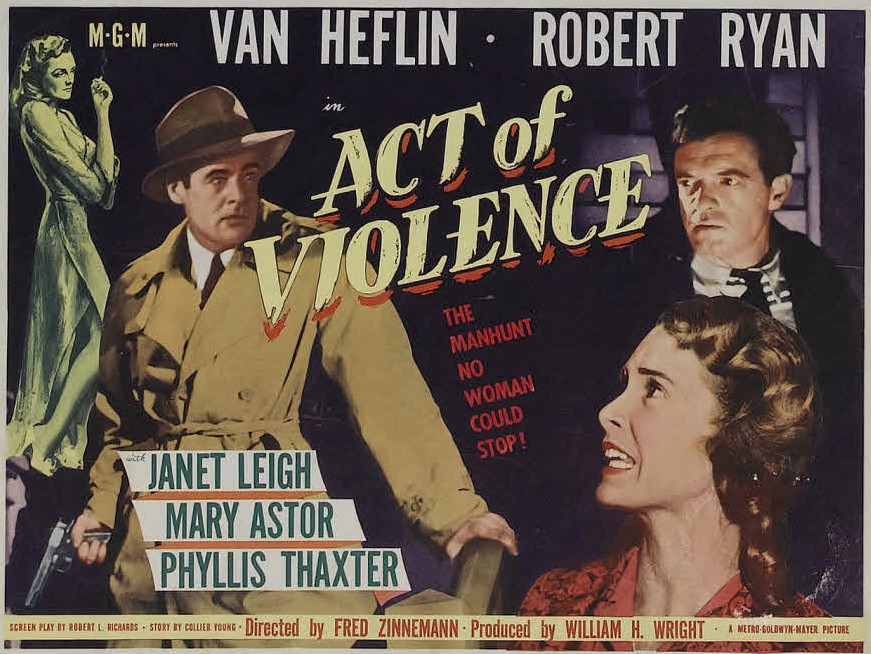
Fred Zinnemann’s Act of Violence opens with a shot of New York City at night. The Chrysler Building is silhouetted against a dark gray sky. Bronislau Kaper’s musical score is ominous and intense. Robert Ryan crosses the street toward the camera. He’s wearing a hat and a trench coat, and his stride is determined despite his limp.

The sound of his limping walk is distinctive. Step, drag, step, drag, step, drag, step, drag. It’s a sound that will haunt the film.

He walks upstairs to a shabby rented room and pulls a semiautomatic pistol from a dresser drawer. He slaps a magazine into the pistol, checks the barrel and the ejection port, and then the title of the film appears onscreen in block letters.
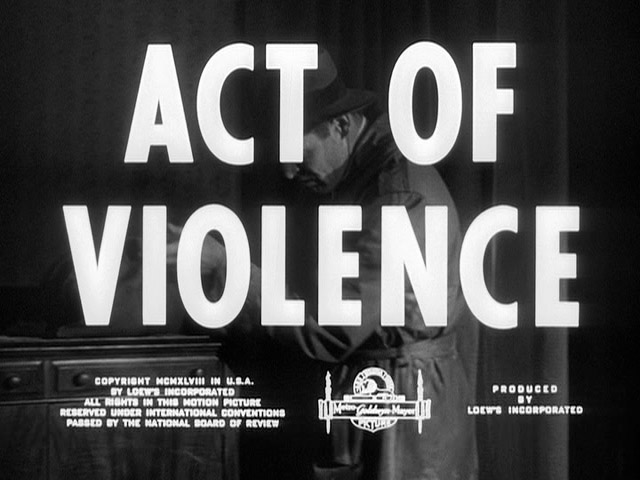
Act of Violence title

Now that’s the way to start a movie. Zinnemann, his cinematographer Robert Surtees, and his editor Conrad A. Nervig build more suspense and engagement in the first minute of Act of Violence than most movies are able to muster in their entire first reel.

It helps that the film drops us right into the action. Most movies in the 1940s began with screen after screen of opening credits; a time-honored cinematic tradition. Act of Violence and Nicholas Ray’s They Live by Night are the only films from 1948 I’ve seen that eschewed that hoary convention, and both films immediately arrest the viewer.

After the opening, Ryan’s ominous character Joe Parkson takes a Greyhound bus to California, where the viewer meets the other star of the film; Van Heflin. Heflin plays Frank Enley, a World War II veteran, housing contractor, and family man with a beautiful young wife named Edith (Janet Leigh) and an adorable baby boy. (Janet Leigh was just 21 when this film was made. Heflin and Ryan were both in their late 30s.)

We know right from the beginning that Joe Parkson wants to kill Frank Enley, but we don’t know why. For awhile, all we know is that Enley was Parkson’s CO in the war, and that Parkson has a vendetta against him.
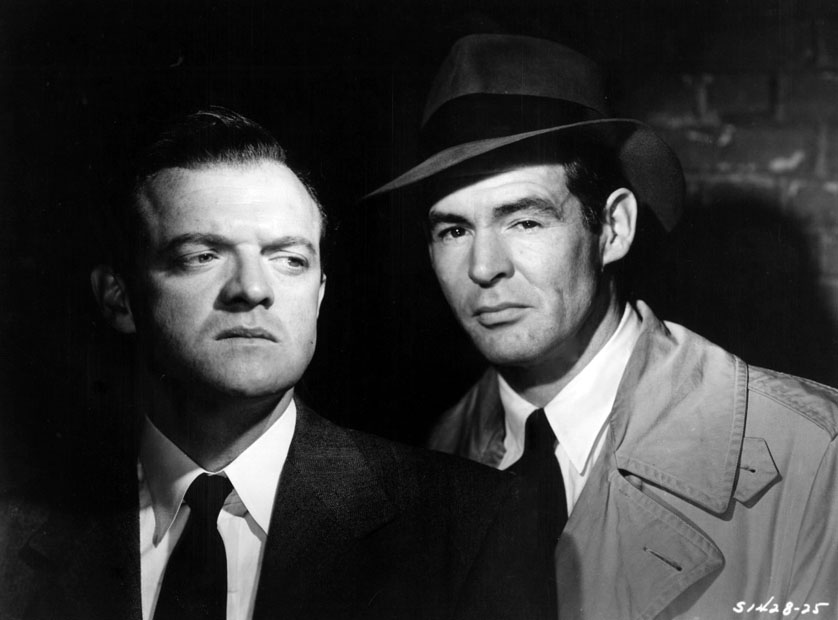
Van Heflin and Robert Ryan

M-G-M didn’t produce very many noirs, but when they did, they were glossy affairs with high productions values and great actors, like The Postman Always Rings Twice (1946), Undercurrent (1946), Lady in the Lake (1947), and High Wall (1947).

Act of Violence is a stylish thriller that looks and feels ahead of its time. The cinematography is meticulously constructed and dripping with noir atmosphere, but it never feels studio-bound and uses real-world locations beautifully. The sound effects in the film sometimes do a better job of creating suspense than any musical score could.

All the actors in Act of Violence are really good. Van Heflin was a sad-eyed Everyman, and Robert Ryan had a physically intimidating presence, but enough charisma to make even his most villainous characters magnetic. Apparently Gregory Peck and Humphrey Bogart were originally slated to star in Act of Violence, but I can’t picture anyone but Heflin and Ryan as these characters.

Janet Leigh has a pretty thankless role, but she has enough star power to make it interesting. Phyllis Thaxter doesn’t have much to do as Joe’s girl Ann, but she’s fine. Mary Astor is wonderful in an unglamorous role as a barfly obsessed with “kicks” who Frank meets on a business trip to Los Angeles, and the always-creepy Berry Kroeger is great in a small part.

I thought Zinnemann’s previous film, The Search (1948) was a minor masterpiece, and I feel the same way about Act of Violence. Zinnemann’s best work may have been ahead of him, but Act of Violence is an exceedingly well-made, visually inventive thriller with enough moral ambiguity to keep it interesting. I think our cultural views have evolved since World War II in ways that make the central conceit of the film even more ambiguous than it probably seemed when the film was first released.

I don’t want to go into more detail for fear of spoilers, but for me there’s a great deal of meaning packed into Enley’s statement to his wife, “A lot of things happened in the war that you wouldn’t understand. Why should you? I don’t understand them myself.”
Jungle Jim (Dec. 15, 1948)

Jungle Jim
Jungle Jim (1948)
Directed by William Berke
Esskay Pictures Corporation / Columbia Pictures

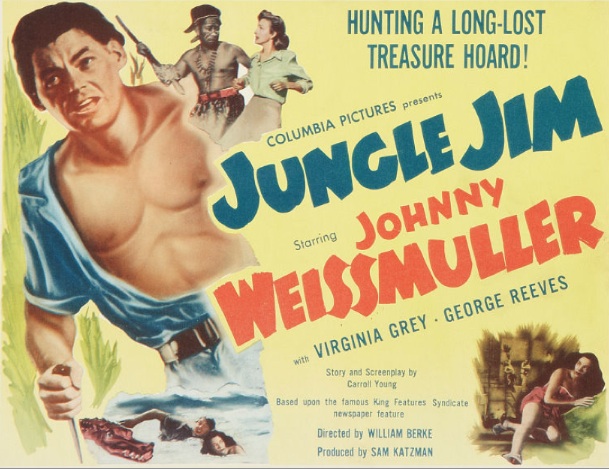
It’s the end of an era, and the start of a new one. Tarzan and the Mermaids (1948) was Johnny Weissmuller’s last time playing Tarzan, and this was his first time playing Alex Raymond’s comic-strip hero Jungle Jim.

Raymond was one of the greatest writer-artists to ever work in the medium of the funny pages, and in addition to Jungle Jim he also created Flash Gordon, Secret Agent X-9, and Rip Kirby.

Unlike other jungle heroes like Tarzan, Ka-Zar, Ka’a’nga, and Sheena, Jungle Jim operated in Southeastern Asia, not Africa, and he wore a full set of clothes.

For the purposes of a Saturday-afternoon flick, however, it’s clear that director William Berke and his production team didn’t spend much time differentiating their highly fictionalized jungle world from the highly fictionalized version of Africa that appeared in most jungle B-movies.

In fact, I’m unclear after one viewing whether this film was meant to take place in Africa or Southeastern Asia. There were references to the Masai, but the “natives” being referred to were not black Africans, but rather the type of “natives” common to films produced by “Jungle Sam” Katzman; in other words, they’re white actors who look like Brooklyn teamsters wearing turbans.

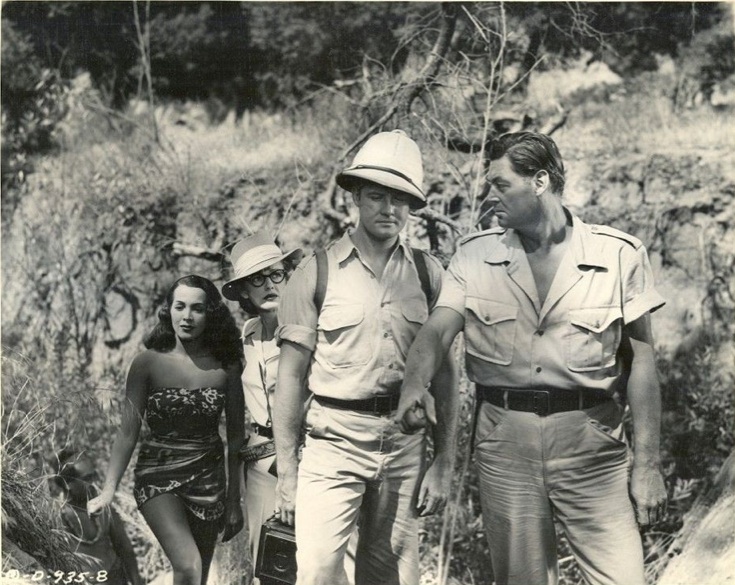
The biggest difference between Jungle Jim and the Tarzan films comes when we see Weissmuller walk out of the jungle in the first shot of the film, fully clothed and wearing a Panama hat, which is an odd sight after so many years of mostly only seeing him in loincloths of various sizes.

But never fear. Most of the things that made Weissmuller an action star are still on display. It takes exactly 2 minutes and 4 seconds from the moment the film begins before Weissmuller takes off his shoes and leaps into the water to attempt to save a terrified native from a man-eating leopard. Even though Weissmuller is older and heavier as Jungle Jim than he was in a lot of his Tarzan films, he’s still an Olympic champion swimmer, and no other B-movie actor could knife through the water like he could. (Well, maybe Buster Crabbe could.)

Reeves and Weissmuller

The plot of Jungle Jim is the typical jungle-adventure-film malarkey. A scientist named Dr. Hilary Parker (Virginia Grey) is searching for the lost temple of Zimbalu, which has great archaeological value. Zimbalu may contain gold, but — more importantly — it might be the source of a substance that could be used to cure infantile paralysis if placed in the right hands. (Paging Dr. Jonas Salk!)

Curing polio is Dr. Parker’s goal, but it’s not the goal of safari member Bruce Edwards (played by George Reeves, who would go on to play Superman on TV in the ’50s). Edwards is only in it for the gold, and doesn’t care who he has to stab in the back to get it.

There’s also a beautiful “native” girl named Zia (Lita Baron), who doesn’t know why Dr. Parker dresses and acts like a man, and is jealous of the attention Jungle Jim pays to Dr. Parker.

Like most low-budget jungle adventures, Jungle Jim employs lots of stock footage. An entire sequence is edited to make it appear as if Dr. Parker’s dog Skipper is interacting with a little monkey. There’s also a crocodile attack, a monkey stealing honey, and a crow smoking a pipe. The emphasis in Jungle Jim is on action above all else. An elephant stampede is immediately followed by a rock slide, which is followed by the shapely Zia dancing spastically around a campfire.

Jungle Jim is dumb, but plenty of fun if you like B-movies set in the jungle. If you like beautiful women, there’s plenty to enjoy, too. Grey and Baron are both stunning. Dr. Parker is supposed to be mannish, but those glasses don’t cut it.

Street Corner (Dec. 3, 1948)

Street Corner

Street Corner (1948)
Directed by Albert H. Kelley
Wilshire Pictures Corp.

Street Corner is one of several “sex hygiene” films that followed in the wake of Kroger Babb’s notorious roadshow presentation Mom and Dad (1945) and attempted to copy its phenomenal success.

Like all exploitation movies from the 1940s, Street Corner had to demonstrate some kind of legitimate educational value in order to show lurid footage that could never make it into mainstream Hollywood entertainment, like syphilitic penises and close-up footage of babies being born.

Street Corner does a much better job of walking this line than a trashy picture like Test Tube Babies (1948). Its call for facts-based sex education for young people is a noble one, although the film is in every way a product of its time.

Dr. James Fenton (played by Joseph Crehan) narrates the film, telling the sad tale of his friends Mr. and Mrs. Marsh (Don Brodie and Jean Fenwick), who didn’t have the intestinal fortitude to prepare their daughter Lois (Marcia Mae Jones) for the realities of grown-up life. Clara Marsh tells Dr. Fenton that Lois is a very sensitive girl and that she’d be shocked. She’ll learn about the birds and the bees “somehow.” Somehow is right, says the doctor, who warns Mr. and Mrs. Marsh that if children aren’t given proper sex education they’ll learn about it on “the street corner” or in “the alley.”

Lois Marsh is 17 years old when she ambivalently loses her virginity to her 19-year-old boyfriend Bob Mason (John Treul) on prom night. He gets her with the old “I’m going to college and this’ll be our last date in a long, long time” routine. The director of Street Corner, Albert H. Kelley, shows that he knows how to wield symbolism as a blunt object by depicting Lois having sex for the first time with a close-up shot of her hand slowly crushing her corsage. (Wink wink.)

Naturally, since this is a sex hygiene film, one night of knocking boots knocks up poor Lois. Her clueless parents offer no help. Her boyfriend rushes back from college to marry her, but he winds up a smear on the highway, and Lois winds up in the hands of the local abortionist (Gretl Dupont).

In the Clutches of the Abortionist

Lois’s visit to the abortionist is shot and scored like a horror movie. Unlike Vera Drake, this abortionist takes payment and doesn’t seem to care very much about the young women in her care.

Dr. Fenton’s voice-over drives home the horror: “Fear and ignorance have combined to add another victim to the ever-mounting toll. Another human life has been destroyed by one of the most malignant practices of a civilized society; abortion.”

People who bought tickets to Street Corner had to wait nearly an hour to see Dr. Fenton’s “clinical demonstration,” his regular weekly clinic of sex education that features explicit short films. The first is The Miracle of Birth, which begins with an animation of an egg being released into the female organs of reproduction, then being fertilized by a lone sperm. Eventually this leads to what Dr. Fenton calls “the ultimate and crowning glory of womanhood, the miracle of birth,” which takes place while the mother is asleep under a light anesthetic. We get to see a baby boy coaxed out of a vagina and then see his umbilical cord cut.

The next film is Birth by Caesarean Section, which I’m sure satisfied any budding gore-hounds in the audience while sickening everyone else.

Then we get Human Wreckage, a film about venereal disease that explains the importance of blood tests before marriage, followed by a series of graphic close-ups of male and female genitals infected with syphilis and gonorrhea, which are meant to caution viewers against neglect, self-treatment, and quack medicine.

Street Corner was made long before Roe v. Wade, when abortion was still illegal in America. Dr. Fenton makes no bones about calling abortion “murder.” And of course there is no mention of any kind of birth control in the film. Apparently just knowing that it isn’t the stork that brings babies will be enough to stop girls from getting green-gowned and knocked up after the prom.

3 Godfathers (Dec. 1, 1948)

3 Godfathers
3 Godfathers (1948)
Directed by John Ford
Argosy Pictures / Metro-Goldwyn-Mayer

After making the western masterpiece Fort Apache (1948), director John Ford returned to the religious overtones of the movie he made right before Fort Apache, The Fugitive (1947).

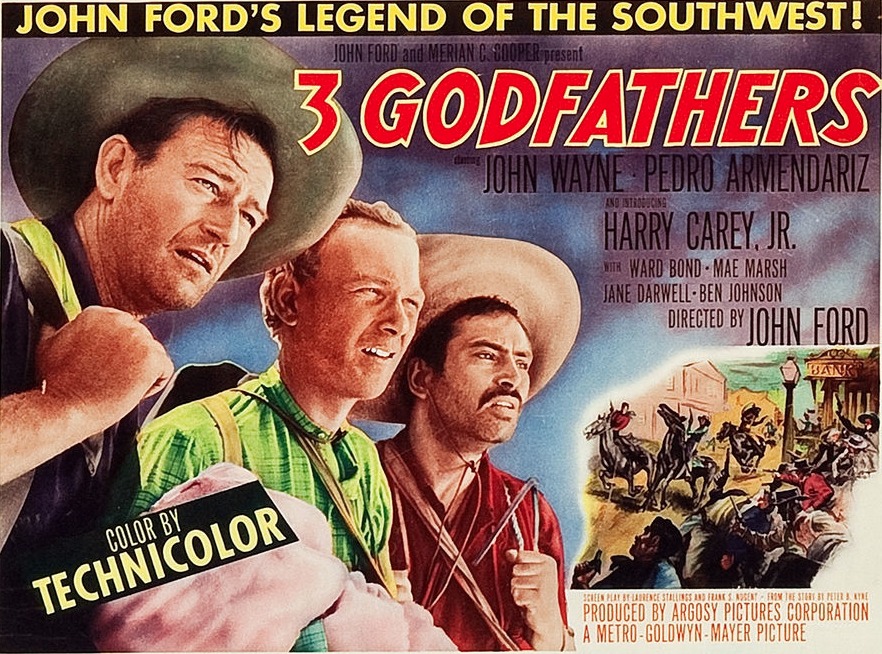
3 Godfathers reimagines the biblical story of the three wise men as a story of three bank robbers from Texas who are fleeing a U.S. Marshal in the Arizona Territory.

Unlike Ford’s previous several black & white films, 3 Godfathers is shot in Technicolor. It’s dedicated to the memory of Harry Carey, “Bright Star of the early western sky.” (Carey acted in dozens of Ford’s early films, and died on September 21, 1947.)

3 Godfathers stars John Wayne and Pedro Armendáriz, and “introduces” Harry Carey’s son, Harry Carey, Jr.

I put “introduces” in quotation marks because he’d already had credited roles in several films, including Pursued (1947), Red River (1948), and Moonrise (1948).

The three bank robbers are named Robert Marmaduke Hightower (John Wayne), William Kearney, a.k.a. “The Abilene Kid” (Harry Carey, Jr.), and Pedro “Pete” Roca Fuerte (Pedro Armendáriz). John Wayne’s drinking buddy, Ward Bond, plays the U.S. Marshal who pursues Robert, William, and Pedro after they rob a bank. Bond’s character is named Perley “Buck” Sweet, or “B. Sweet,” a name Robert finds hilarious. Marshal Sweet’s bearlike body and easygoing nature belie his craftiness. When he first pursues the bank robbers, he shoots a hole in their waterskin, then he sets up camp with his deputies at the spot he thinks they’ll have to circle back to in order to get water.

Godfather John Wayne

Wandering through the desert, the three bank robbers find a dying woman (Mildred Natwick), who has just given birth to a baby. She tells them that they will be the boy’s godfathers, and she names her baby after the three of them — Robert William Pedro.

The following section of the film is sort of like a religious version of Three Men and a Baby in the Old West, as the trio of roughnecks try to figure out how to care for a baby in sometimes hilarious ways. When they finally rig up a nursing device and fill the bottle with milk, John Wayne laughs and says, “Boy, he hops to it like a drunkard at a Fourth of July barbecue.”

There are tender moments, too, like the one in which Carey holds the baby and sings “Streets of Laredo” in a beautiful baritone.

The religious aspects of the story are fairly explicit. The three godfathers follow a bright star in the sky toward the town of New Jerusalem, and they do so to the musical strains of “Away in a Manger” as the desert sands blow over the large wooden cross they’ve placed over the baby’s mother’s grave. They also use Bible verses as guides and portents in their journey.

3 Godfathers is based on Peter B. Kyne’s first novel, which was published in 1913. An immensely popular little work, The Three Godfathers was first filmed as The Three Godfathers (1916), a silent film directed by Edward LeSaint that starred Harry Carey. John Ford filmed the story as Marked Men (1919), again starring Carey. Ford made another version of the story called Action in 1921, William Wyler made a version called Hell’s Heroes in 1929, and Richard Boleslawski filmed a version called Three Godfathers in 1936.

I’ll admit that John Ford’s appeal sometimes eludes me. I’m not nearly as in love with some of his masterpieces as others are. But while 3 Godfathers will probably never be counted as one of Ford’s masterpieces, I thought it was a well-crafted, emotionally satisfying film. It’s also the perfect choice if you love westerns and are looking for a good movie to watch around Christmas with your family.

Bicycle Thieves (Nov. 24, 1948)

Ladri di biciclette

Ladri di biciclette (1948)
Directed by Vittorio De Sica
Produzioni De Sica / Ente Nazionale Industrie Cinematografiche (ENIC)

Every decade since the 1950s, Sight & Sound magazine has polled an international group of professional film critics to assemble lists of the greatest movies ever made.

For most of the 20th century, Orson Welles’s Citizen Kane (1941) dominated the lists as the greatest film of all time, but in the very first critics’ poll, published in 1952, Vittorio De Sica’s Bicycle Thieves was their choice for best film of all time, followed by two Chaplin movies, City Lights (1931) and The Gold Rush (1925). (Kane didn’t quite crack the top 10.)

In the most recent Sight & Sound poll, published in 2012, Citizen Kane was unseated as the greatest film ever made by Alfred Hitchcock’s Vertigo (1958), and officially became merely the second greatest film ever made. (Bicycle Thieves was #33 on the list of 250 films.)

“Greatest films of all time” lists are notoriously contentious and usually somewhat arbitrary, but Sight & Sound is one of the few that carries real weight.

I first became aware of De Sica’s neorealist masterpiece when I was 14 or 15 (back when it was still called The Bicycle Thief in English), but I never got around to seeing it until a few days ago.

Watching a widely acknowledged masterpiece for the first time can be a difficult experience. It’s easy to overanalyze it and constantly ask yourself, “Well, what’s so great about this really?”

So when I watch one of the “great films” for the first time, I just try to let it all wash over me and not think about it too hard until the credits roll.

Bruno and Antonio

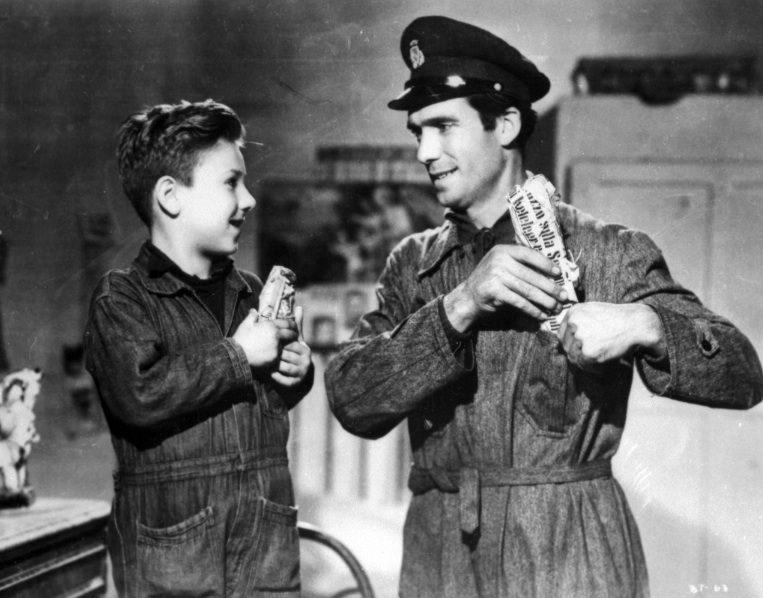
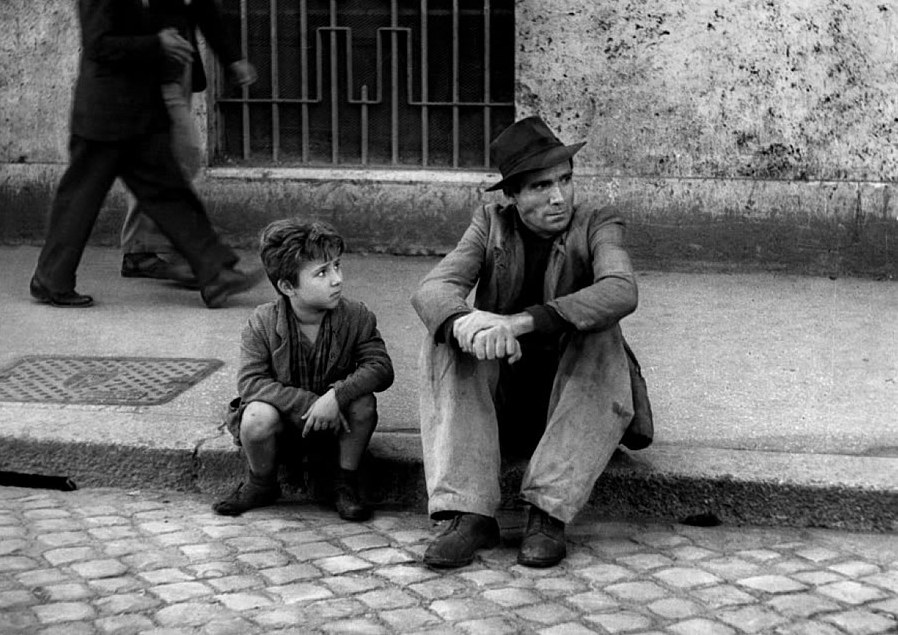
Bicycle Thieves is based on the novel by Luigi Bartolini. It’s the story of Antonio Ricci (Lamberto Maggiorani), a man with a wife and young son and a baby. Like most of the citizens of Rome in the post-war 1940s, they are poor and struggling, and Antonio is desperate for work. (His son Bruno, played by Enzo Staiola, is only 8 years old, but even he works part time at a gas station to help the family.)

When Antonio gets a job hanging posters throughout the city, it’s the answer to his prayers, but he needs a bicycle to do the job, and he pawned his bicycle some time ago. So his wife, Maria (Lianella Carell), pawns their precious dowry sheets to get the money Antonio needs to get his bicycle out of hock, which allows him to do his job and earn a regular salary.

Antonio’s joy is short-lived. As he’s standing on his ladder one day, pasting up a poster of Rita Hayworth, his bicycle is swiped from the wall where it is leaning next to him.

The rest of the film follows Antonio’s journey through Rome with his son Bruno as they search for the bicycle, the bicycle thief, and the larger network of thieves who helped pull off the theft.

When Bicycle Thieves ended, it left me with a mixture of sadness and exhilaration that I haven’t felt since the first time I watched Luis Buñuel’s Los Olvidados (1950).

Bicycle Thieves is very different from Los Olvidados, and its tragedies are less earth-shaking, but it affected me in a way that cinematic death and destruction almost never does.

Antonio and Bruno

The Italian neorealist movement started with Roberto Rossellini’s Rome, Open City (1945). Neorealism rejected Hollywood-style glamor in favor of nonprofessional actors working in real locations. Although neorealist films are shot in a verité style, none of them are documentaries. While De Sica’s actors were all appearing in a film for the first time, he was a seasoned director working with a professional crew. There is even a rainstorm in Bicycle Thieves that De Sica and his crew created themselves.

As Antonio, Lamberto Maggiorani is not always likeable, but he is always relatable and always seems like a real person. Enzo Staiola, who plays his son Bruno, gives a deeply affecting performance. In the beginning of the film he’s a “little man,” and makes a lot of gestures and utterances that are funny because they seem so adult. But in the end, he’s just a child, and his wordless acting conveys so much.

What impressed me most about Bicycle Thieves was the way it used grandness of scale to tell a story of individuals. When Maria pawns her family’s linen at the beginning of the film, we watch it slowly disappear into a huge warehouse of pawned linen. Each bundle tells its own sad story. For the majority of the film, the number of people and bicycles in Rome is overwhelming. But we never stop thinking about that one, precious bicycle that Antonio and Bruno are searching for. The film ends with Antonio and Bruno disappearing into a crowd, just the way the linen disappeared into a warehouse of linen, and the way his bicycle disappeared into streets full of bicycles. The man and his son are just two tiny people in a sea of humanity, but when the film ended, their story meant more to me than I can express.

He Walked by Night (Nov. 24, 1948)

He Walked by Night
He Walked by Night (1948)
Directed by Alfred L. Werker
Bryan Foy Productions / Eagle-Lion Films

He Walked by Night is a police procedural directed by Alfred L. Werker, with uncredited directorial assistance from Anthony Mann. The starkly lighted cinematography is by John Alton, who had previously worked with Mann on two of his most memorable film noirs: T-Men (1947) and Raw Deal (1948).

Docudrama films were a popular genre after World War II. The genre began with documentarian and newsreel producer Louis de Rochemont’s purportedly true espionage stories The House on 92nd Street (1945) and 13 Rue Madeleine (1947), as well as his fact-based legal drama Boomerang (1947).

Producer Mark Hellinger and director Jules Dassin’s film The Naked City (1948) wasn’t based on any single true incident, but it sought to depict realistic police work — a team of detectives recording the details of a crime scene, interviewing witnesses, tracking down leads, and pursuing suspects.

He Walked by Night didn’t invent the police procedural, but it’s probably the single most influential film in the genre. It featured Jack Webb in his first credited role, and his relationship with the film’s technical advisor, LAPD Sgt. Marty Wynn, led to the creation of the radio show Dragnet in 1949. (The series hit television in 1951.)

The film begins with a screen of text explaining that what you’re about to see is a true story, and is based on the case of one of the most diabolically cunning killers ever to be hunted by the police. It ends with the following sentence: “Only the names are changed — to protect the innocent.” Sound familiar, Dragnet fans?

Like every film or book that can properly be called a police procedural, He Walked by Night features a team of police officers and detectives. The lead investigator in the case, Sgt. Marty Brennan, is played by Lawrence Tierney’s little brother, Scott Brady, fresh off a starring role in another docudrama, the “ripped from the headlines” prison escape drama Canon City (1948). The other police officers include Capt. Breen (Roy Roberts), Sgt. Chuck Jones (James Cardwell), and police laboratory technician Lee Whitey (Jack Webb).

Richard Basehart

The meatiest role in the picture belongs to Richard Basehart, who plays Roy Morgan (a.k.a. Roy Martin), an electronics-obsessed former serviceman who — in the tense opening scene of the film — graduates from breaking & entering to murder.

Basehart delivers a lean, mean performance. He has some great scenes with his fence, Paul Reeves (Whit Bissell), but other than that he has very little dialogue. The film hangs on his performance, and he’s completely believable as an endlessly resourceful sociopath who’s able to elude the police through a combination of planning and luck. (The character was inspired by the real-life case of Erwin “Machine Gun” Walker, who went on a crime spree in 1945 and 1946.)

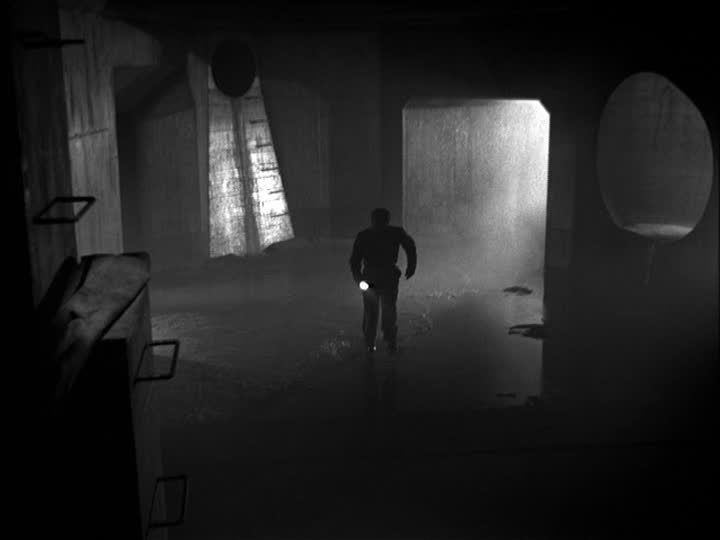
He Walked by Night in the Sewers

It’s a cliche to say that the real star of a film noir is its cinematography, but it’s usually true. John Alton’s photography consistently gives the low-budget film an intense, driving atmosphere. Nearly ever shot in the film is a masterwork of lighting and composition, culminating in the final chase through the Los Angeles sewer system.

He Walked by Night is currently in the public domain, so it can be seen on YouTube (below), and is available on DVD from a variety of companies. The only caveat is that some of them look pretty lousy, so noir fans who want to own this film on DVD are advised to pick up the disc from MGM and to avoid at all costs the cheapo disc from Alpha Video, which looks just terrible.

The Boy With Green Hair (Nov. 16, 1948)

The Boy With Green Hair

The Boy With Green Hair (1948)
Directed by Joseph Losey
RKO Radio Pictures

If you only know Dean Stockwell as the craggy character actor who appeared in TV shows like Quantum Leap and Battlestar Galactica, it might be hard to believe that he was ever an adorable little 12-year-old boy.

Well, he was. Even with a shaved head, which is how he first appears in The Boy With Green Hair, in the 1940s Stockwell was cuter than a barrel of baby pandas.

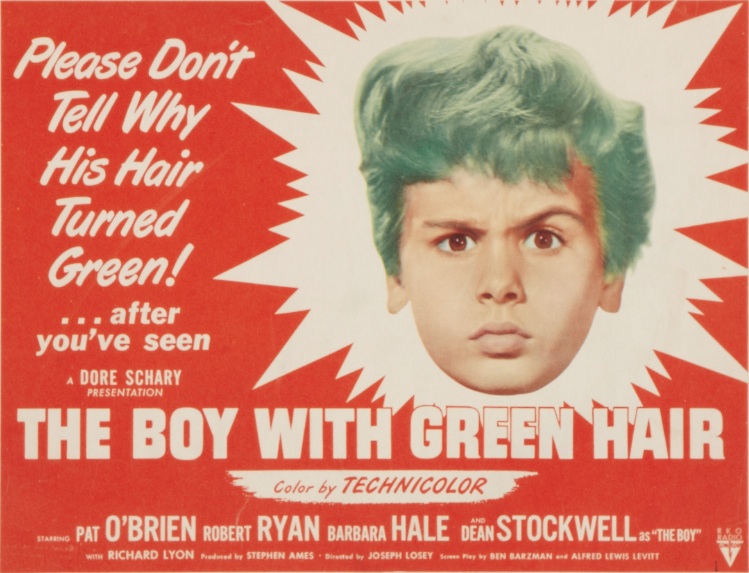
The Boy With Green Hair was Joseph Losey’s first feature-length film. It’s a lovely little Technicolor parable that opens with the song “Nature Boy.” (You know, the one about “a very strange, enchanted boy”?) Nat King Cole’s recording of the tune was a big hit in 1948, and was the #1 single in the United States for seven weeks. The melody of the song recurs throughout the film.

It’s the story of a boy named Peter Fry (Stockwell), whose parents are dead, but no one seems to want to tell him. He’s shuttled around from home to home, always carrying a letter to show his foster parents (who he refers to as his “aunts and uncles”), although he’s not aware of the contents.

Eventually he settles down with “Gramp,” a former vaudevillian and magician (and current singing waiter) played by likeable old Irishman Pat O’Brien.

Peter thrives under Gramp’s care, feeling good enough about life that he no longer has to sleep with a baseball bat (though he keeps it on the floor next to him just in case). One day, however, his school holds a charity drive for war orphans. As Peter stands in front of a poster with a black and white photograph of an “Unidentified War Orphan,” he’s forced to confront the truth about his parents. They died in the London Blitz, and Peter can no longer deny the horrors of war. All of a sudden, war orphans aren’t just “over there,” they are right here, and he is one of them.

O'Brien and Stockwell

Not long after this revelation, he wakes up one morning with bright green hair. Punks with brightly dyed hair turned heads in the 1970s, and it was even more unheard of in the 1940s. Peter is instantly ostracized by people who happily tousled his hair when it was brown. His teacher, Miss Brand (Barbara Hale), tries to make him feel OK about his condition. He may be the only kid in class with green hair, but there’s also only one boy who has red hair. But nothing stops the bullying and name-calling. The world is cruel to those who are different.

The Boy With Green Hair is told in flashback, as Peter sits in a police station with a shaved head, telling his story to kindly child psychologist Dr. Evans (Robert Ryan). The message of the film might seem simple, but Losey’s direction and Stockwell’s assured performance elevate it to something haunting and strange that can’t be boiled down to a single slogan. It’s a movie that tells a serious, allegorical story about a child that other children can understand.

The Snake Pit (Nov. 13, 1948)

The Snake Pit

The Snake Pit (1948)
Directed by Anatole Litvak
20th Century-Fox

The Snake Pit wasn’t the first film about mental illness, but it’s one of the most significant.

German Expressionist films like The Cabinet of Dr. Caligari (1920) and M (1931) are powerful films about mental illness, but they’re more horror films than they are dramas, and they don’t explore the day-to-day reality of life in mental asylums. Films like Maniac (1934) and Dead of Night (1945) are at least partially about “crazy people,” but again, mental illness is used as a horror trope, not a sad and difficult fact of life.

The Seventh Veil (1945) and Spellbound (1945) both dealt with psychoanalysis, but they were designed to appeal to a public newly interested in Freudian theory, and didn’t touch on the facts of life in state mental institutions.

In fact, the only movie I can remember seeing before The Snake Pit that really dealt with life inside a mental institution was Mark Robson’s Bedlam (1946), but the fact that it was both a horror film and a period piece gave audiences a comfortable sense of remove.

Olivia de Havilland

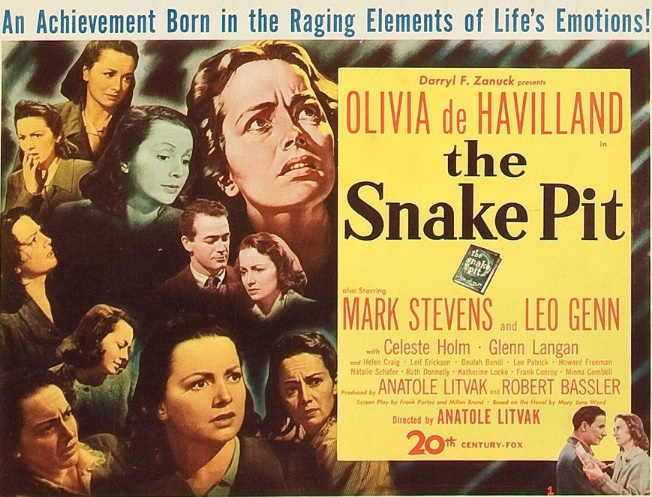
The Snake Pit changed all that. It was based on the novel by Mary Jane Ward, who spent eight and a half months in a mental hospital. She was institutionalized for schizophrenia, which was possibly misdiagnosed. The Snake Pit was rejected by several publishers. When it was eventually released in a small print run in 1946 it became an unexpected bestseller and was reprinted many times. It was a novel, not a memoir, but it contained autobiographical elements and most of the characters were based on people Ward had known in Rockland State Hospital.

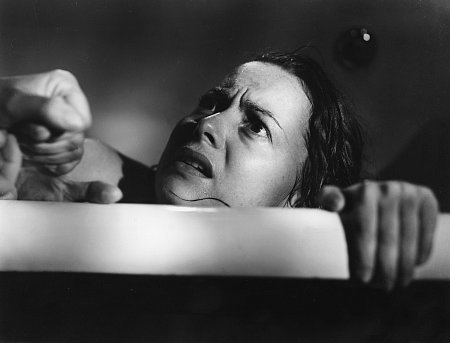
The film version of the the novel stars bona fide superstar Olivia de Havilland in an unglamorous, makeup-free performance as Virginia Stuart Cunningham. The film drops us into Virginia’s schizophrenic experience in media res. She’s sitting on a park bench, looking up at the sun shining through the branches of a tree. On the surface, it’s idyllic, but we soon notice that her clothes are threadbare and her nylons have a run in them. Her voiceover conveys how confused she is about where she is and what she’s doing there.

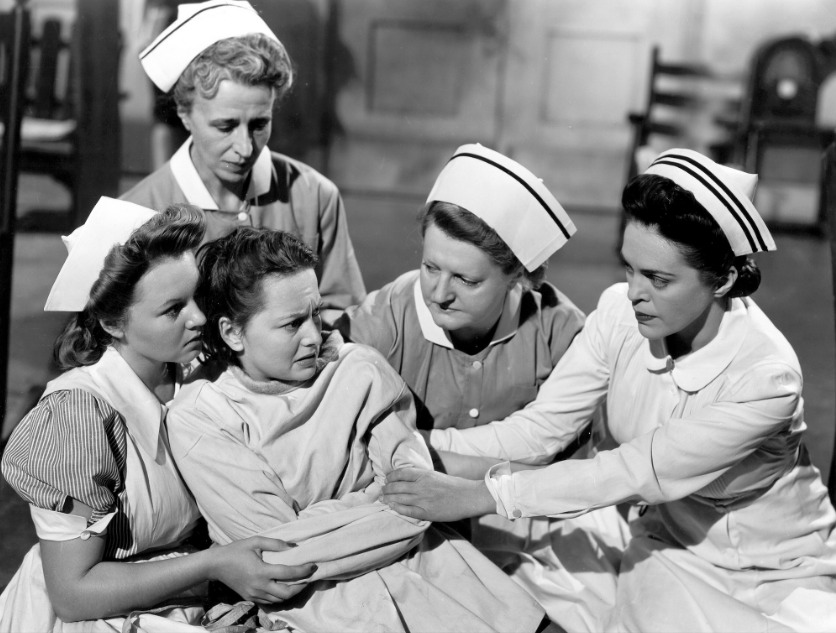
Her fellow inmate, Grace (Celeste Holm), is more aware of what’s going on and guides Virginia into the group of women when the noontime break is over. They are shuttled inside by the nurses, and Virginia’s surroundings resemble a prison. There are even iron bars.

This is a major theme in the film. Virginia is locked in a prison of her mind’s own making — her mental illness. But she is also locked in a very real prison — a mental institution where electroshock treatments, cruel staff, and harsh conditions are the norm.

Snake Pit 1948

The one bright spot for Virginia inside the institution is Dr. Mark van Kensdelaerik (Leo Genn), who is only ever referred to as “Dr. Kik,” because Americans find his surname too hard to pronounce. Dr. Kik has a picture of Freud hanging in his office, and believes psychoanalysis is the key to Virginia’s recovery.

I had some uncharitable things to say about Leo Genn in my review of Mourning Becomes Electra (1947), but that was more about his miscasting than anything else. He’s perfectly cast in The Snake Pit, and his performance is wonderful. His Freudian explanation of Virginia’s condition is a bit too neat, but audiences in the 1940s liked their stories with every T crossed and every I dotted.

The other man in Virginia’s life who cares for her is her husband, Robert Cunningham (Mark Stevens), but there’s very little he can do for her. Through a series of heartbreaking flashbacks, we see her grow increasingly fearful of him and confused about reality.

The Snake Pit was directed by Anatole Litvak, a Ukrainian director who became an American citizen in 1940. Litvak’s previous couple of films, The Long Night (1947) and Sorry, Wrong Number (1948), were both beautifully crafted, but they weren’t as powerful or as resonant as The Snake Pit. The scene in which the title of the film is realized visually is one of the most haunting I’ve ever seen.

Litvak’s direction is wonderful, but none of it would work without Olivia de Havilland’s phenomenal performance. She was nominated for an Academy Award for best actress, but she lost out to Jane Wyman for her role in Johnny Belinda (1948). The Snake Pit actually had an extremely high portion of its budget devoted to hiring seasoned and professional actors, since Litvak wanted even the small roles in the film to be convincing. It paid off.

In addition to de Havilland’s nomination, The Snake Pit was nominated for Academy Awards for best picture, best director, best screenplay, best score, and best sound recording, which is the only Oscar that it actually won.

Joan of Arc (Nov. 11, 1948)

Joan of Arc
Joan of Arc (1948)
Directed by Victor Fleming
Sierra Pictures / RKO Radio Pictures

Joan of Arc was always a force to be reckoned with.

In life, she had heavenly visions, led the French army to several victories against the English during the Hundred Years’ War, paved the way for Charles VII to become King of France, and was tried for heresy and burned at the stake in 1431. When she died, she was only 19 years old.

In death, she exerted a powerful influence over the imaginations of artists and writers. From Shakespeare’s largely unflattering portrayal in Henry VI, Part 1 to Mark Twain’s largely forgotten historical novel Personal Recollections of Joan of Arc, the Maid of Orléans was a devil to some, and a saint to others.

Over time, the English decided to stop caring so much, and she came to be seen by more and more people as a holy figure. In 1920 the Catholic Church decided to make it official, and canonized her, which reignited interest in her life. Her trial for heresy, which was held in 15 sessions from February 21 to March 17, 1431, was exhaustively recorded. Most fictional portrayals of Joan of Arc, like George Bernard Shaw’s play Saint Joan (1923), drew from these official records.

Maxwell Anderson’s play Joan of Lorraine opened on Broadway on November 18, 1946, and played for 199 performances at the Alvin Theatre. The last performance was on May 10, 1947. The original production starred Ingrid Bergman as Mary Grey, an actress playing Joan of Arc who struggles with her director, Jimmy Masters (played by Sam Wanamaker), over how Joan should be portrayed.

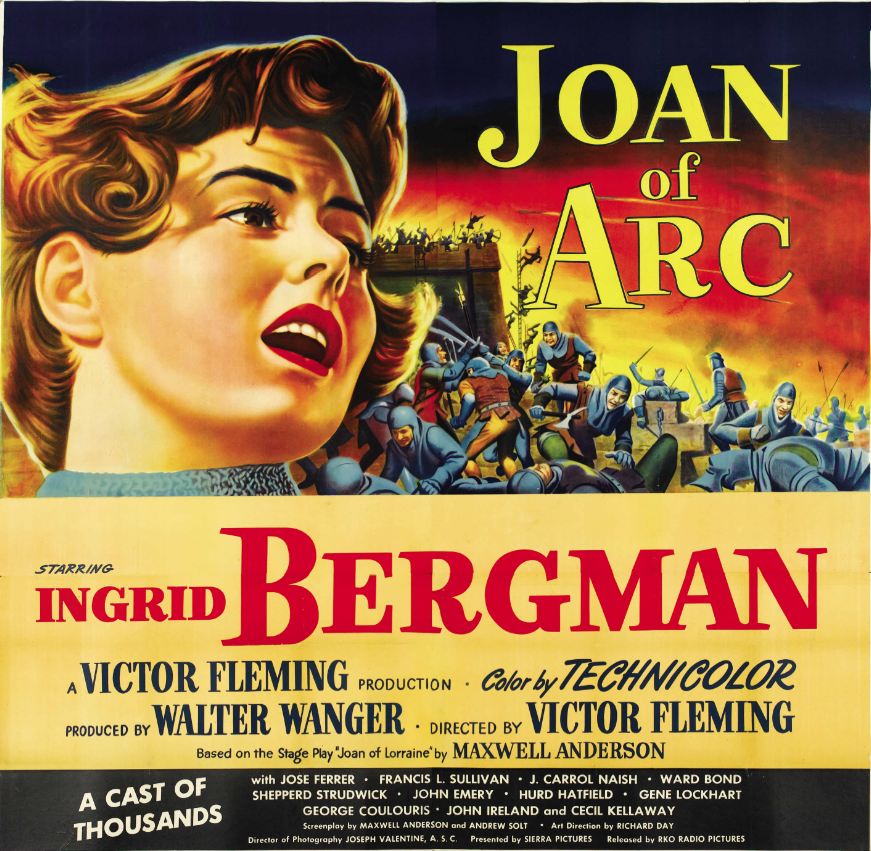
Joan of Lorraine was the basis for the 1948 film Joan of Arc, which also stars Ingrid Bergman, but the “play within a play” concept was jettisoned in favor of straight historical drama. Much of Anderson’s original dialogue was retained, however, with additional scripting and added characters by Andrew Solt.

Ingrid Bergman

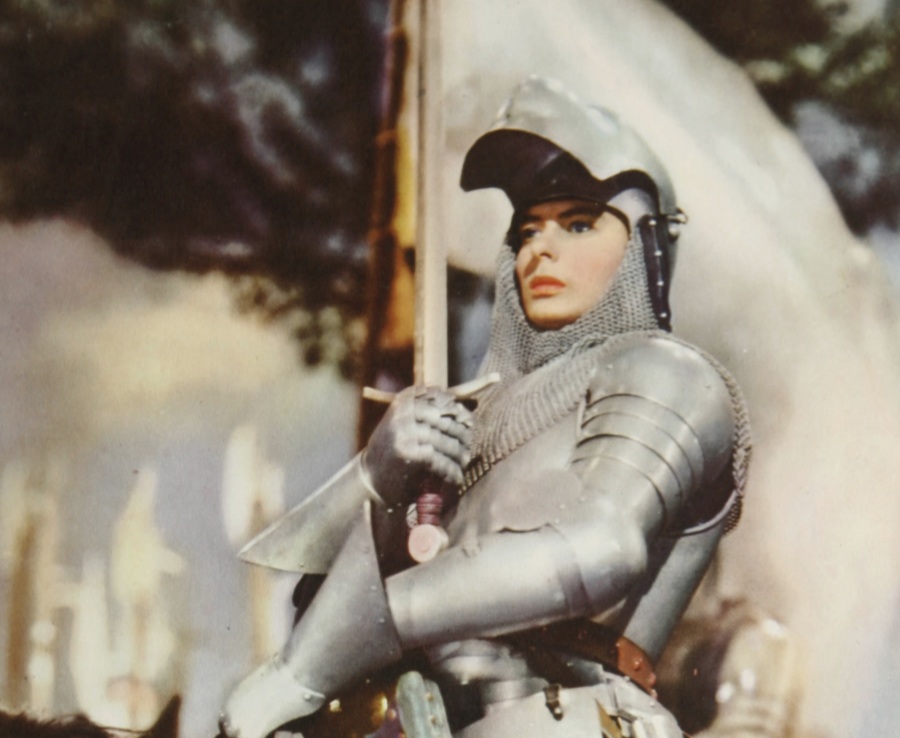
Joan of Arc was the last film that Victor Fleming directed. The man who directed The Wizard of Oz (1939) and Gone With the Wind (1939), as well as many other memorable films, died of a heart attack on January 6, 1949. He was 59 years old. While it might not be as fondly remembered as some of his other films, it’s still a pretty good one to go out on. It’s a big, sprawling, Technicolor costume drama (although there is a cut version that is just 1 hour and 40 minutes, the original cut of the film is 2 hours and 25 minutes long). Most importantly, Joan of Arc features a brilliant lead performance by Bergman. Most of the other actors are pretty good, especially José Ferrer (in his first film role) as the Dauphin, later Charles VII. With a cast of thousands, however, there are bound to be a few duds, and there are, although Ward Bond, whom I more closely associate with westerns than European historical dramas, was better than I was expecting. John Ireland? Not so much.

Joan of Arc is also heavy on dialogue and light on spectacle. With the film looks great, there’s only one big battle scene, and it doesn’t come close to matching similar scenes that Fleming directed for Gone With the Wind. While Joan of Arc is by no means a bad film, without Bergman’s performance it would lose most of its impact.

It’s certainly worth seeing, but if you’re only going to see one film about Joan of Arc in your lifetime, it should be Carl Theodor Dreyer’s silent film The Passion of Joan of Arc (1928), which stars Maria Falconetti in one of the most hypnotic film performances of all time. With spare sets and simple costumes, Dreyer achieves effects Fleming could only dream of. Falconetti’s performance in The Passion of Joan of Arc walks the fine line between madness and mysticism. Religious faith is a tricky thing to depict on film, but Dreyer’s film is one of the few that gets it exactly right.

The fiery finale of Fleming’s Joan of Arc is powerful, too. And as far as visual depictions of religious martyrdom go, I think both films are more powerful statements than the geek-show excesses of The Passion of the Christ (2004).

In the run-up to the 21st Academy Awards, Joan of Arc was the first film to receive seven nominations without a nomination for best picture. Ingrid Bergman was nominated for best actress, José Ferrer was nominated for best supporting actor, Hugo Friedhofer was nominated for best dramatic or comedy score, Richard Day was nominated for best art direction in a color film, and Frank Sullivan was nominated for best editing. The film won in two categories; Joseph Valentine, William V. Skall, and Winton Hoch won the Oscar for best cinematography in a color film, and Dorothy Jeakins and Barbara Karinska won for best costume design in a color film.

Blood on the Moon (Nov. 9, 1948)

Blood on the Moon
Blood on the Moon (1948)
Directed by Robert Wise
RKO Radio Pictures

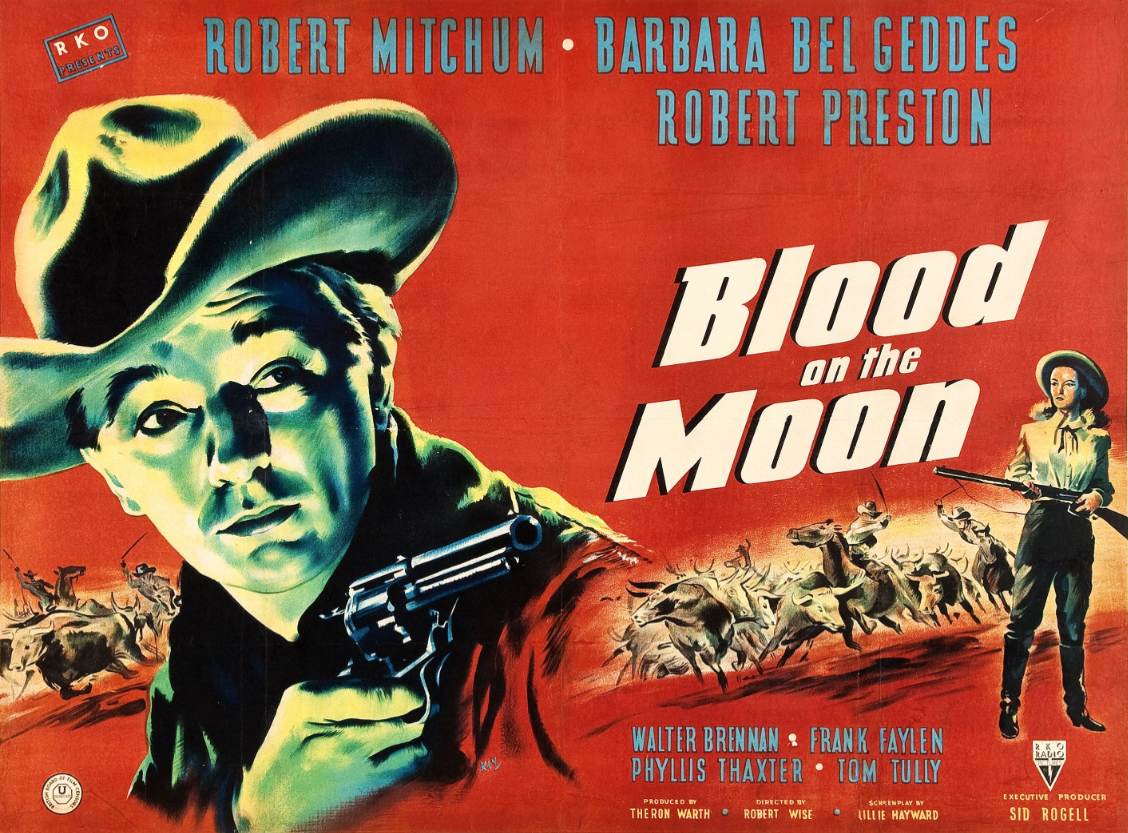
Blood on the Moon is an RKO western directed by Robert Wise. It’s based on Luke Short’s novel Gunman’s Chance, which was originally serialized in The Saturday Evening Post in 1941.

I’ve only read one of Luke Short’s western novels (he wrote more than 50), but judging by it and the two films I’ve seen that were based on his work (this one and André de Toth’s 1947 film Ramrod), dense plotting, terse dialogue, and three-dimensional protagonists were some of Short’s trademarks.

Like most protagonists of westerns in the ’40s and ’50s, the protagonists of Blood on the Moon and Ramrod are on the side of the angels. But they’re more interesting than the cookie-cutter heroes of countless B westerns. Not so much because they’re complex people, but because they’re believable people who exist in a complex world.

First-time viewers of both Ramrod and Blood on the Moon will likely have a little difficulty figuring out who the “good guys” and the “bad guys” are right away, and who’s telling the truth and who’s lying — at least for the first couple of reels.

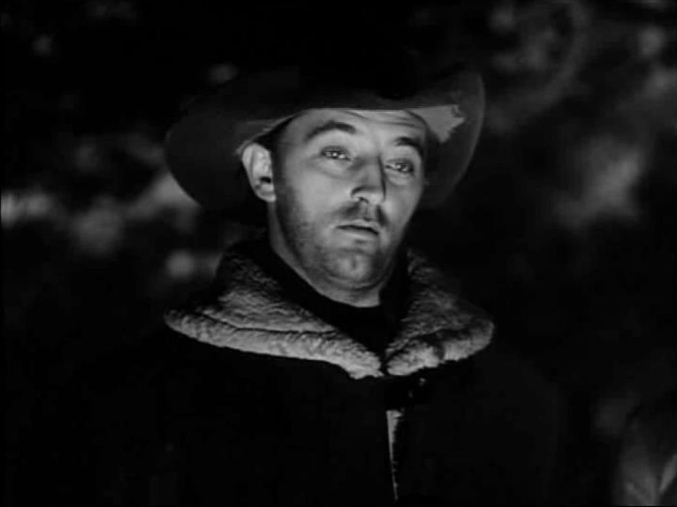
The hero of Blood on the Moon — Jim Garry — is played by Robert Mitchum. Garry is a solitary cowpoke with a small herd. He’s passing through open country when his herd is run off in a stampede. Rancher John Lufton (Tom Tully), owner of the Lazy J Ranch, apologizes and offers to reimburse Garry for the outfit he lost. Even so, their exchange is tense. Lufton doesn’t trust loose riders, since he’s feuding over grazing land with Jake Pindalest (Frank Faylen), a newly appointed Indian agent who’s thrown Lufton off the reservation grass, and stopped Lufton from supplying the tribe with beef, even though he’d done so for years.

When Garry turns down Lufton’s offer to work for him, the opposition comes knocking in the form of an old friend of Garry’s — a man named Tate Riling (Robert Preston). Tate represents the homesteaders who are opposed to Lufton, and he offers to hire Garry as a gunhand for $10,000. Tate tells Garry, “Lufton’s tough and my ranchers aren’t. You make up the difference.”

“I’ve been mixed up in a lot of things, Tate, but up till now I haven’t been hired for my gun,” Garry says.

“Can you afford to be particular?”

Garry thinks for a moment, then says, “No, I guess I can’t.”

Mitchum

Mitchum is perfect for this type of role. He was a laconic actor who barely ever changed his expression, but he could suggest depths of emotion with his eyes.

I’ve seen him in run-of-the-mill westerns like West of the Pecos (1945), and he’s fine in them, but he did his best work in dark, noirish westerns like this one and Raoul Walsh’s Pursued (1947).

Robert Wise, the director of The Body Snatcher (1945) and Born to Kill (1947), keeps Blood on the Moon moving at a brisk, tense pace. The cinematography by Nicholas Musuraca is full of darkness and shadows. It’s not full-on “noir” like James Wong Howe’s cinematography for Pursued, but Blood on the Moon still spends a lot of time in darkened saloons, lonely country at night, and the streets of a frontier town after dark. Even the exterior scenes that take place in daylight have a sense of gray desolation.

The cast is really great, too. I like seeing Barbara Bel Geddes in just about anything, and I especially liked her as one of Lufton’s two daughters, Amy. (Phyllis Thaxter plays the other daughter, Carol.) Square-jawed, gruff-voiced tough guy Charles McGraw plays a gunhand named Milo Sweet who wears one of the sweetest buffalo coats I’ve ever seen. As a homesteader named Kris Barden, Walter Brennan plays essentially the same character he played in every movie he was ever in, but he finds depths of emotion in his character that he didn’t always get to explore as a comical sidekick. And I always love seeing Tom “Captain Marvel” Tyler in any western, even if he was a pretty wooden actor. In Blood on the Moon, he appears just long enough to be effective — in a tense showdown with Mitchum that’s 10 times as exciting as most western showdowns that have more traditional outcomes.

The tough, no-nonsense screenplay of Blood on the Moon is by Lillie Hayward, from an adaptation of the novel by Luke Short and Harold Shumate.

Blood on the Moon won’t ever be counted as one of the all-time great westerns, but the western was a damned busy genre at the time of its release, and it’s a cut above the rest. It holds up to multiple viewings, and presages the many ways in which the genre would mature in the 1950s.